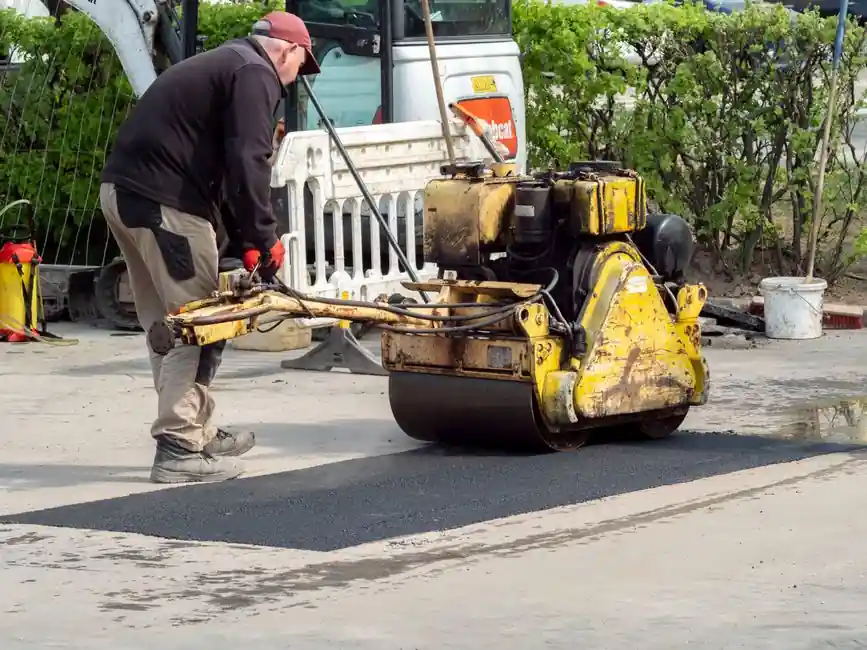
At a fixed application rate of 5 m² per litre (≈200 ft²/gal, the lower bound of manufacturer coverage charts) a 5-gallon pail of water-based acrylic curing compound covers about 95 m² of slab per pail, putting the material-only cost on a US distributor shelf at roughly USD 0.55–1.30 per m² depending on solids content and resin chemistry [S2][S3].
Coverage-rate reference points that anchor the cost
City of Columbus Item 512 specifies 150 ft²/gal, equivalent to 3.6 m²/L, when a qualified-list epoxy sealer is used on bridge decks, which becomes the conservative upper bound for material consumption [S1].
W. R. Meadows' published guidance splits the catalogue into two bands: 300–600 ft²/gal (≈7–15 m²/L) for 25%-and-above-solids cure-and-seal compounds, and 200–600 ft²/gal (≈5–15 m²/L) for sub-25%-solids formulations, with the lower end applying to rougher tined or broom finishes [S3].
White Cap's 2026 distributor listing for Birmingham shows 200 ft²/gal (≈4.9 m²/L) as the modal entry for 5-gallon pails of clear acrylic cure-and-seal, with 5-gallon and 55-gallon drum SKUs in roughly equal share across the 75-product catalogue [S2].
PDH Academy's FHWA-derived course text confirms that 5 m²/L is widely cited as a commonly recommended rate and notes it is often near the maximum for solvent-based systems, which means cost-per-m² calculations at this rate are close to worst-case for product consumption [S5].
Cost drivers at fixed 5 m²/L coverage
At 5 m²/L the wet-film consumption is 0.20 L/m², so a 5-gallon pail (18.93 L) covers 94.6 m² of slab before waste factor; a 55-gallon drum (208.2 L) covers 1,041 m², and the drum tier typically runs 15–25% lower per litre than the pail tier on the same SKU [S2].
Solids content is the second-largest lever: a 25%+ solids cure-and-seal at the same wet-film rate deposits 0.05+ L/m² of active film former versus 0.025–0.04 L/m² for sub-25% solids, which is why manufacturers authorise the higher 7–15 m²/L coverage band on the premium tier [S3].
VOC and flash-point constraints can disqualify the cheaper solvent-based SKUs in regions with CDPH or OTC Phase II rules, forcing specifiers to the water-based or low-VOC acrylic tier where the cost per m² at 5 m²/L lands in the upper half of the USD 0.55–1.30/m² band [S2][S3].
Cost comparison across chemistry tiers at 5 m²/L
Wax-resin and dissipating-resin compounds (White Cap composition tags 4-chloro-alpha, alpha, alpha-trifluorotoluene plus distilled tall oil fatty acids) typically list 15–25% below acrylic cure-and-seals at the same 5-gallon pail size, putting them at roughly USD 0.40–0.90/m² at 5 m²/L coverage [S2].
Standard 25%-solids water-based acrylic cure-and-seals sit in the middle at roughly USD 0.55–0.95/m², while high-solids 30%+ cure-and-seals and lithium-polysilicate densifier-curing hybrids land at USD 0.90–1.30/m², with White Cap's 55-gallon drum SKUs of clear gloss acrylic concentrated in that band [S2][S3].
Bridge-deck epoxies and HMWM resins, called out in Columbus Item 512 sections 705.15 and 705.23.A, fall outside this comparison because they are specified at the 3.6 m²/L Columbus rate and priced per square metre of deck on a 2-coat basis, not on the 5 m²/L single-coat paving model [S1].
Total cost of ownership beyond the pail price
Application labour is where curing compounds pull ahead of water curing and wet burlap on large paving pours, with PDH Academy's FHWA-derived course text calling them the most economical method for large areas specifically because of low labour cost, not material cost [S5].
Surface-prep cost is identical across the chemistry tiers (dry, dust-free, free of curing compounds from previous pours per Columbus 512.03.E) but re-coat windows diverge: White Cap SKU data shows 1–2 hour re-coat times for water-based acrylics versus 4-hour re-coat for some solvent systems, which compresses spray-rig rental days on multi-coat bridge deck work [S1][S2].
Equipment cost is roughly equalised by the manufacturer-recommendation clause in Columbus 512.03.A, which forces the contractor to use spray equipment, tanks, hoses, brooms, rollers, coaters or squeegees per the sealer manufacturer's written procedure, so any per-chemistry premium for sprayer compatibility gets passed through to the same line item [S1].
Removal cost for future flooring or coatings is the hidden TCO line: dissipating resins are designed to break down under UV (typically 30–60 days), eliminating blast cost on interior slabs, while non-dissipating acrylic and wax-resin films can add USD 0.30–0.80/m² in surface prep before a subsequent coating or floorcovering can be installed [S2][S3].
Standards, documentation and specification traps
Columbus Item 512 enforces a 5-day pre-application submittal window in 512.03.D, during which the contractor must hand the engineer the manufacturer's written requirements for mixing, storage, recoat times, temperatures and MSDS, and application cannot start until that submittal is in the engineer's hands [S1].
Storage clause 512.03.C requires tightly sealed containers in a dry location with manufacturer-numbered seals intact on delivery, which rules out partial pail transfers and pushes small-area jobs toward 5-gallon pails rather than 55-gallon drum splits, raising effective per-litre cost on jobs under 200 m² [S1].
Surface-condition clause 512.03.E explicitly excludes surfaces contaminated with previous curing compounds, which means a contractor who applied a non-dissipating film and tries to re-seal within 30 days will fail spec and have to abrasive-blast, a real risk when a cure-and-seal is mis-specified as a curing compound on a multi-phase pour [S1].
Coverage-rate validation is the audit point that bites: the 5 m²/L rate in this analysis sits inside the 200 ft²/gal lower bound of White Cap's Birmingham catalogue and the 200 ft²/gal lower bound of the W. R. Meadows sub-25%-solids band, both of which apply to rougher broom or tined finishes rather than steel-trowel slabs, so smoother finishes should be costed at 7–8 m²/L with proportionally lower material per square metre [S2][S3].
Calculator cross-checks and where the math breaks
VibeCalc's 2026 concrete-curing-compound calculator accepts slab area, coats, coverage rate, waste factor, pail size and rough material cost and outputs gallons, pail count and dollar value, which matches the 5 m²/L × 0.20 L/m² × waste-factor framework used in this article [S4].
Procurement Resource's 2026 Concrete Curing Compound production cost report covers industrial-scale economics, machinery cost and production cost structure, but its data is for bulk manufacturing economics rather than the distributor-shelf tier that drives small-to-mid contractor pricing, so use it only for volume-tier modelling above roughly 20,000 L/year [S6].
Track the October 2026 distributor price refresh from White Cap and the W. R. For related context on slab-prep decisions that follow curing, see Concrete Vibrator Field of Action: Stiff vs Flowing Mix Selection and a cost benchmark on cutting tools used during the same pour at 7-1/4″ Carbide Saw Blade Cost: Tooth Count and Grade Breakdown 2026.
For the relevant spec sheets and selection criteria, see concrete curing compound, clamp meter, and conductivity meter.