
Countersunk (flat-head) sleeve anchors are set by driving an internal expander cone down the stud so the surrounding split sleeve deforms outward against the drilled hole wall, locking the anchor in the substrate [S1][S3].
The hole diameter must match the anchor diameter exactly because the expansion sleeve only develops full bearing pressure when the steel-to-concrete clearance is at the designed interference fit [S6].
What "Flush" Means for a Countersunk Expansion Anchor
A countersunk expansion anchor is correctly set when the flat head is seated flush with, or just below, the concrete surface so the fixture bears on solid substrate, not on the head [S3]. Sleeve anchors ship in hex head, acorn (round) head, and flat (countersunk) head variants, with the flat-head style specified where a flush finish is required, such as railings, door frames, and floor-mounted channel [S6].
The head does not need a separate cover plate or cap, because the countersink in the fixture itself acts as the recess; the anchor is a one-piece headed fastener, not a two-part system [S1]. For hollow-base or through-fixture mounting, the fixture's own countersink or a machined pocket takes the head; the anchor's expansion mechanism, not the head, carries the load [S1][S6].
Spacing, Edge Distance, and the 10x Diameter Rule
The expansion anchor industry uses a minimum spacing of 10 anchor diameters between adjacent anchors and 5 anchor diameters to a free edge as a working rule of thumb, and these minimums assume concrete with sufficient compressive strength (typically 2,000 psi or higher) and proper hole cleaning [S2]. Spacing tighter than 10x da causes the expansion cones of influence to overlap, reducing pullout capacity and risking concrete breakout between the anchors [S2][S5].
For a 1/2 in. wedge anchor at 3-3/4 in. embedment, Hilti publishes two cases in Table 5 of its Anchor Fastening Technical Guide: Case 1 favors small edge distance, Case 2 favors small anchor spacing, and the two cases cannot be mixed without linear interpolation under footnote 1 [S5]. A 1/2 in. anchor therefore needs a minimum of 5 in. center-to-center spacing and 2-1/2 in. to a free edge when the case-2 parameters are adopted [S5].
Countersunk vs Hex Head Sleeve Anchors: A Direct Comparison

Countersunk (flat) head sleeve anchors and hex head sleeve anchors share the same internal expansion mechanism, a split sleeve deformed by an expander cone, but differ in finish profile and torque method [S1][S6]. Hex head units are torque-set with a wrench on the nut, while flat-head units are typically set with a manual or impact driver in the Phillips or slotted recess, then the sleeve is fully expanded by tightening until the head pulls down into the countersink [S1][S6].
Across four decision criteria, the comparison lines up as follows. Profile: hex head protrudes 0.25-0.4 in. above the surface, flat head sits flush. Installation tool: hex uses socket wrench, flat uses screwdriver bit or nut setter. Load direction: hex and flat both carry tension and shear through the sleeve, but flat-head units show reduced shear capacity in overhead installations because the head sits below the fixture bearing plane. Typical use: hex for baseplates and structural steel, flat for finish hardware, door frames, and flush-mounted railing posts [S1][S3][S6].
Setting Procedure and the Most Common Installation Errors
The setting sequence for a countersunk sleeve anchor is: drill a hole to the listed diameter with a carbide-tipped bit in hammer-drill mode, clean the hole with a wire brush and compressed air or vacuum, insert the anchor, then drive the expander cone or tighten the head until the sleeve is fully compressed and the head pulls flush [S3][S6]. The anchor will not develop full tension capacity unless the expansion is complete, so installers must continue tightening until resistance is felt and the head stops moving [S1][S6].</h2> <p>Field failures trace to three predictable causes. (1) Oversized hole, which prevents the sleeve from developing enough interference to grip the concrete, and this is the most frequent field problem because installers often drill one standard bit size up to "make it easier" [S6]. (2) Dirty hole, where concrete dust left in the bore acts as a lubricant and reduces sleeve-to-wall friction, and the cure is brushing plus blowing plus vacuuming in that order [S3]. (3) Spacing or edge distance violations, where two anchors closer than 10 da or 5 da to an edge produce a concrete breakout wedge and both anchors pull out together [S2][S5].
What a Countersunk Cover Plate Is and Is Not
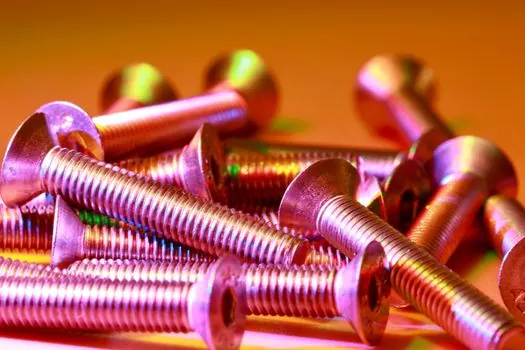
For most countersunk expansion anchor applications, no separate cover cap is required because the head is concealed within the fixture's countersink; the cover, when specified, is part of the fixture, not the anchor [S1][S6]. A separate cover cap is only relevant for drop-in anchors and other internally threaded anchors where a flush bolt head must later be removed, not for one-piece flat-head sleeve anchors [S3].
Engineers who spec a "cover over the anchor head" for a countersunk expansion anchor are usually describing one of three things: a finish escutcheon plate for aesthetic reasons, a grout or mortar fill over the head in a recessed pocket, or a tamper-resistant plug in a security application [S1][S6]. None of these are load-bearing; the anchor transfers tension and shear through the expansion sleeve, not through the cover [S1].
Material and Corrosion Selection Around a Flush Head
Zinc-plated carbon steel sleeve anchors are the commodity grade, with 304 stainless used for indoor wet or mildly corrosive environments, and 316 stainless specified for chloride exposure, coastal, or chemical-plant service [S2]. For a countersunk head specifically, 304 and 316 stainless flat-head sleeve anchors are stocked by the major US fastener distributors in standard diameters from 1/4 in. through 5/8 in. [S2].
The flush head is a crevice: any corrosion product or organic buildup that collects in the countersink accelerates galvanic attack on zinc-plated carbon steel in a wet environment, which is why 316 stainless is the default for outdoor flat-head installations rather than a 304 upgrade [S2]. In dry interior service, zinc-plated flat-head sleeve anchors are the cost-effective choice and the head finish can be painted over to match the substrate [S1][S2].
Trackable signal to watch: ICC-ES ESR reports for the next generation of stainless flat-head sleeve anchors, which would publish updated ACI 355.2 / AC193 cracked-concrete data and tighten the 10x da spacing guidance currently used as a rule of thumb [S2][S4]. For related specification choices on the fixture side, the trade-offs between custom and off-the-shelf industrial hose assemblies surface in a similar rule-of-thumb vs vendor-data debate worth tracking in parallel: Custom vs Off-the-Shelf Industrial Hose: A Spec-Driven Decision.
Spec-level background on the components involved: expansion anchor, chemical anchor, and expansion joint.