
Internal vibrator heads in standard 1.5-2 ft radius of influence cover around 7-12 sq ft of freshly placed concrete per insertion point, but only when slump, frequency, and amplitude line up with the mix [S5]. Drive that same head into a stiff 2-3 in slump and the field of action collapses toward the head; in a flowing 7-9 in SCC-style mix, the radius barely needs to exceed the rebar spacing because the mix essentially places itself [S4].
For typical wall, column, and slab pours, ACI-aligned guidance points to vibrator head diameter at roughly one quarter of the form wall thickness, frequency/amplitude tuned to aggregate size, and an insertion interval that lets adjacent fields of action overlap by 50% [S4][S5]. Picking the wrong end of that range is what produces honeycombing on stiff side walls and segregation bleed-water channels on flowing decks.
Why field of action changes with slump
Slump (ASTM C 143) is the single largest variable that shifts a vibrator's effective radius of influence on a job site, because amplitude drives coarse aggregate movement while frequency drives the surrounding sand and mortar into a fluid state [S1][S5]. In a stiff mix, internal friction between aggregate particles is high, so the operator must rely on a larger head delivering higher amplitude to physically move aggregate into a dense matrix; the radius of action around the head is typically 1-2 ft but drops sharply once the head lifts [S4]. In a flowing or self-consolidating mix, that friction is already low, so a smaller head at higher frequency can saturate a much smaller zone and the limiting factor becomes avoiding reventrainment of air rather than spreading the field wide [S4].
Stiff mixes (about 0-3 in slump) tolerate larger heads in the 2-3 in diameter range running at lower frequency and higher amplitude, because the energy has to physically displace coarse aggregate. Flowing mixes (6 in and above, including SCC) work better with smaller 0.75-1.5 in heads at higher frequency, where the vibrator's job is just to settle the last few percent of entrapped air and remove bugholes against the form face [S4]. Indian Standard IS 3558 (1983) frames the same trade-off in terms of insertion spacing depending on vibrator radius, with the explicit goal of overlapping zones of influence so no concrete is left unconsolidated [S7].
Equipment class comparison: internal, external, high-cycle, flex-shaft
Internal (immersion) vibrators cover the broadest set of cast-in-place pours and let the operator control depth directly, with effective head diameters from roughly 0.75 in up to 3 in and shaft lengths from 1 ft to 8 ft, typically powered by 120/240V single-phase electric, pneumatic, or small petrol engines [S4]. External (form) vibrators are mounted to the formwork and deliver oscillation through the panel, which makes them the right answer for precast, congested rebar cages, and closed forms where an internal head cannot reach, but they require stiffer mixes to transmit energy effectively and are not the tool of choice for flowing concrete on open decks [S1][S2].
High-cycle vibrators (typically 200 Hz three-phase power delivered through a converter) are explicitly engineered for low-slump, stiff concrete where consistent power is needed to liquefy the mix and move it around rebar; they are the wrong tool for flowing concrete because the mix does not need that much energy input and over-vibration becomes the failure mode [S6]. Flex-shaft vibrators are the common jobsite compromise, with the motor and flexible drive shaft separated from the head, which makes them portable and inexpensive for stiff to medium mixes but limits high-cycle performance and head size compared with motor-in-head designs [S3][S4]. On a stiff precast wall pour, a high-cycle or larger motor-in-head stick vibrator typically wins; on a flowing 7-8 in slab, a smaller flex-shaft stick or even surface screed vibration is usually the safer specification.
Stiff-mix field procedure and the failure modes to plan against
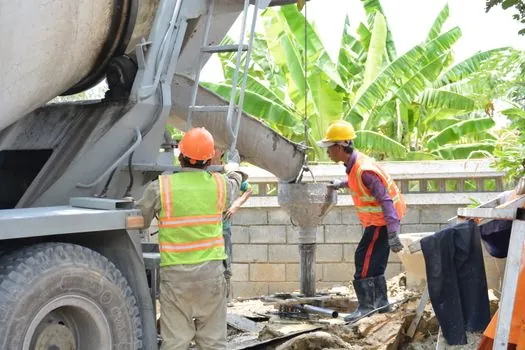
Stiff concrete still contains 5-20% entrapped air by volume right out of the chute, and that air is the direct cause of honeycombing, rock pockets, bugholes, and sand streaks if the vibrator is misused [S5]. The two operator mistakes that account for most of those defects are pulling the head too fast (so the radius of action never has time to liquefy the surrounding matrix) and dragging the head sideways through the mix (which leaves a weak mortar channel rather than consolidating the aggregate) [S5].
Field procedure for a stiff mix, in concrete terms: insert the head vertically and let it descend under its own weight, do not force it, penetrate the previous lift by about 6 in (150 mm) to avoid cold joints, hold the head in place long enough for the surface to stop releasing large air bubbles and for a slight gloss of mortar to appear, then withdraw slowly in 1-2 in increments so the head re-liquefies the column above it as it rises [S5][S7]. The vibrator head diameter should be roughly one quarter of the wall thickness, smaller-diameter heads for higher-slump concrete and larger-diameter heads for lower-slump concrete, and adjacent insertion points should overlap so their radii of action cover the full pour [S4][S5]. If the next lift is delayed, revibrate the previous lift before placing fresh concrete to cut down on pour lines and cold joints [S5].
Flowing-mix field procedure and the failure modes to plan against
Flowing concrete (slump 6-9 in and self-consolidating concrete) consolidates under its own weight, so the vibrator's job shrinks from "move the aggregate" to "release the last few percent of entrapped air and close bugholes against the form face" [S2][S4]. Smaller heads at higher frequency are appropriate because the radius of action needed is small, and over-vibration becomes the dominant failure mode: bleed-water channels, aggregate segregation, and surface sand streaks all show up when a stiff-mix head is dropped into a flowing mix and left in place [S4][S5].
Where the form is closed or rebar is so dense an internal head cannot penetrate, external form vibrators are specified instead, with the caveat that the mix still needs enough body to transmit the oscillation through the form wall [S1][S4]. For foundation work on heavy lift or crawler-crane-supported decks, a related comparison of plant choices is laid out in Crawler vs Truck Crane for Heavy Lift Foundation Work, and for cycle-time-driven vertical pours the vibrator decision is part of the same spec set covered in Climbing Formwork vs Jump Form Cycle Time: 3-5 Day Floor Cycle Compared.
Sourcing, standards, and the next decision to nail down

Three standards documents govern the field decisions above: ASTM C 143 for the slump classification that drives head-size selection, IS 3558 (1983) for insertion spacing and radius-of-action overlap on immersion-type vibrators, and ACI guidance cited by the OEM literature on the 5% density uplift achievable with proper internal vibration [S1][S4][S5][S7]. The OEM-level sources backing the head-size and frequency/amplitude numbers are Airmatic's internal-vs-external writeup and the Precast.org operator-procedure note, both of which lay out the same rule of thumb (head diameter around one quarter of wall thickness, smaller head for higher slump) [S4][S5].
For the next decision node: pin down the design slump and nominal aggregate size for the pour before picking the vibrator, because the head diameter, frequency, and radius of action all follow from those two inputs rather than from the form dimensions alone [S4][S5]. Two trackable signals worth following are whether the spec sheet actually quotes a frequency in vpm/Hz and amplitude in millimeters (not just "high-cycle" as a marketing label) and whether the insertion pattern on the pour drawing shows overlapping radii of action rather than a single grid of points [S5][S6].
Detailed specification references: concrete vibrator, cement concrete, and concrete admixture.