
Data center roof and substrate waterproofing is a 4-chemistry decision (SBS-modified bitumen, PVC KEE single-ply, PMMA liquid-applied, polyurethane/polyurea) bounded by four non-negotiable performance gates: Class A fire rating, FM Very Severe Hail (VSH) approval, up to 120 mph wind uplift, and a manufacturer NDL guarantee of 20–35 years [S1].
Below-grade waterproofing follows a separate decision path (PMMA, hot rubberized asphalt, self-adhered membrane) because hydrostatic pressure and slab-to-wall transitions dominate that envelope, not UV or hail [S1]. For PCB and electronics-level water protection inside the white space, a different chemistry class (fluoropolymer/silane nano-coatings) is used, typically specified to IPX7 submersion targets, which is a separate spec gate from the roof [S3].
Roof chemistries: SBS-modified bitumen vs PVC KEE vs PMMA vs polyurethane/polyurea
Four chemistry families cover roughly all data center roof assemblies in current North American and European practice, and each carries a distinct failure mode that drives the selection [S1][S2]. SBS-modified bitumen (multi-ply, torch- or cold-applied) is the legacy heavy-duty option, with redundancy from a base and cap sheet, and is the system most often paired with a 35-year NDL guarantee for hyperscale builds [S1]. PVC single-ply membranes with Ketone Ethylene Ester (KEE) plasticizer dominate the cool-roof segment, with white single-ply PVC specified specifically to reflect solar gain and lower the cooling load that otherwise penalizes PUE (Power Usage Effectiveness) [S2].
PMMA (polymethyl methacrylate) liquid-applied membranes cure in minutes and conform to complex penetrations, which is why they are layered over an asphaltic base in the hybrid systems used on data center roofs with dense HVAC and conduit penetrations [S1]. Polyurethane and polyurea spray-applied systems are the fastest to install on irregular geometry and deck details, but they require strict moisture control at application and are typically paired with a separate topcoat for UV and traffic resistance [S1]. For facilities that want cool-roof performance and a single-source guarantee, PVC KEE and SBS-modified bitumen are the most common finalists; PMMA and polyurethane/polyurea win on penetration density and fast-cure sequencing [S1][S2].
Performance gates that override chemistry preference
Four performance gates routinely override the chemistry debate on hyperscale data center roofs, and every OEM data sheet should be checked against them before a submittal is approved [S1]. Class A fire performance per ASTM E108 is the baseline because data center loss expectancy concentrates around fire and water damage, not wind alone. FM Very Severe Hail (VSH) approval is the second gate, relevant for most U.S. Midwest and Plains sites where hailstones exceeding 2 in. are a credible threat. Wind uplift ratings are quoted up to 120 mph on manufacturer data sheets, but the project-specific value comes from FM 1-90, FM 1-105, or FM 1-120 uplift classifications and must be matched to the ASCE 7 basic wind speed for the site, not to the marketing maximum [S1].
The fourth gate is the guarantee term and structure: a 20- to 35-year No Dollar Limit (NDL) roof guarantee that covers leak repairs, hail up to 3 in. wide, wind gusts to 120 mph, workmanship, and scheduled inspections is the contractual instrument that converts coating selection into long-term risk transfer, and it is the gate most often tied to the installer being a manufacturer-trained critical-infrastructure contractor [S1]. For comparison, a residential waterproofing coating spec does not carry hail or wind uplift at this severity, which is why residential chemistry tables should not be reused for data center submittals. Building envelope waterproofing is also distinct from thermal waterproofing and from industrial coating selections for steel or flooring, and confusing the three spec lines is a recurring error in design-bid work [S1][S4].
Below-grade waterproofing and the white-space floor
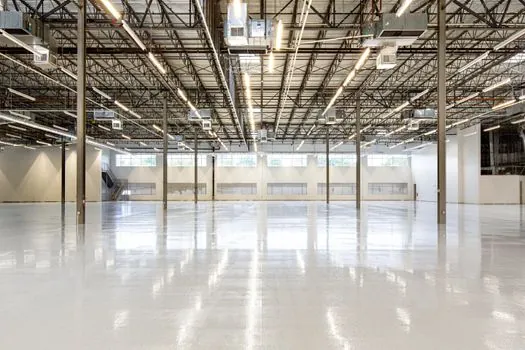
Below-grade waterproofing on data center sites is dominated by PMMA, hot rubberized asphalt, and self-adhered membrane systems, and the design driver is hydrostatic head, not weather exposure [S1]. Where the data hall slab is poured over a ground-contact slab or a moisture-prone subgrade, a moisture-mitigating underlayment is added below the poured-in-place resinous floor to block vapor transmission; this is a separate spec line from the roof and is governed by the floor system's water vapor transmission rate, not by ASTM E108 or FM VSH [S4].
The data hall floor itself is a resinous, seamless, non-porous system chosen for abrasion resistance under rolling server-rack loads, predictable ESD (electrostatic discharge) control, and clean-room particulate performance, with a resinous system preferred over sealed concrete because sealed concrete sheds particulates when damaged and needs frequent resealing [S4]. For mezzanines and mechanical rooms above occupied space, an additional waterproofing membrane is often specified on the floor to prevent water intrusion into the rooms below from a chilled-water pipe failure or a condensate event, and this is the application where polyurethane or polyurea spray systems are most often substituted for PMMA because of the irregular geometry and the speed of cure [S1][S4].
PCB- and electronics-level water protection
Inside the white space, water protection at the printed circuit board (PCB) level is a different spec line, governed by IPC and IEC electronics standards and by the IP rating target, not by ASTM E108 or FM VSH. Nano-coating systems (fluoropolymer and silane-based) are applied to PCBs at thicknesses of 1–5 micrometres and are typically specified from IPX4 (splash) up to IPX7 (temporary submersion at 1 m for 30 min), with claims of IPX8 (continuous submersion) available on higher-end product lines [S3].
The trade-off against traditional conformal coating and parylene is process scalability: nano-coatings are typically applied by dip, spray, or brush at ambient conditions and cure in seconds to minutes, which is the key reason they are displacing parylene in high-volume PCB production lines where batch throughput is a constraint, while parylene still wins for medical and aerospace PCBs that require uniform conformal coverage on the harshest geometries [S3]. A waterproof coating spec used for a roof or floor is not interchangeable with a PCB-level nano-coating: the binder chemistry, film thickness, substrate (concrete or steel vs copper-clad FR-4), and test method (ASTM E108 vs IPC-CC-830 / IEC 60529) are all different, and submittals that mix the two spec lines should be rejected at design review.
Selection by project profile: hyperscale vs colocation vs edge
For a hyperscale data center (10+ MW, single roof often larger than 50,000 m²) the dominant selection is SBS-modified bitumen multi-ply or PVC KEE single-ply, both with a 35-year NDL guarantee, VSH hail rating, and Class A fire, because the owner values long-interval re-roofing and single-source accountability [S1]. The Siplast Mission Critical NDL Roof Guarantee is one of the few line-item guarantee products marketed specifically to this segment, and it is contingent on the installer completing a dedicated Critical Infrastructure Data Center Training [S1].
For colocation facilities (1–10 MW, mixed-use floors, frequent retrofits) the dominant selection shifts toward PVC KEE single-ply and PMMA hybrid systems because penetration density is high and the roof is more likely to be cut into for tenant fit-outs, where the faster cure and easier patching of PMMA outperform multi-ply bitumen [S1][S2]. For edge and micro data centers (under 1 MW, often in converted industrial space) the spec is typically a polyurethane or polyurea liquid-applied system over an existing deck, with less emphasis on NDL guarantees and more on speed of install and tolerance of irregular substrates [S1]. Across all three project sizes, the coating thickness gauge used at QA/QC must be calibrated to the substrate (steel vs concrete vs membrane) and to the dry film thickness specified by the OEM, which is a frequent audit finding on data center projects [S1].
Limitations and failure modes
Every chemistry in the data center waterproofing spec has at least one well-documented failure mode, and the selection should be made with the failure mode in mind, not just the headline performance [S1][S2][S4]. SBS-modified bitumen is torch-applied, which carries a hot-work permit risk on an operating data center campus and has caused ignition events on retrofits; cold-applied or self-adhered variants exist but trade away some redundancy.
PMMA is sensitive to moisture at application and to substrate temperature (typically above 5°C and below 35°C with a defined dew-point window), which makes it less forgiving in shoulder-season schedules. Polyurethane and polyurea systems degrade under UV without a topcoat, so an aliphatic topcoat is mandatory for any exposed application; the data sheet should be checked for ASTM G154 or xenon-arc UV exposure data, not just a marketing claim of UV resistance [S1]. Resinous data hall floors are vulnerable to moisture-vapor bubbling if the underlayment is skipped or mis-specified, and ESD conductivity is contingent on the topcoat formulation, not on the base layer [S4]. For PCB nano-coatings, the failure mode is typically a thickness deficit at connector and lead edges during dip or spray application, and the QA/QC is a coating thickness gauge measurement per IPC-CC-830, not a visual inspection [S3].
Sourcing, standards, and verifiable signals to track
Specifying engineers should anchor the data center waterproofing submittal to four documents: the manufacturer NDL guarantee sample (request it before bid), an FM Approval RoofNav listing matching the assembly to the project's FM 1-90, 1-105, or 1-120 wind classification, an ASTM E108 Class A fire certificate, and a VSH hail approval letter for the exact assembly (not the membrane alone) [S1]. ENR's 2026-03-24 coatings feature flags the wider shift in data center construction: shop-applied zinc-rich primers curing in 1–3 hours, intumescent fire-resistant materials (IFRMs) replacing cementitious fireproofing for clean-room reasons, and poured-in-place resinous floors replacing sealed concrete for ESD and clean-room reasons, all of which sit alongside the waterproofing selection rather than inside it [S4].
For sustainability documentation, request product-specific Environmental Product Declarations (EPDs) from the membrane manufacturer, and confirm contribution to the green-building rating system in use (LEED v4, BREEAM, or local equivalent) before the bid, because not all PVC KEE and SBS products carry EPDs at the assembly level [S1][S2]. Two trackable signals to monitor over the next two quarters: (a) revisions to FM VSH approval listings as more assemblies are tested under the updated 2025 FM Property Loss Prevention Data Sheet criteria, and (b) the rate at which PMMA hybrid systems replace pure SBS multi-ply on hyperscale projects with penetration densities above 200 per 10,000 m², which is the threshold at which the hybrid chemistry is most often selected [S1].