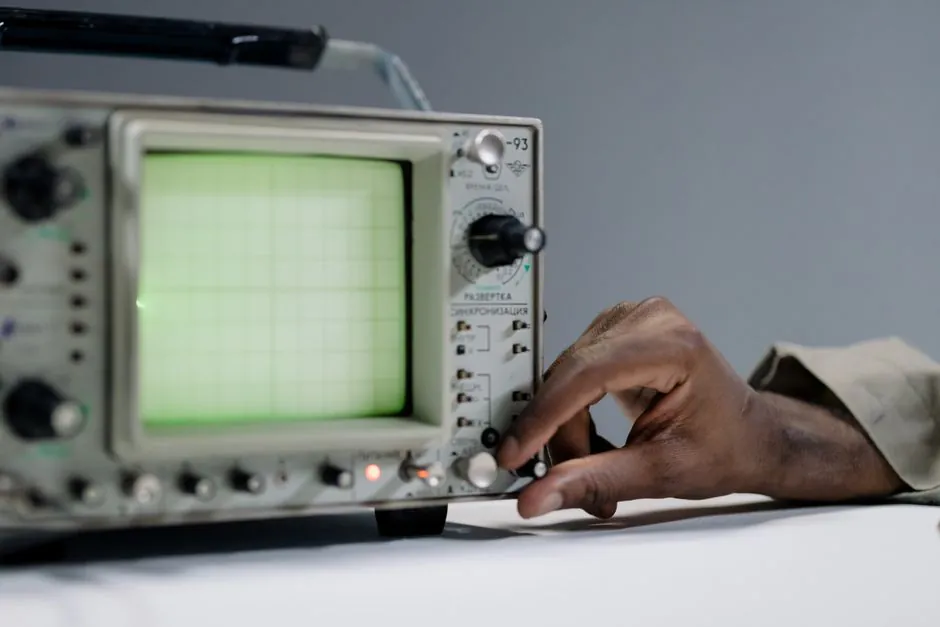
A seven-decade resistance substitution box covers 1 ohm to 11 megohm with 1 percent accuracy and 1 W rated resistors, dial-selected in 1, 10, 100, 1 k, 10 k, 100 k and 1 M ohm steps [S1]. That is the working envelope most bench technicians meet first when they reach for a decade resistance box as a stand-in for a fixed resistor of unknown optimum value.
The instrument is a switchable resistor network, not a measurement device: it supplies a known, low-uncertainty resistance so a meter, bridge or circuit under test sees a controlled stimulus. It is the metrology complement to a function generator, which plays the same reference role on the AC signal side [S2][S5].
Internal architecture: rotary decades wired in series
Each decade is a string of ten equal resistors terminated by a single-pole rotary switch, with positions 0 through 9 shorting across 0 to 9 of those resistors in series [S5]. Because the decades themselves are also wired in series, the dial reading on each switch is additive: 4 on the x1000 ohm step plus 5 on the x100 ohm step plus 6 on the x10 ohm step plus 7 on the x1 ohm step yields 4,567 ohm at the binding posts [S2].
The series-additive topology is what gives the box its name: each switch covers one decimal place, so n switches give 10^n discrete values. A typical six-decade unit therefore resolves 1 part in 1,000,000 across its range, with internal resistors commonly specified at 0.1 percent or 0.01 percent tolerance and low temperature coefficient for stability [S2][S3]. High-end metrology builds from IET Labs reach 20 ppm initial accuracy and 5 ppm per year long-term stability across more than 55 models [S6].
Operating envelope: power, current, and the 1/4 W ceiling
For a low-voltage decade box the binding-post pair is rated at roughly 1/4 W total dissipation and 300 mA through the rotary switch contacts [S5]. The power ceiling translates, via P = V^2 / R, into a minimum safe resistance at any given supply rail: 100 ohm at 5 V, 324 ohm at 9 V, 576 ohm at 12 V, and 3,600 ohm at a plus/minus 15 V split supply [S5].
Push past those limits and the dissipation concentrates in the engaged resistors of the lowest decade, so the box stops being a reference and starts being a heater. Engineers who need a higher-wattage adjustable resistor are looking at a different product class: 225 W per resistor, 10 percent tolerance, intended as a dummy load, not a calibrated standard [S4]. Picking the wrong class for a calibration loop is the most common decade resistance box failure mode in practice.
What it calibrates: DMMs, bridges, and sensor loops
The primary metrology use is feeding a known resistance into a digital multimeter on its ohms range to verify full-scale accuracy and linearity, or into a Wheatstone or Kelvin bridge to balance the null detector during calibration [S2][S3]. A four-wire resistance decade box, where the high-current and sense paths are brought out on separate terminals, removes lead and contact resistance from the loop, which is what makes sub-ohm dial values trustworthy [S9].
For process work, the same box simulates a 100 ohm RTD Pt100 element when checking a temperature transmitter loop, or a 250 ohm load when validating a HART positioner, without dragging a calibration bath or a full RTD simulator onto the bench. It is also wired as a precision voltage divider: two resistance decades across a stable DC source produce a defined output voltage for exercising analogue inputs [S2].
Box class versus decade box class
A teaching resistance box and a metrology decade box are not the same product, even though both look like a row of rotary dials on a metal case. The teaching unit is typically a 0.1 ohm to 9,999.9 ohm five-decade kit in an ABS shell with 1 W resistors, sold for Ohm's law demonstrations [S1]. The metrology unit runs 0.01 percent or better, 4-wire, hermetically sealed, with calibration traceability, and costs accordingly [S3][S6].
A digital decade box replaces the rotary switch stack with relays and a numeric display, giving 4-wire remote-programmable resistance for ATE racks where the box must be swept under software control [S9]. For a precision filter test rig or a sensor simulator that is asked to step through hundreds of values automatically, the digital form removes the human dial-in bottleneck.
Selection criteria, compared

Four parameters separate a usable decade resistance box from a reliable one: tolerance, temperature coefficient, power rating, and switch contact resistance. Entry-level units on the Amazon best-seller list for the Industrial and Scientific category sit at 1 percent accuracy and 1 W per resistor [S1]. Mid-range units from VPG Foil Resistors (Alpha Electronics) and IET Labs drop tolerance to 0.01 percent or 20 ppm, with 5 ppm per year stability, sealed foil or wirewound elements, and 4-wire Kelvin terminals [S3][S6].
Power-handling and accuracy move in opposite directions: the 225 W, 10 percent power decade is a load, not a reference [S4], while the 0.01 percent metrology box is usually capped below 1 W per resistor. For insulation-resistance tester work, where the box may sit at several hundred volts across its terminals, a standard decade box is the wrong tool, and an insulation resistance tester calibration jig with appropriate voltage rating is required instead. Matching the box class to the loop it sits in is the entire selection decision.
Failure modes and field constraints
The dominant failure mode is switch contact resistance drift after thousands of rotations, which adds an offset to every dial setting and is most visible on the 0.1 ohm and 1 ohm decades where the contact resistance is a meaningful fraction of the step value [S5][S8]. Oxidation on the wipers, loose knob shafts, and cracked PCB traces inside the decade stack are the usual culprits, and a contact-cleaner service on the rotary switches restores most of the original accuracy.
Second is thermal drift when the engaged resistor is run near its dissipation limit; the resistance value walks upward as the element warms, then settles over minutes. For this reason, metrology-grade decade boxes used as calibration standards are typically run at no more than 10 percent of rated power, with a settle period allowed before the reading is taken [S3][S6]. A digital relay-based box sidesteps the contact-resistance failure but introduces relay bounce and thermal EMF at the contact pairs, which is why four-wire Kelvin connections are still specified for sub-ohm work [S9].
Use cases where the decade box is, and is not, the right tool

The box is the right tool when a known, low-uncertainty DC resistance is needed at the binding posts: DMM and bridge calibration, RTD simulation, voltage-divider trimming, and university teaching labs. It is not the right tool as a high-wattage dummy load, as a substitute for an RTD Pt100 simulator with active temperature profiling, or as an AC impedance standard, where frequency-dependent effects of the internal resistor network start to dominate [S2][S4].
Engineers who compare a decade box against a programmable resistance calibrator usually land on the decade box for bench use where tactile dial feedback and instant value changes matter, and on the digital or calibrator form for ATE racks and field loops where scripting, 4-wire accuracy, and traceability certificates are required [S9]. For process control loops that read resistance, the cheapest correct answer is often a used metrology-grade decade box from a calibration lab upgrade, paired with a printed calibration chart for the actual dials in use.
Two trackable signals to watch over the next quarter: IET Labs' release notes for additional low-resistance decade additions to its RS and HARS series, and any VPG Foil Resistors (Alpha Electronics) product change notification for foil-resistor decade elements that would shift published ppm specs.
For related coverage, see One-Channel vs Four-Channel Controller and Probe: Real Cost Split.
