
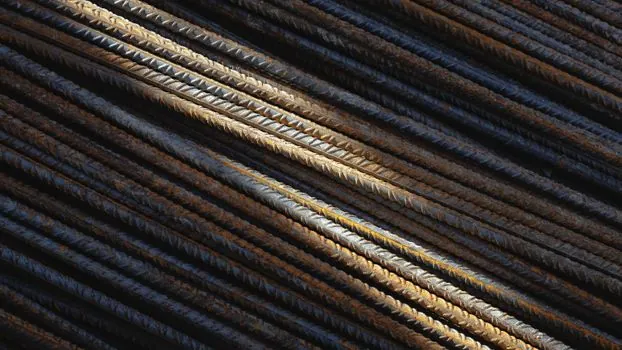
Deformed rebar for prefabricated components is typically specified in HRB400 or HRB500 hot-rolled ribbed bars at nominal diameters of 10, 12, 16, 20, 25 and 32 mm, with the most actively listed sizes on Chinese B2B channels being 10 mm, 12 mm and 20 mm [S1].
Standard straight lengths of 9 m and 12 m dominate, with cut-to-length and coil options available for factory cage welding; the de facto minimum order is 50 m.t. and single-mill export supply capacity sits at roughly 200,000 m.t./month under TT or LC terms [S2].
Why prefabrication changes the rebar spec sheet
Prefabricated building factories cage, tie and pour rebar horizontally on jigs, then lift the completed element vertically, so the spec that matters most is yield-strength consistency bar-to-bar, not field-bendability [S3]. A 500 MPa grade bar that deflects 2 mm at the tip of a 6 m precast beam truss will fail QC where the same bar would be accepted on a cast-in-place slab, so HRB500 with documented tensile testing is increasingly the default over HRB400 for horizontal precast elements in capacity-driven designs [S2].
For vertical elements (precast columns, shear wall panels), HRB400 remains the workhorse because the lap-splice lengths and grouted-sleeve coupler geometry are already tabulated against 400 MPa yield in factory design software, and switching grades forces a re-check of every splice schedule [S1]. Procurement teams therefore default to HRB400 unless the structural engineer signs off a 500 MPa substitution explicitly.
Diameter and length options actually in stock
Active export listings cluster at 10 mm, 12 mm and 20 mm because these feed the highest-volume prefabricated products: 10 mm and 12 mm go into pile-cap cages, slab reinforcement mesh and thin-wall panel trusses, while 20 mm is the backbone of beam-column cages in PC (precast concrete) frames [S1].
Lengths split cleanly: 9 m straight bars for truck-and-crane friendly handling, 12 m straight bars for long-span beam reinforcement where fewer splices are wanted, and small-diameter coil (6–12 mm) for spiral stirrups and hoop ties that the cage-welding robot unrolls on demand. For precast double-tees and hollow-core slabs, 8 mm and 10 mm coils are usually the lowest-tolerance path because the line can decoil straight, cut, and bend without the straightness memory that a hot-rolled straight bar carries [S2].
Selection criteria against the four main options
Specifying deformed rebar for a precast yard is a four-way trade between grade, diameter, length form and connector strategy, and the matrix below is what factory procurement engineers actually work against [S1][S2].
On the straight-bar vs coil axis, straight 9/12 m bars win on measuring and cutting accuracy (no uncoil memory), while coils win on material yield (less scrap from cut-offs) and on small-diameter stirrup production at diameters 6–10 mm. On the diameter axis, 10/12 mm bars target slab and panel reinforcement, 16/20 mm target beam-column cages, and 25/32 mm target heavy transfer beams and PC column main reinforcement; 25 mm and above is the point at which rebar coupler and threading requirements begin to drive the splice design rather than the bar selection itself, as covered in the rebar coupler reference page [S1].
Site-side constraints that drive the spec
Factory cutting and bending equipment typically rated for bar diameters up to 32 mm sets the upper bound on what a precast yard can process without outsourcing; bars above 40 mm generally force a rebar cutter upgrade or a hand-torch station, which in turn defeats the throughput model of a precast line [S1].
Bending accuracy is tighter in a precast jig than on an open site because the cover concrete is thinner (often 15–20 mm) and any hook that overruns tolerance will poke through the form face. HRB500 needs slightly larger bend radii (typically 4d vs 3d for HRB400 at the same diameter) to avoid micro-cracking, so the bending machine's minimum-radius chart must be checked before the grade switch is locked in. The same constraint is why procurement teams also keep a rebar straightener on the inbound receiving line for coil stock: an under-straightened bar will mis-feed the cage welder and throw the stirrup pitch off-tolerance.
Jointing strategy and accessory equipment

Prefabricated construction has moved decisively away from lap splicing for primary reinforcement, in favour of grouted sleeve couplers and headed bars at element-to-element connections, because the precast element is cast with the protruding starter bar already in place and the splice happens in a much smaller cross-section than a cast-in-place lap zone would occupy [S1].
The practical selection rule: if the connection is a precast column-to-foundation or column-to-column moment joint, use a grouted sleeve coupler matched to the bar diameter; if the connection is a slab or wall panel where the splice is hidden inside a grouted trough, a lap splice is still acceptable and saves the cost of the coupler plus the threading pass. Diameter 20 mm and above is where the coupler's labour savings (versus a long lap that requires extra bar length and congestion control) start to outweigh the coupler's per-piece cost. Onsite prep work for either system runs through the same rebar bender and threading station; matching the bend radius and the thread rolling pass to the same bar diameter is what keeps a precast line from holding inventory of two tolerance grades of the same nominal bar [S2].
Sourcing channels, MOQ and standards
Export procurement for prefabricated-component factories routes predominantly through Chinese B2B platforms, where the working MOQ sits at 50 m.t. per shipment, payment is TT or LC, and listed single-mill monthly capacity reaches 200,000 m.t., giving a buyer enough volume headroom to lock a 6–12 month forward price [S2]. Diameter options actively listed include 10, 12 and 20 mm as the top three search hits on the same channel, with 16 mm, 25 mm and 32 mm as secondary cuts that most mills can roll on a 3–4 week lead time rather than ex-stock [S1].
On standards, HRB400 and HRB500 are the Chinese GB/T 1499.2 grade designations; project teams exporting to Southeast Asia, the Middle East and Africa typically accept GB/T 1499.2 mill certificates alongside the project's local standard (for example BS 4449 in the UK legacy market, ASTM A615 in US-funded projects, or equivalent national mirror standards), with CE certification appearing on a portion of export listings though the issuer status must be re-verified per shipment [S1]. For higher-risk procurement, two verification points to insist on: the mill test certificate per heat, and a third-party tensile and bend test from the receiving port before the bar is released to the cage-welding line.
Trackable next signals for buyers building a 2026–2027 precast capacity plan: any change in the 50 m.t. MOQ floor on the major B2B channels (it has held since at least 2022) would shift the project economics for small-yard precast fabricators; a published tightening of CE certificate issuance on export listings would force a switch to mill-issued EN 10080 or BS 4449 test packages for European-bound rebar. Related procurement angles worth cross-checking sit in this concrete curing compound selection map for data center slabs reference, which covers the downstream QC side of the same precast workflow.