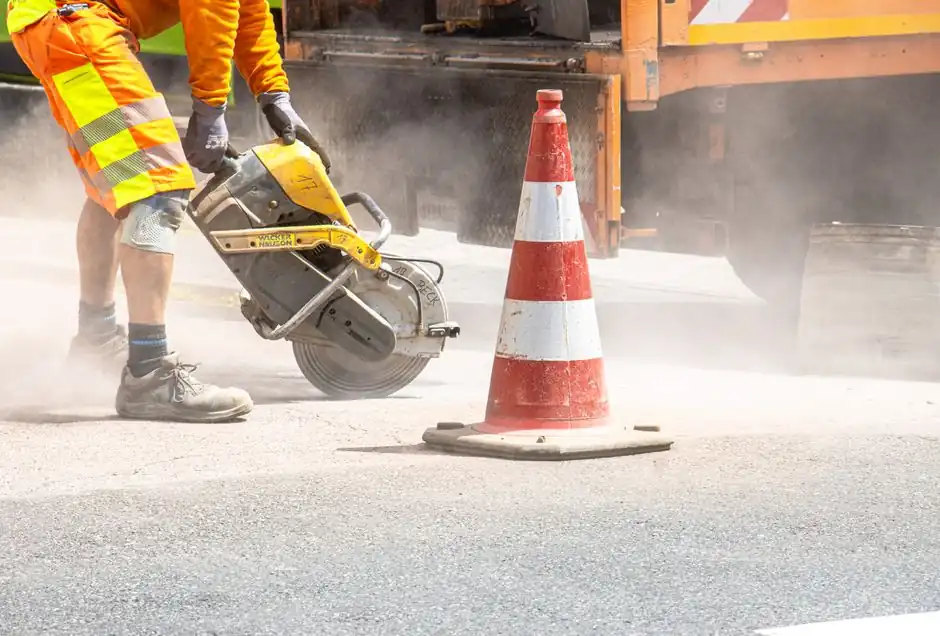
Hard-bond diamond grooving blades resist the abrasive slurry generated by asphalt, while soft-bond blades expose fresh diamonds efficiently in cured concrete [S1][S2].
The decision applies to asphalt, green concrete, cured concrete, reinforced concrete, brick, and block; blade diameter, arbor, and machine rating must also match the cutter [S1][S3].
Bond Hardness Determines Diamond Exposure
The bond is the metal matrix that retains diamond grit, and its wear rate controls whether the blade continues to expose sharp particles [S1][S5]. Asphalt is relatively soft but highly abrasive, so its sandy slurry attacks the matrix and core. A hard bond holds the diamonds long enough to survive this wear, while a soft bond can disappear before the diamonds are fully utilized [S1].
Cured concrete is harder and less abrasive, so it calls for a softer bond. The matrix wears steadily, releases dulled particles, and exposes new sharp diamonds at a useful rate [S1][S3]. The distinction is not a difference in cutting principle: both materials are ground by embedded diamonds, but the correct bond controls whether the working edge stays sharp or becomes polished and inefficient [S5].
Asphalt Versus Concrete: Decision Matrix
Use a hard-bond asphalt blade for soft, abrasive asphalt because it better withstands the sandpaper effect and limits premature segment loss. Use a soft-bond concrete blade for cured or reinforced concrete because faster matrix wear maintains diamond exposure [S1][S3]. Asphalt blades usually use taller segments, wide gullets, and undercut protection, while concrete blades generally use standard-height segments and narrower gullets [S1][S5].
Concrete blades commonly run on handheld saws, masonry saws, and walk-behind saws. Asphalt blades are normally selected for high-horsepower walk-behind flat saws and are commonly used wet [S1]. A combination blade is reasonable where crews regularly alternate between concrete and asphalt, but it compromises the peak performance available from a specialized blade [S5].
The key comparison is bond hardness, debris handling, core protection, and operating environment. Asphalt blades prioritize matrix retention and undercut resistance; concrete blades prioritize controlled diamond release and fracture of hard aggregate [S1][S5].
Segment Geometry Protects Asphalt Blades

Asphalt blades often include drop or wedge segments because loose, sandy slurry rubs against the steel core immediately below the cutting edge. These shapes protect the core from undercutting, a failure mode in which abrasive material removes material beneath the segments [S1]. Tall asphalt segments and wide gullets also help clear debris and maintain the intended cutting path [S5].
Concrete blades generally use standard-height segments without the same dedicated undercut protection [S1]. Their geometry is optimized for fast penetration and fracture in cured concrete, brick, and block rather than for prolonged resistance to a sand-filled slurry [S1][S5]. The number of segments, their spacing, and the blade grade should be selected for the cutter and production rate, not inferred from diameter alone.
Wrong-Bond Blades Fail Differently
A concrete blade misapplied to asphalt can lose its soft matrix and shed diamonds, producing rapid segment and blade wear [S1]. An asphalt blade used on cured concrete can cause its exposed diamonds to become smooth and glazed. The result is slow cutting, excessive heat, and possible core warping or equipment damage [S1][S3].
Replace a blade when cutting remains slow despite adequate pressure, segments are worn flush with the core, or the cutting edge has become glazed [S3]. Stop operation immediately if segments are missing or cracked, or if the blade has a visible bend or wobble; continuing with a damaged blade creates a serious operating hazard [S3].
Wet Cutting Controls Heat and Dust

Wet cutting is preferred when water is available because it cools the blade, extends life, suppresses dust, and supports deeper continuous cuts [S3]. Road-cutting machines commonly carry a water tank for that purpose. Segmented-rim diamond blades, with gaps that clear slurry, tolerate dry cutting better than continuous-rim or turbo-rim designs and are a standard choice for concrete grooves and expansion joints [S3].
For dry cutting, use a blade rated for dry service, make short passes, and allow the blade to spin free between passes so it can cool [S3]. Do not run a wet-only blade continuously in dry mode. Cut wet whenever water is available to cool the blade, extend its life, and control dust, and when cutting dry use a dry-rated blade in short passes and let the blade spin free to cool [S3].
Machine Fit and Production Selection
Match blade diameter and arbor size to the cutter before evaluating bond type [S3]. A concrete groove cutter operating on cured concrete should use a soft-bond, segmented blade; an asphalt machine requires a hard-bond blade with suitable gullet geometry and undercut protection. Blade speed, engine power, water delivery, and cut depth must remain within the machine and blade manufacturer’s ratings, but the research material does not provide a universal RPM table or maximum depth for an unspecified model.
For daily groove cutting, an abrasive blade has a low purchase price but loses diameter quickly, while a diamond blade can cost less per metre of cut because it maintains cutting performance longer [S3]. When selecting among a concrete grooving blade, an asphalt blade, and a combination blade, compare service life, expected cutting speed, segment loss, core protection, and the proportion of concrete versus asphalt work.
Procurement and Failure-Control Checklist
Specify the material, machine model, blade diameter, arbor size, wet or dry duty, and expected cut depth when requesting a blade [S3]. For asphalt, require the supplier to identify the bond grade, segment type, gullet arrangement, and undercut-protection feature. For concrete, specify a soft-bond segmented blade suited to the machine and cut geometry. The cited guides give no universal blade price, life in linear metres, or standardized hardness number, so those values must come from the selected product grade and a site trial [S1][S3][S5].
A useful acceptance test is to compare cutting rate, visible glazing, segment profile, and slurry behavior under the planned machine load. If the edge glazes, the bond may be too hard for cured concrete; if the matrix and segments erode rapidly, the bond may be too soft for asphalt [S1][S3]. For mixed workloads, retain separate specialized blades rather than forcing one blade across both materials.
Record blade diameter, segment condition, cut metres, and machine model after each production shift, then replace a blade when the edge is flush, glazed, cracked, or bent rather than continuing to consume the machine and operator time [S3].