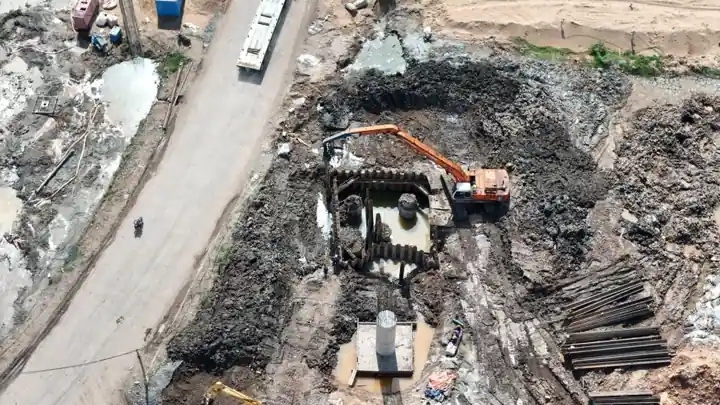
The selection of diaphragm wall excavation equipment depends primarily on soil conditions and trench depth [S1].
Trench cutters are especially used in hard or very hard soils and at large trench depths [S1].
What Closing Force Must Achieve
Closing force is the usable jaw force available to penetrate formation, shear excavation bites and release soil into the support slurry. It is not a universal soil classification: the governing requirement is the force needed to open the soil and maintain controlled excavation through the full panel depth [S1][S3].
Grabs excavate trenches by closing a pair of jaws, whereas trench cutters mill soil or rock with rotating cutting wheels [S3].
The diaphragm wall grab must also match the trench geometry.
Soil Type Versus Excavation Method
Soft and medium-dense soils favor a mechanical or hydraulic grab because the jaws can penetrate and remove material in discrete bites.
Hard or very hard soil shifts the decision toward a trench cutter. Cutting wheels loosen the material, which is mixed into slurry and transported upward by a mud pump before solids are separated in a desanding plant [S1].
Trench cutters loosen existing material with cutting wheels and transport it upward with the slurry using a mud pump anchored in the cutting frame [S1].
Panel Geometry Changes the Force Demand
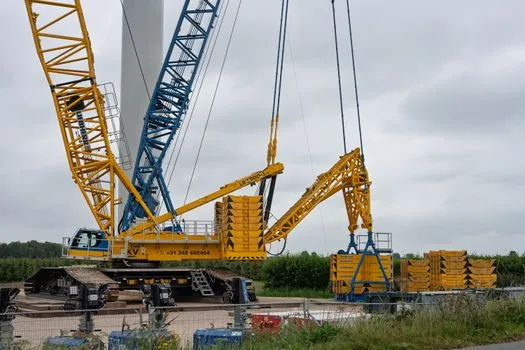
Panel width, bite length and wall depth directly affect how many closure cycles are needed and how much embedded material each jaw must penetrate. Published wall thicknesses range from 0.6 m to 1.1 m, while typical panel widths range from 2.5 m to 6 m [S4].
A panel is not necessarily excavated in one pass. Corner and T-shaped panels also require multiple bites [S5].
The maximum bite length is constrained by the grab itself.
Force, Penetration and Cycle Time
High closing force does not guarantee high production when the jaw profile, tooth penetration, opening area and spoil discharge are poorly matched to the soil. A grab excavates by closing a pair of jaws and lifting the soil out bite by bite, whereas a cutter mills the material and pumps it to the surface with the fluid [S3].
Accordingly, specify closure force against the expected maximum formation resistance along the panel, not against an average soil description. The basis should include depth, panel width, bite geometry, soil classification, groundwater conditions and expected cobble or obstruction content. The research establishes the tool-selection principle and panel geometry, but it does not provide a universal force-to-soil conversion, so no kN value should be inferred from soil type alone [S1][S2].
Related power-pack selection is covered in Size a Diaphragm Wall Grab Power Pack by Force. This equipment decision should remain separate from the soil decision, because adequate hydraulic power cannot compensate for an unsuitable jaw geometry or an inappropriate cutter-versus-grab choice.
Groundwater, Slurry and Operational Limits
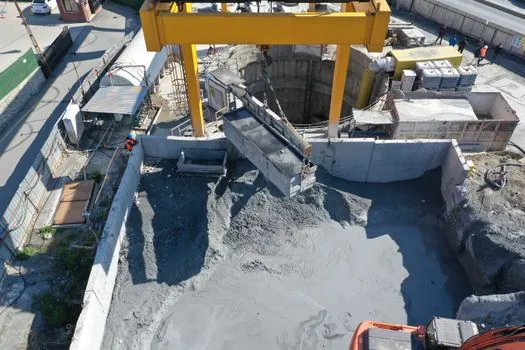
Excavation proceeds in a trench filled with support slurry, whose pressure stabilizes the exposed trench sides.
Guide walls set the panel alignment and width, support the unstable upper approximately 1 m of the excavation and guide the grab vertically. The slurry pump must be fully submerged before pre-excavation, and the initial excavation is filled with slurry before the main panel excavation proceeds [S5].
Failure modes are not limited to insufficient closure force. An oversized bite can overload the jaws or frame, a narrow bite can cause repeated cycling, and poor slurry control can destabilize the trench even when the grab penetrates the soil correctly.
Equipment Selection by Use Case
Select a hydraulic grab for dense urban excavation where controlled verticality, discrete bites and a usable panel width matter more than continuous rock excavation. Reinforced-concrete wall thicknesses of 0.6–1.1 m and panel widths of 2.5–6 m provide the initial dimensional envelope, subject to project-specific geotechnical design [S4].
Select a trench cutter when the profile includes hard or very hard layers, rock, or a depth that makes a grab uneconomic. BAUER reports excavation depths above 250 m with BC cutters, while identifying trench depth and soil conditions as the primary equipment-selection factors [S1].
Use a mechanical cable grab where soil resistance is manageable, simplicity and robustness are priorities, and the required bite length fits the grab. Do not assign a hydraulic grab to hard ground solely because it has greater closure force, and do not specify a cutter for ordinary soft soil without assessing cycle time, slurry handling and capital cost.
The trackable procurement record should include the design closing force, jaw geometry, maximum bite length, rated trench width and depth, carrier configuration, hydraulic flow and pressure requirements, plus the soil log defining the hardest formation expected along each panel.