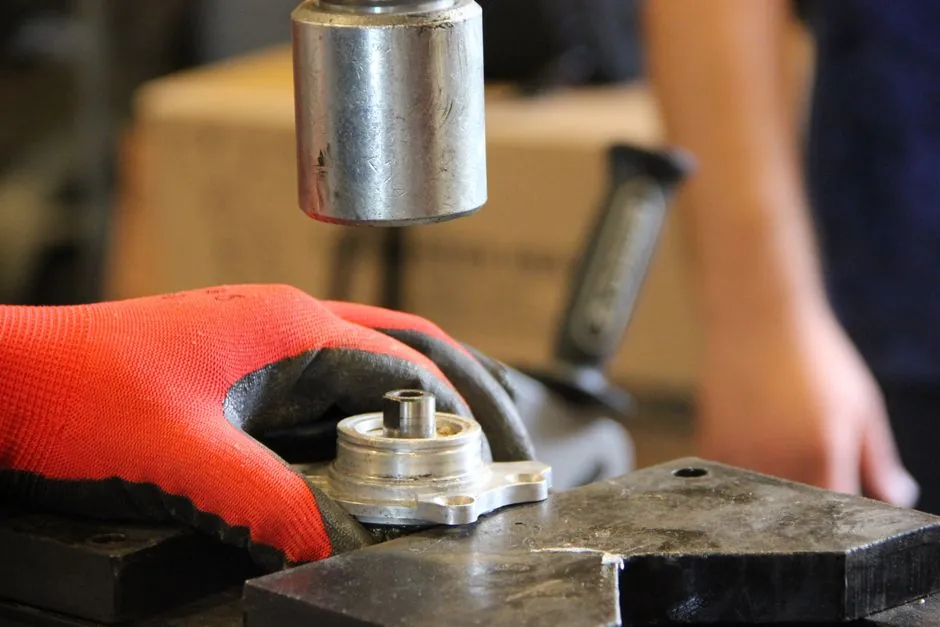
Hardware-grade die casting dies are built around H13 hot-work tool steel (ASTM A681, DIN 1.2344) at 44-52 HRC, run on machines delivering 1000-4000 kN locking force and 30-100 MPa injection pressure, and target a 100,000-500,000 shot envelope with cycle times of 30-120 s [S1].
The selection gate that determines everything downstream is alloy: cold-chamber aluminum cells (A380, A383, ADC12) and magnesium cells (AZ91D, AM60B) need different tonnage, shot sleeves, and shielding gas than hot-chamber zinc lines (Zamak 3/5/7), so the die family and machine class are fixed by the alloy before the cavity drawing is even started [S2][S3]. For hardware programs weighing thin-wall enclosures, fasteners, and zinc hardware fittings, this alloy-first decision is non-negotiable.
Alloy-to-Die Family and Machine Pairing
Zinc sits below ~420 deg C melt and is processed on hot-chamber die casting machines with shot weights typically capped at a few kilograms per cycle, while aluminum above ~660 deg C and magnesium need cold-chamber cells running 50-800 ton clamp force and shot sleeves from ~70 mm to ~140 mm bore; magnesium cells add SF6/CO2 cover gas shielding at the shot chamber to suppress oxidation [S2].
A 2026 sourcing spec for hardware lines therefore locks the order: alloy first, machine tonnage second, die envelope third. A zinc hardware fitting (Zamak 3 bracket, ZA-8 decorative trim) lives in a totally different tooling ecosystem than an A380 EV controller housing or an AZ91D handheld electronics frame, and conflating the two is the fastest way to overspend on die steel or undersize clamp force.
Die Steel, Heat Treatment, and Rated Shot Life
H13 remains the dominant cavity steel for aluminum cold-chapter work, with H11 and premium H13 variants used where thermal fatigue and solder resistance are the limiting failure modes; pre-hardened suppliers deliver at 44-48 HRC and vacuum-degassed ESR remelted billet is the 2026 default for inserts under high thermal cycling [S2].
For high-volume zinc hot-chamber tooling, P20+Ni (DIN 1.2738) and similar pre-hardened mold-base grades are widely used, with H13 again specified for cavity inserts and slides. Realistic shot-life numbers reported by 2026 die builders cluster at 100,000-250,000 shots for aluminum dies under routine maintenance, 500,000-1,000,000+ for zinc hot-chamber dies, and notably lower for magnesium dies once melt temperature exceeds ~680 deg C, where melt-front soldering and steel-grain attack shorten life [S2][S1]. Maraging steel and copper alloys (typically beryllium-copper) are reserved for inserts where thermal conductivity beats raw strength, not for the cavity block itself.
Gating, Overflow, and Vacuum-Assist Geometry
Gate velocity of 30-45 m/s for aluminum and magnesium cold-chamber work is the 2026 consensus rule of thumb, with overflow wells sized at 2-3x the runner cross-section and vent depths of 0.10-0.20 mm at the cavity's last-to-fill point [S2]. For thin-wall aluminum hardware enclosures (1.5-2.5 mm wall, typical of die-cast chassis and structural automotive parts), a tab or fan gate is preferred over a direct sprue gate to keep fill time under ~0.05-0.10 s and limit gate-removal witness marks.
Vacuum-assist via vacuum die casting machines reduces entrapped air and lets the cavity fill at lower injection velocities, which tightens achievable as-cast porosity bands; this is the lever hardware buyers pull when the spec calls for radiographic-grade Class 2 acceptance per ASTM E505-equivalent criteria [S2]. For a like-for-like comparison, die casting die selection under vacuum is one of the few cases where capital equipment (the vacuum cell) is the gating constraint rather than the die itself.
Cooling Layout, Ejection, and Cycle-Time Levers
Cooling-line layout is the second-largest contributor to cycle time after wall thickness: beryllium-copper inserts at hot spots paired with stainless or H13 conformal channels at 10-40 L/min flow rate carry heat out fast enough to keep cavity surface roughness in the 0.2-0.8 micrometer Ra band and hold dimensional tolerance to ISO 2768-m (typically +/-0.05 mm on hardware-grade castings) [S1]. Insufficient cooling causes hot spots, warpage, and premature thermal-fatigue cracking; over-aggressive local cooling causes solder sticking and cold shuts.
Ejection geometry is die-steel dependent: ejector pins sized per NADCA product specification guidance are placed in nonfunctional areas (overflows, bosses, deep pocket bottoms) and clear the part in a 30-150 mm stroke without distorting thin walls [S1][S9]. Hardware buyers specifying a new die should treat the cooling-channel drawing and the ejector-pin layout as one package, because the two together set the realistic 30-120 s cycle time the cell will actually run.
Comparison: Die Family Options for Hardware Programs

For hardware sourcing, the three realistic die-family options line up against decision criteria as follows. (1) Hot-chamber zinc dies (Zamak 3/5/7, ZA-8) on 50-400 ton machines: lowest per-shot cost, 500,000-1,000,000+ shot life, thinnest castable wall (~0.8-1.5 mm), best surface and plating response, but limited to small hardware fittings and decorative trim below a few kg per shot [S2][S3]. (2) Cold-chamber aluminum dies (A380, A383, ADC12, A360, 413) on 350-3000 ton machines: medium per-shot cost, 100,000-250,000 shot life under routine maintenance, 1.5-3.0 mm typical wall, broadest structural-hardware reach including EV housings and gear cases, requires vacuum-assist for Class 2 radiographic parts [S1][S2]. (3) Cold-chamber magnesium dies (AZ91D, AM60B) on similar tonnage: lightest hardware, shorter die life once melt exceeds ~680 deg C, and needs SF6/CO2 shielding at the shot chamber, which adds capex the other two families do not [S2].
Sand casting and investment casting sit outside this comparison but are the realistic fallback when annual volume cannot amortize die tooling or when the alloy is non-die-castable (ferrous, titanium, superalloys) [S3]. For ferrous or titanium hardware brackets, die casting machine selection is moot; the die-cast process window simply does not apply. Related industrial spec methodology for adjacent capital equipment is covered in Truck Scale Selection for Warehouse Automation: Spec Gates and 2026 Decision Map, which uses the same alloy-or-process-first gate structure.
Who This Spec Path Is For, and Where It Fails
Hardware programs running 50,000+ annual parts in aluminum, zinc, or magnesium, with thin walls (under 3 mm), integrated features, and a tolerance band around ISO 2768-m, are the sweet spot for HPDC tooling and will amortize a 100,000-500,000 shot die inside two to five years [S1][S3]. Programs under 10,000 annual parts, or needing ferrous / titanium / superalloy chemistry, or requiring tighter than +/-0.02 mm tolerance, are not: those belong on sand, investment, or machined billet paths, not die casting.
For broader die-cell context, aluminum die casting machine and gravity die casting machine cover the cold-chamber aluminum and the lower-pressure aluminum/gravity variants respectively, while magnesium die casting machine covers the SF6/CO2-shielded cells used for AZ91D and AM60B hardware frames. The four failure modes a hardware die buyer should write into the PO are thermal-fatigue cracking, soldering at melt-front hotspots, ejector-pin galling, and vent clogging at the last-to-fill point; each maps to a specific die-steel, cooling, or venting spec line in the checklist.
Trackable signals to watch: NADCA-published revisions to the Product Specification Standards document (current revision is the operative reference for ejector-pin layout, draft angles, and as-cast tolerance classes) and any 2026-vintage update to ASTM E505-equivalent radiographic acceptance for Class 1 and Class 2 die castings, since the vacuum-assist gating lever in this spec path is only worth pulling if the buyer is actually paying for radiographic-grade acceptance.