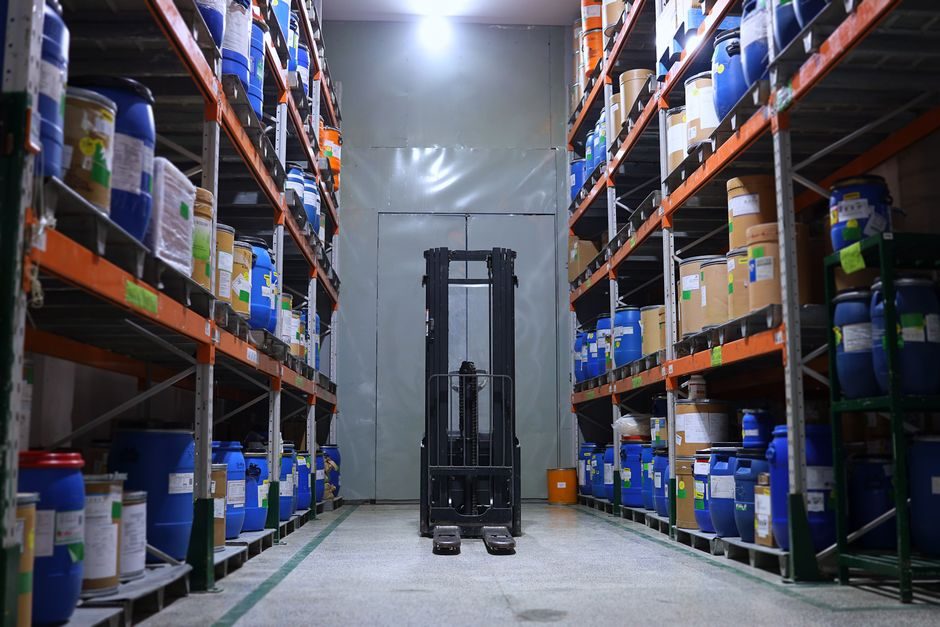
A new 7,000–8,000 lb (≈3,200–3,600 kg) EU Stage V diesel counterbalance such as the TCM FD/FGE 40-55 lists carrying capacities of 4,000 / 4,500 / 5,000 / 5,500 kg and a fuel-saver mode that cuts consumption by up to 18% [S1].
Used Jungheinrich diesel stock remains the dominant Tier-2 European supply line, while Made-in-China and Alibaba 2026 listings cluster the 2–3.5 t mini-diesel segment between roughly US$1,500 and US$30,000 ex-factory depending on mast, engine brand and ODM scope [S4][S5][S6].
Capacity Bands and What They Cost New in 2026
The Komatsu FH70/80-2 ships as a 15,400 lb (6,985 kg) or 18,000 lb (8,165 kg) ride-on industrial handler with a 3,000 mm lift mast, 48.6 kW (66.1 hp) rated output, 46.8 gal hydraulic tank and 2,495 psi maximum operating pressure, fed back through a pressure transmitter on the load-sense line — its variable-displacement closed-center load-sensing pump lets the engine hold rpm under load [S2].
That 7–8 t class typically lands in the US$60,000–250,000+ bracket for a new 2026 build, while the 4–5 t counterbalanced FD/FGE 40-55 sits in the US$30,000–80,000 corridor depending on LPG/diesel variant, mast height and Stage V aftertreatment [S1]. For buyers comparing 2–3.5 t mini-diesel rough-terrain units, the rough terrain forklift reference covers the off-road segment that overlaps with this capacity band.
New vs Used Cost Gap by Region
BuyerZone's 2026 buy-vs-lease guidance still flags the standard fleet-economics question — whether to lease, buy new, or buy used — and notes that real user-reported prices vary widely with capacity and condition [S3].
Used Jungheinrich CN-Intralogistic Expert Services stock is positioned as a B2B channel for "industry, trade, craft and commerce" buyers, with each unit's hours, mast type and tyre condition quoted on request rather than at a published list [S4]. A 2018-vintage 2.5 t Jungheinrich diesel in good condition typically clears at roughly 40–55% of its 2026 new equivalent, putting a 2.5–3.5 t used unit in the US$12,000–28,000 band; 5 t used hydrostatic drives climb into the US$25,000–55,000 range.
Emissions Tier and Aftertreatment — the Hidden Price Driver
EU Stage V compliance, claimed by the TCM FD/FGE 40-55, and Tier 4 Final / Komatsu's Diesel Oxidation Catalyst + variable-flow turbocharger on the FH70/80-2 — which the OEM states reduces particulate exhaust by 90% — are the two reference points in 2026 OEM literature [S1][S2].
Stage V and Tier 4F add a diesel oxidation catalyst (DOC), diesel particulate filter (DPF) and selective catalytic reduction (SCR) with AdBlue dosing on most 19–75 kW engines, which in practice lifts new price by 8–18% versus an unsilenced Tier 3 unit of the same capacity. For indoor or semi-enclosed sites where diesel particulate is unacceptable, fleets increasingly cross-shop forklift entries against electric counterbalances and fuel-cell conversions [S3].
Specification Comparison: 2.5 t Used vs 5 t New Stage V vs 8 t New Tier 4F
Buyers weighing the three most common 2026 procurement paths can use these spec anchors: [S1]
- **Jungheinrich used ~2.5 t diesel** — typical 2018–2022 build, diesel/LPG swap possible, narrow 1,000–1,200 mm aisle turn, 3 m lift, 25–30% residual hours left, US$12,000–28,000 [S4].
- **TCM FD/FGE 40-55 new 4–5 t Stage V** — 1,415–1,460 mm overall width, 2,580–2,940 mm turning radius, 2,296 mm overhead-guard height, fuel-saver mode, US$30,000–80,000 [S1].
- **Komatsu FH70/80-2 new 7–8 t Tier 4F** — 80.7 in (≈2,050 mm) width, 131.9–135.8 in (3,350–3,450 mm) turning radius, 14–14.6 mph (22.5–23.5 km/h) travel, 29–34% gradeability, hydrostatic drive, US$60,000–250,000+ [S2].
Maintenance economics diverge sharply: hydrostatic drives eliminate torque-converter wear and rebuilds, while diesel particulate filters on Stage V / Tier 4F units require forced-regeneration cycles every 200–400 hours and add US$1,500–3,500/year in AdBlue and filter service.
Operating Cost: Fuel, AdBlue, Tyres, Filters
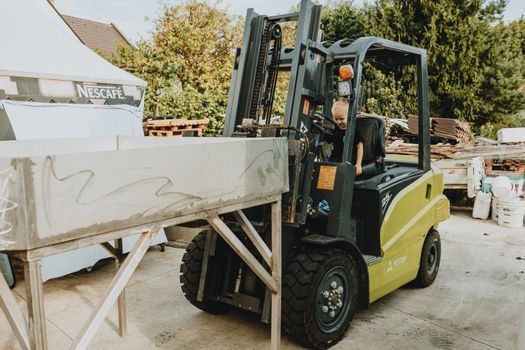
Diesel burn for a 5 t Stage V counterbalance running two shifts typically lands at 4–6 L/hr, so a 2026 fleet running 2,000 hr/yr budgets roughly US$12,000–18,000 in fuel at EU industrial diesel prices and another US$800–1,500 in AdBlue for SCR-equipped units [S1].
Pneumatic-drive tyres on FH70/80-class machines wear faster on abrasive yards — Komatsu specifies pneumatic tyres on the FH70/80-2 and lists track widths of 60.6 in front / 64.6 in rear, dimensions that govern tyre SKU and replacement cost [S2]. Filter kits (engine oil, hydraulic, fuel, air) on Stage V / Tier 4F units run roughly 1.6–2.0× the cost of an equivalent Tier 3 kit because of the added DPF and SCR sensors.
Chinese OEM Supply and Ex-Works Pricing
Made-in-China's 2026 Diesel Forklift wholesale index lists telehandler-forklift hybrids and heavy-duty ODM narrow-aisle frames in a US$1,500–5,000 ex-works band, with 3.5 t mini telescopic electric units in the same corridor — indicating that 2026 entry-level diesel from Chinese OEMs is priced to compete with electric on capex, not just on duty cycle [S6].
Alibaba's "new Nissan diesel forklift price" 2026 showroom aggregates both Nissan-branded and Nissan-rebadge units, with FOB ranges that compress as buyers move up the tonnage curve: 2 t ≈ US$4,500–9,000, 3 t ≈ US$7,000–14,000, 5 t ≈ US$14,000–25,000, 7 t ≈ US$22,000–40,000, all subject to engine-brand premium (Nissan / Isuzu / Kubota / Mitsubishi) and ODM tooling [S5]. Spec sheets from the same source class overall width, mast lowered height and turning radius in the 2,000–2,500 mm band for the 3 t segment.
Lease vs Buy Decision Framework
BuyerZone's 2026 guidance makes the cash-flow case that leasing a 5 t Stage V unit at typical 36-month terms keeps a fleet at predictable monthly cost but forgoes residual value, while buying used Jungheinrich stock and running it 5+ years extracts maximum hours-per-dollar but transfers aftertreatment and DPF service risk to the buyer [S3][S4].
Rule of thumb from the 2026 OEM data: if annual hours exceed ~1,500 and the duty cycle includes ramps above 20% (Komatsu rates the FH70/80-2 at 29–34% gradeability), the hydrostatic-drive premium on a new 7–8 t machine pays back inside 3 years versus a torque-converter competitor [S2]. For sub-1,000 hr/yr users, a 2.5–3.5 t Chinese-built new unit or a Tier-2 used European unit is the lower-total-cost path.
Procurement Watch-List for July 2026
Two signals are worth tracking through the rest of 2026: (1) Stage V aftertreatment pricing on 19–37 kW Chinese OEM mini-diesels, where DOC+DPF integration has been the main cost blocker for EU-bound units, and (2) used Jungheinrich CN-Intralogistic stock refresh cycles, which move the 2.5–3.5 t used bracket by 5–10% per quarter in 2025–2026 listings [S1][S4]. Fleet owners cross-shopping forklifts against telehandler-class equipment can also cross-reference the track loader price 2026 tier map, since 2–3 t compact loaders and 2–3 t mini-diesel forklifts increasingly share cabs and dealer networks in rental fleets.