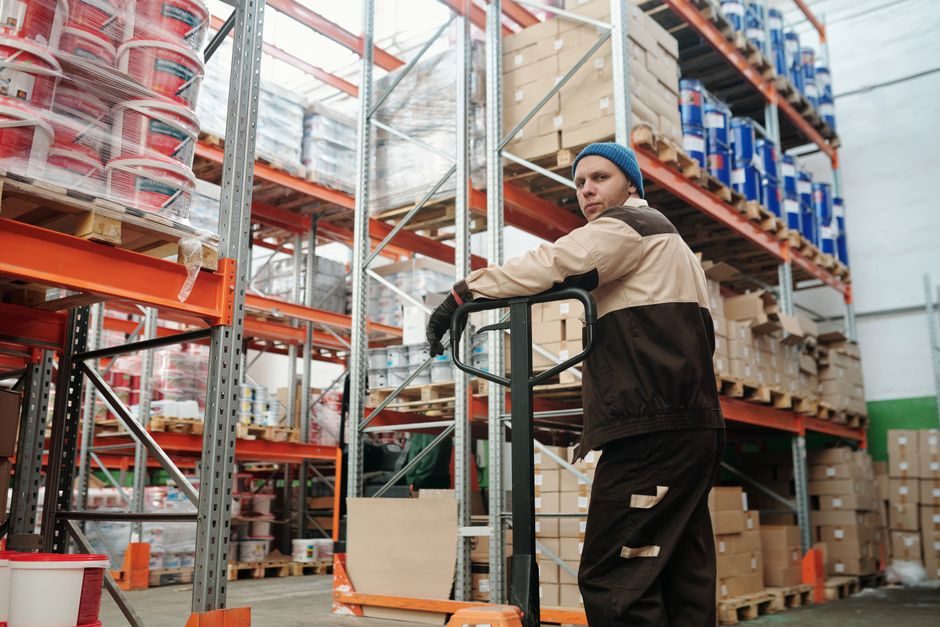
Diesel counterbalance forklifts cover a 1,500–16,000 kg load window with 3,000–5,000 mm lift heights and Stage V / EPA-compliant diesel or LPG engines, per OEM listings from TCM, Komatsu, and JAC [S1][S2][S3].
The "forklift" category also includes electric, LPG/gasoline, and rough-terrain variants, so the diesel version is a sub-type defined by fuel, emissions tier, and duty profile — not a separate machine class. Buyers in 2026 still need to match the unit to load weight, shift pattern, and ventilation requirements rather than treating diesel as the default.
What Counts as a Diesel Forklift and Where It Fits
A diesel forklift is a ride-on, 4-wheel counterbalance truck powered by a compression-ignition engine, typically specified for outdoor yards, lumber, steel, and port operations [S1][S2][S3]. The TCM FD/FGE 15-35 series carries 1,500–3,500 kg at a 500 mm load center with EU Stage V compliance and an 18% fuel-saver mode [S1]. The Komatsu FH70/80-2 lifts 6,985–8,165 kg (15,400–18,000 lb) with a 48.6 kW (66.1 hp) diesel, hydrostatic drive, and 29–34% gradeability [S2]. JAC's CPCD50/60/70H series runs 5,000–7,000 kg with 83 kW engines and CE/SGS/ISO9001/ISO14001 certification [S3].
Within the broader forklift category, diesel sits alongside electric (battery, AC Curtis-controlled up to 3.5 T), LPG/gasoline (1–3.5 T, Nissan/BAOFA/GM engines), and rough terrain forklift models from suppliers such as Niuli, Royal Forklift (Suzhou), and Henan Jingcheng Xiandai [S4][S5][S6]. Chinese OEMs commonly bundle 1–16 T diesel product lines (e.g., Vmax CPCD35/40/50/70/120) with 60–80 L fuel tanks and 500 mm load centers [S9]. The 3-ton Euro 4 / EPA-standard diesel class retails around US$1,500–5,000 FOB China on made-in-china export listings [S8].
Decision Criteria: Diesel vs Electric vs LPG vs Rough Terrain
Four decision gates drive the diesel-versus-alternative choice: load class, duty cycle, emissions zone, and refuel vs recharge logistics. A buyer matching load capacity to tier sees diesel dominating above 3.5 T: JAC's diesel line runs 1–10 T, the TCM FD/FGE tops at 3.5 T with an LPG option, and Komatsu's hydrostatic FH70/80 series handles 7–8 T heavy shuttling [S1][S2][S3]. Electric units in the same catalogs cap at 3.5 T with AC Curtis controllers [S3].
Refuel time is the diesel edge in multi-shift yards: a 60–80 L diesel tank refills in minutes versus 1–2 hours for opportunity charging or full battery swaps on electric equivalents [S3][S9]. For indoor food, pharma, or warehouse use, electric models win on zero tailpipe emissions and lower noise. Where a yard has uneven ground, gravel, or slopes, the rough terrain forklift class — with 4WD, larger pneumatic tires, and higher ground clearance — outclasses a standard diesel counterbalance, and Komatsu's 29–34% gradeability FH70/80-2 is the benchmark for hoseduty shuttling [S2].
Spec Comparison Table: Engine Type vs Operating Fit
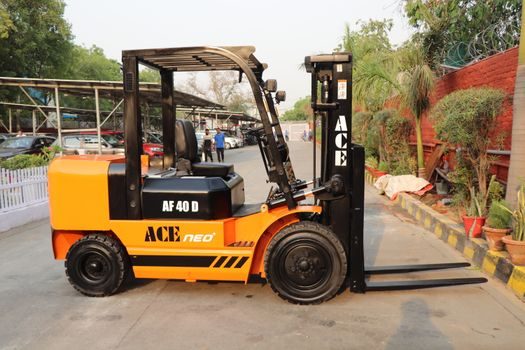
The matrix below lines up the four main forklift sub-types against the four spec criteria that drive sourcing in 2026: [S4]
1. Load class: Diesel 1.5–16 T (TCM 1.5–3.5 T, JAC 5–7 T, Komatsu 7–8 T, Vmax 1–16 T) [S1][S2][S3][S9]; Electric 1–3.5 T [S3]; LPG/Gasoline 1–3.5 T [S3]; Rough terrain 1–10 T typical [S4][S5].
2. Fuel / power: Diesel uses compression-ignition (JAC 83 kW, Komatsu 48.6 kW) [S2][S3]; Electric uses AC Curtis controllers and battery packs [S3]; LPG/Gasoline uses spark-ignition (Nissan, BAOFA, GM) [S3].
3. Refuel vs recharge: Diesel 60–80 L tank, minutes to refill [S3][S9]; Electric 1–2 hour charge cycle [S3]; LPG swappable cylinder.
4. Emissions / venue: Diesel EU Stage V or EPA Tier 4 (TCM Stage V with 18% fuel-saver mode) [S1]; Komatsu diesel oxidation catalyst cuts particulates 90% [S2]; Electric zero local emissions — required indoors; LPG mid-tier emissions, semi-outdoor use.
5. Price band (FOB China listings): 3-ton Euro 4 / EPA diesel forklift at US$1,500–5,000 per unit [S8]; Goodsense TCF 3.8-ton diesel forklift at US$8,629–9,299 per set [S7].
Where Diesel Is the Wrong Choice
Diesel forklifts fail in three common scenarios: enclosed warehouses with no exhaust ventilation, food-grade or cleanroom operations, and noise-sensitive retail back-of-house. The TCM FD/FGE 15-35 description still markets "low-noise" as a feature, but even a Stage V diesel cannot match a 60 dB(A) Class II electric truck for indoor shifts [S1]. Sites with strict air-permit rules inside the EU should default to electric or LPG to avoid Stage V retrofit cycles [S1].
Light-duty 1–2 T warehouse work is also a poor fit: a 1.5 T TCM diesel sits at the bottom of its capacity range while a 1.5 T electric unit delivers lower total cost of ownership over a two-shift duty cycle. Buyers under 3.5 T and inside a building should shortlist electric first and use diesel only when the duty cycle demands continuous 8-hour-plus outdoor refuel speed [S3].
Sourcing and Certification Trail for 2026
Chinese OEM listings in 2026 cluster around Hefei (JAC), Suzhou (Royal Forklift), Zhengzhou (Henan Jingcheng Xiandai), and Guangdong (Niuli), with the bulk of diesel models carrying CE marking, ISO 9001, ISO 14001, and SGS quality certifications [S3][S4][S5][S6]. Goodsense's 3.8-ton TCF diesel lists a US$8,629–9,299 FOB price with Chinese-engine configuration, and Vmax's CPCD35–CPCD120 line covers 1–16 T with 1170 mm triplex mast variants [S7][S9].
Export markets span 120+ countries for Niuli's combined diesel, electric, and stacker lines, and the Okorder JAC CPCD70H single-item run-rate hits 20,000 units per year [S3][S6]. Specifying engineers should request the engine emission tier (Stage V / EPA Tier 4 / Euro 4), load test certificate, and mast type in the RFQ — a 3,000–5,000 mm lift with triplex free-lift is the default 2026 build, but pnuematic vs cushion tire selection changes the ground-clearance and axle-load envelope materially [S1][S3][S9].
Final selection: target diesel when load class exceeds 3.5 T, the site is outdoor or semi-outdoor, and refuel turnaround beats battery swap economics; default to electric below 3.5 T indoors; reserve rough terrain forklift units for unpaved yards with slopes above 20%.
Track the EU Stage V diesel retrofit cycle and Chinese OEM announcements of higher-tonnage hydrostatic models in the next 6 months for any fleet planning above 7 T.
Spec-level background on the components involved: pressure transmitter.
For related coverage, see OEM vs ODM Server Hardware: 2026 Spec-Driven Sourcing Map.