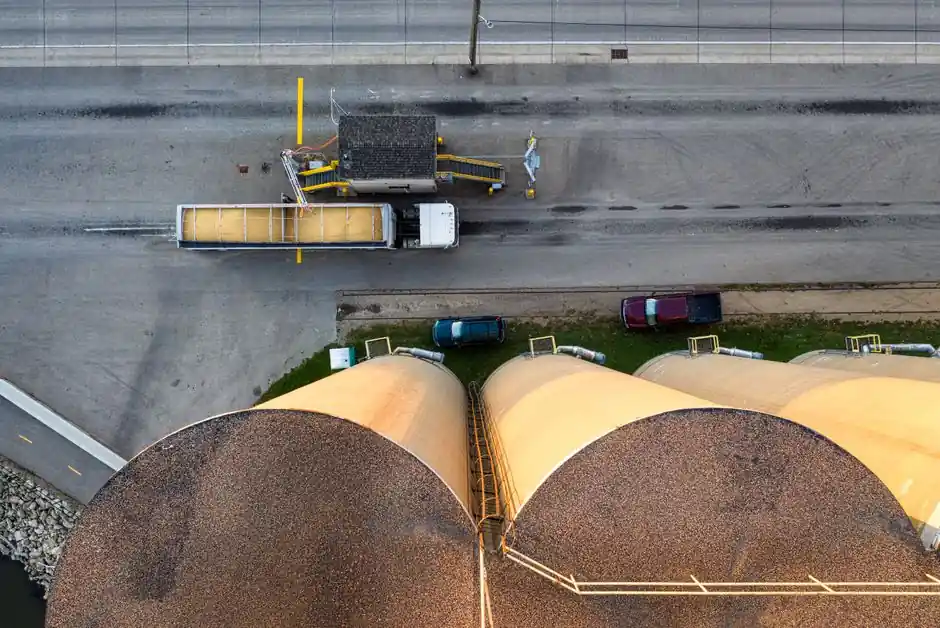
On a truck or rail weighbridge, the practical difference between analog and digital load cell hardware is no longer about accuracy alone, it is about signal integrity over long cable runs, the presence (or absence) of a moisture-trapping summing junction box, and how the weighing terminal performs corner-load diagnostics [S1][S2].
Analog cells put out a millivolt signal in the nanovolt-to-millivolt range that must travel through a junction box and be summed before reaching the indicator; digital cells convert that signal inside the cell housing and put out a 2-6 V digital bus, removing the junction box from the signal path entirely [S1][S4].
Signal Path and Hardware: Where the Two Architectures Actually Differ
Analog cells rely on an external summing junction box, while digital cells run a daisy-chained digital bus to the indicator, with the junction box replaced by inline connectors or a small termination card at each cell [S1][S3]. Analog cells rely on a Wheatstone bridge to convert force into a millivolt-level voltage, while digital cells add a microprocessor and A/D converter inside the housing so the output is already digitised when it leaves the cell [S3][S4]. The digital bus commonly runs on RS-485 at 2-6 V, which is dramatically more robust against radio-frequency interference, electromagnetic pickup, and temperature drift than a raw mV signal, so signal degradation over the 20-60 m cable runs typical of a pit-style weighbridge is far less of a problem on the digital side [S1][S4].
Weighbridge Accuracy, Repeatability, and Legal-for-Trade Class
Properly installed analog and digital load cells both reach 0.03-1% of full scale on a weighbridge, so the headline accuracy gap is narrower than marketing material suggests [S1]. The real-world advantage for digital cells shows up in repeatability and corner-load diagnostics: each digital cell is individually addressable, so the indicator can flag a single weak or failing cell rather than guessing from a summed mV drift [S2][S3]. The standard weighbridge accuracy classes used in trade (OIML R76, NTEP Handbook 44) are defined at the complete scale level, so a digital cell does not automatically buy a tighter class, but it makes it easier to keep the existing class after a partial failure because the bad cell is identifiable instead of being averaged into the sum [S1][S2]. For weighbridge spec sheets, treat the cell-level accuracy as a necessary but not sufficient condition; the indicator, foundation stiffness, and mechanical check-rod geometry usually set the floor on the overall system class.
Environmental Stress: Moisture, Lightning, and Temperature

The analog weighbridge's Achilles heel is the summing junction box, which is the single most common point of moisture ingress, rodent damage, and lightning-induced board failure on a truck scale [S1][S3]. Digital cells are typically hermetically sealed, factory-potted, and IP68/IP69K-rated, and because the signal is already digital at 2-6 V on the bus, a strike or surge that would destroy an analog junction board often just locks out one digital cell while the rest keep weighing [S1][S3]. Temperature behaviour is also cleaner: analog mV signals drift roughly with the cell's combined error budget (typically ±0.02% / 10 K on a quality compression cell), whereas digital cells apply temperature compensation in firmware before transmission, so the indicator sees a temperature-corrected value [S4][S7]. For a weighbridge sitting outdoors in a freeze-thaw or tropical humidity cycle, the digital topology removes the single highest-MTBR component in the analog chain.
Cost, Lifetime, and Service Model
Lifetime economics flip the equation: industry sources state digital cells are proven to last roughly twice as long as analog cells in field service, with less frequent breakdown, fewer lightning damage events, and no junction-box maintenance [S3]. Service labour is the hidden cost: a corner-load miscalibration on an analog weighbridge can take 1-2 hours of trimming potentiometers in a wet junction box, while the same fault on a digital scale is identified in under 5 minutes by reading each cell's weight from the indicator menu [S2][S3]. For a weighbridge running two shifts a day at a quarry, port, or waste site, the avoided downtime pays for the digital premium in 1-3 years depending on traffic volume and exposure.
Decision Matrix: When to Specify Each Type

Choose digital cells when the weighbridge has a deck span above 18 m, sits in an exposed location with elevated lightning risk, is legal-for-trade, or is located where a service call costs more than the cell premium (remote sites, ports, mining). Choose analog cells when the deck span is under 12 m, the scale is indoors or under a canopy, traffic is light, and the budget is constrained at install with no in-house service team needing fast diagnostics [S3][S4][S5]. For a retrofit, swapping an analog junction box for digital cells is technically possible only if the indicator is replaced at the same time, because digital cells require a digital indicator and the two are not electrically compatible on the same bus [S4]. The mechanical load cell module footprint (rocker-pin, compression canister, double-ended shear beam) is independent of the analog/digital choice, so the foundation and mounting hardware usually carry over.
Integration with Indicators, PLCs, and Plant Networks
Digital cells typically expose weight, temperature, and diagnostic counters per cell over RS-485, and most modern digital weighbridge indicators then publish this to the plant via PROFINET, EtherNet/IP, or Modbus TCP for ERP ticketing [S2][S7]. Analog cells feed a single summed mV signal into the indicator, which is fine for a standalone weighbridge but means a PLC only sees one number, not eight cell-level numbers, so cell-health data has to be inferred from sum drift over time. Because the digital indicator is essentially a small digital panel meter front-end with network I/O, a single cell failure no longer brings down the whole scale; the indicator marks the bad cell and continues weighing on the remaining cells in many cases, which is a real availability win for a weighbridge at a busy gatehouse. For a new weighbridge, plan the indicator, network, and ERP interface together; retrofitting a digital protocol onto a plant that only has analog 4-20 mA I/O on the electronic load or scale I/O card is wasted spend.
For weighbridges handling more than 200 trucks a day, exposed coastal or high-lightning sites, or any legal-for-trade application under OIML R76 / NTEP HB44, the digital cell has become the default spec; analog cells remain the pragmatic choice for low-traffic, indoor, or budget-driven installations where a junction box can be kept dry and a service call is cheap.
See also our earlier report, Tie Bar Spacing vs Mold Base Width: Sizing Rules for Injection Molding Machines.