
The 2026 displacement-sensor market lists roughly 88 manufacturers and 384 catalog products on DirectIndustry alone, spanning measurement ranges from 1 mm to 5000 mm and linearity bands between 0.01 % and 0.4 % FS [S2].
Buyers should treat the device as a category name covering LVDT, optical, laser, draw-wire, and linear displacement potentiometric transducers, each with a different measuring range and compatibility profile. For a complete taxonomy and sensing-principle primer, the displacement sensor encyclopedia entry gives the canonical overview before diving into the selection logic below.
Four sensing families and where each one wins
Linear Variable Differential Transformer (LVDT) sensors dominate hydraulic-cylinder and press duty because the plunger-and-coil design is non-contacting inside the bore and tolerates up to 350 bar operating pressure, as shown by WayCon's LVPH series at 25–500 mm stroke [S1].
Eddy-current / inductive proximity sensors give sub-micron repeatability in harsh metal-target environments; Micro-Epsilon's induSENSOR DTA gauge hits 0.15 µm repeatability with ±1/3/5/10 µm linearity grades in a 1–10 mm range, while the larger DTA sensors extend to 25 mm at 0.05 %–0.4 % linearity and 5 kHz bandwidth [S1].
Laser triangulation and confocal chromatic probes fit non-contact long-stroke or hot-surface applications; SmarAct's C03 optical sensor head measures from 13 mm out to 5000 mm with a collimated beam, which suits large-structure displacement and tilt tracking [S2]. Capacitive probes, covered in the capacitive sensor encyclopedia page, remain the low-cost pick for sub-millimetre gauging against grounded metal targets.
Draw-wire potentiometric sensors are the workhorse for strokes beyond 1 m where the target cannot be coupled to a rigid plunger; the KS20/Ks30 series from Jinan Kaisi covers 1000 mm at US$100–135/piece MOQ 5, and the Lineski LS2-100 mm potentiometric sensor sits at US$18.50–21.00/piece MOQ 1 on Made-in-China [S4][S6].
Hydraulic duty: pressure rating, IP, stroke length, and life
Hydraulic-cylinder displacement sensors must be specified against three numbers — peak operating pressure, ingress protection, and mechanical life — because the bore environment couples oil, heat, and continuous stroking into a single failure mode [S1].
WayCon's LVPH LVDT handles up to 350 bar with stroke options at 25, 50, 100, 150, 200, and 500 mm and is developed explicitly for in-cylinder mounting [S1]. MEGATRON's HEM12 series runs to 250 bar and IP67 over 50–1000 mm strokes, while the HEM12E variant is rated for up to 100 million movements in continuous-duty actuator feedback [S1].
For low-pressure hydraulic loops the REM13 magnetostrictive-style external-cursor sensor covers 50–1000 mm strokes at 20 bar maximum, with an operating temperature window of −30 °C to +100 °C [S1]. Capetti's PZ67A-50 adds the speed dimension: 50 mm stroke, 5 Hz–2000 Hz response, displacement speed up to 3 m/s standard or 5 m/s maximum, and life of more than 25×10⁶ m strokes or 100×10⁶ operations [S2].
Non-contact optical: range, target, and beam geometry
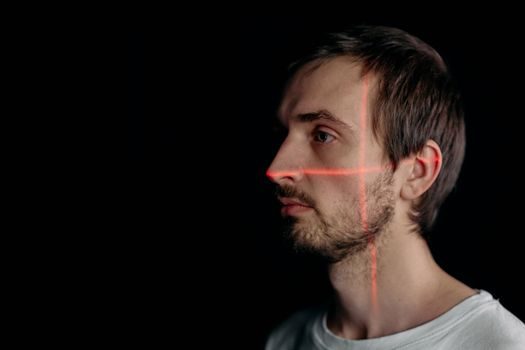
Laser triangulation and confocal sensors should be selected on working distance, target reflectivity, and beam spot size rather than headline range, because the optical path is the actual measurement chain [S2].
SmarAct's C03 sensor head is engineered for long working distances using retro-reflector targets, while the C04 is the compact general-purpose head, and the F04 trades angular tolerance for multi-centimetre short-movement tracking on the PICOSCALE interferometer platform [S2]. Confocal chromatic heads, detailed in the confocal displacement sensor encyclopedia entry, are increasingly specified for transparent and multi-layer targets because the chromatic focus rejects surface colour variation.
Triangulation sensors covered in the laser displacement sensor encyclopedia page deliver the best sub-micron resolution on diffuse reflective metal targets at standoff distances from a few millimetres to roughly 1 m. Avoid long-range retro-reflector setups on vibrating machinery unless the target is rigidly mounted.
Strain, deflection, and crack-monitoring: the specialist category
Potentiometric displacement transducers are still the default in civil and geotechnical monitoring because they survive outdoor IP67 mounting and need no excitation electronics beyond a stable reference voltage [S2].
Capetti's PT50IP delivers a 50 mm stroke at IP67 for outdoor test stands, while the PZ67A-50 reaches 5 Hz–2000 Hz with >100×10⁶ operations life for industrial dynamometer rigs [S2]. The NOVA TR50/FS50 is a dedicated crack-meter with 50 mm range and 0.1 % linearity at a 40 V supply, straddling joints and lesions in concrete and rock-mass monitoring.
For landslide and rock-mass wire sensors, the NOVA TRF100 uses a rotary potentiometer plus tensioner inside a weatherproof housing; this is the same architecture reused across most civil-monitoring deployments [S2].
Selection criteria: matching spec to duty
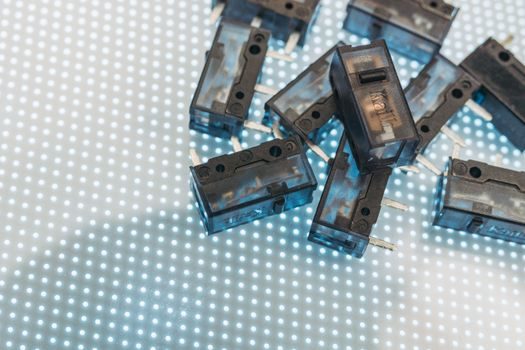
A shortlist decision should run on four numbers: measurement range, linearity, bandwidth/measuring rate, and environmental rating (pressure, temperature, IP), with mounting and target as veto conditions [S1][S2].
Capetti's PZ67A-50 datasheet spells out the envelope: ambient temperature −30 °C to +100 °C, displacement speed ≤ 3 m/s standard or 5 m/s maximum, ≤ 20 N operating force, and 5–2000 Hz vibration with 0.75 g acceleration — the kind of numeric envelope a hydraulic-cylinder integrator actually needs [S2].
For high-precision short-stroke gauging, Micro-Epsilon's induSENSOR LDR hits 0.01 % linearity, 9–21 kHz measuring rate, and 25/50/100 mm variants for space-constrained OEM fixtures [S1]. The trade-off across this family is direct: LVDT and eddy-current sensors cost more per millimetre of stroke than draw-wire potentiometers, but they win on life, accuracy, and dynamic response where the application demands it.
Sourcing reality in 2026: catalogue density and price bands
Made-in-China lists the LS2-100 mm potentiometric linear sensor at US$18.50–21.00/piece MOQ 1, the KS20-1000-01-L draw-wire sensor at US$100/piece MOQ 5, and the Ks30-1000-V10 absolute-position sensor at US$135/piece MOQ 5 with 0–10 V analog output and 1.0 G accuracy class [S4][S6].
These price points are roughly 1/5 to 1/3 of equivalent European LVDT sensors, and they explain why hydraulic-cylinder integrators in South-East Asia and Eastern Europe continue to source draw-wire and potentiometric units from China for non-safety loops [S4][S6]. The Bend Labs flex/angular-displacement Arduino library, released as the FSpaceLab/SparkFunFlexes repository, shows the same low-cost Chinese and US-sourced angle-sensor parts reaching hobbyist and instrumentation OEMs alike [S5].
Buyers running safety-related feedback on presses, elevators, or aerospace test rigs should still insist on European or Japanese LVDT suppliers — WayCon, MEGATRON, Micro-Epsilon — because the documentation, traceability, and 100-million-movement life rating come with the BOM line, not the catalogue description [S1]. For broader plant-instrument sourcing, the pressure reducing valve suppliers 2026 sourcing map follows the same make-vs-buy logic and is worth reading next.