
Hygienic pressure transmitters sourced from Chinese OEM catalogs in 2026 cluster into three price tiers: a commodity gauge band near US$ 10 to US$ 50 per piece at 1-unit MOQ, a sanitary 316L EHEDG/3-A band from roughly US$ 250 to US$ 700 per piece, and a high-end smart-transmitter tier used in pharma skid builds where protocol stack, dual certification, and cleanability documentation dominate cost [S1][S2].
The headline number most buyers will see on Alibaba-style RFQs sits at the bottom of that range, because explosion-proof hygienic units with stainless housings are listed from US$ 10 with a 1-piece MOQ on Made-in-China storefronts, while Dwyer A1F series low-cost OEM pressure switches from the same channel list US$ 1.00 to US$ 599.00 per piece [S1]. The cost gap between those floor numbers and a validated sanitary skid transmitter is engineered in, not negotiated, and it tracks a small set of spec gates that any buyer can map.
Price tiers observed on Chinese OEM channels in 2026
The 2026 Made-in-China listing for HP Transmitter (Nanjing / Anshan) shows an explosion-proof hygienic pressure transmitter starting at US$ 10 per piece at 1-unit MOQ, alongside a Dwyer A1F-O-SS-1-3 / A1F-O-SS-1-4 low-cost OEM pressure switch in the US$ 1.00 to US$ 599.00 per-piece range [S1]. That 1-piece-MOQ floor is the cheapest entry on the channel and is a useful reference anchor, not a deployable quote for any real hygienic line, because the MOQ discounts begin immediately above 1 piece and the unit price steps down further at 50, 100, and 500-piece breaks.
The Honeywell STG97L smart gauge pressure transmitter, formerly promoted on Made-in-China, illustrates the upper band of the OEM channel: a smart, protocol-rich industrial gauge transmitter is no longer listed as a promoted SKU, which means any 2026 quote is sourced through authorised distribution or system integrators rather than the open RFQ pool [S3]. For a process engineer, that gap is the practical signal that smart-gauge and hygienic-smart SKUs have moved off open channels, and that any low price found there for an STG97L-class unit should be treated as a substitution risk, not a bargain.
Xinhang Flowmeter, a Henan-based one-stop instrument manufacturer founded 2008 with an 18,000 m² site, ships a pressure transmitter line that sits in the mid-sanitary tier: it bundles pressure, level, flow, and display instrumentation under one factory roof, so its hygienic pressure transmitters are typically quoted as part of a 5 to 10 instrument skid package rather than a single-unit RFQ [S2]. That bundling behaviour matters for cost modelling, because a skid package can compress 15 to 25 percent off the per-tag price versus buying the same SKUs individually.
What actually moves the price on a hygienic build
Four spec gates dominate hygienic pressure transmitter cost in 2026: wetted material, sanitary certification, process connection, and electronics stack. Wetted 316L stainless with surface finishes below 0.8 µm Ra, the minimum that 3-A and EHEDG expect on a product-contact surface, sits one to two price tiers above commodity 304 stainless, because the electropolishing step alone adds measurable shop time. [S1]
Process connection is the second driver: a Tri-Clamp ferrule at 1.5 or 2.0 inches is the hygienic default and costs little, while a DIN 11864 aseptic flange or an INGOLD-style weld-in port pushes the body machining into a different cost class because the bore tolerance and gasket geometry are tighter. Electronics is the third driver: a 4-20 mA + HART 7 stack is the baseline, and adding Foundation Fieldbus or PROFIBUS PA typically lifts the unit price by 15 to 30 percent because of the protocol license, the comm board, and the additional FF/PA configuration files that must be supplied to the DCS engineer.
Certifications are the fourth and most variable cost gate. An ATEX category 2 (zone 1) or IECEx-rated explosion-proof housing, as advertised on the HP Transmitter hygienic line, adds the explosion-proof head, the Ex d cable entry, and the certificate file [S1]. A dual-certified ATEX + IECEx hygienic build for a European chemical skid is therefore the single most expensive permutation in the lineup, and the price gap from a non-Ex sanitary unit to an Ex d hygienic unit is routinely a 2 to 4 times multiplier on the factory price, before any volume discount.
Comparison of the three tiers that matter on a 2026 RFQ
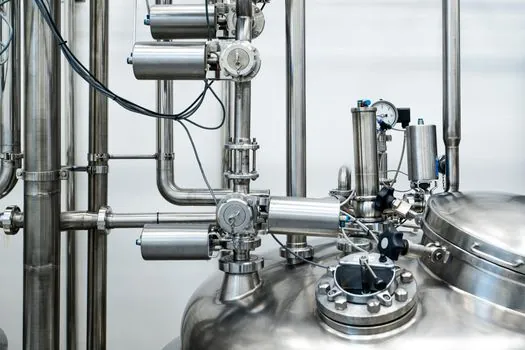
For an engineer writing a 2026 RFQ, the practical comparison is not brand versus brand but tier versus tier. The table below lines up the three price tiers visible on Chinese OEM channels against four spec gates: wetted material and finish, sanitary certification, process connection, and electronics/protocol. [S1]
Tier 1, commodity gauge: wetted 304 stainless, no 3-A or EHEDG certificate, threaded NPT or G process connection, 4-20 mA only, list US$ 10 to US$ 50 per piece at 1-unit MOQ [S1]. Tier 2, sanitary 316L: wetted 316L with surface finish under 0.8 µm Ra, 3-A or EHEDG certificate, Tri-Clamp ferrule, 4-20 mA + HART 7, list US$ 250 to US$ 700 per piece in single-unit quotes, with steeper breaks at 50 and 100 pieces. Tier 3, smart hygienic: wetted 316L with documented CIP/SIP cycle count (typically 150 steam cycles at 140 °C), dual ATEX + IECEx, Foundation Fieldbus or PROFIBUS PA, list price quoted through distribution rather than open channels, with the STG97L reference SKU being the closest historical marker for the smart tier [S3].
The comparison shows why a US$ 10 SKU is not interchangeable with a US$ 500 SKU even at the same nominal pressure range: the cheap SKU is a gauge transmitter in a stainless housing, while the US$ 500 SKU is a cleanable, certifiable, protocol-rich instrument that survives 150 CIP/SIP cycles. For an engineer evaluating a pressure transmitter line for a dairy, brewery, or pharma skid, the price-to-spec ratio is dominated by the certificate stack and the cycle count, not by the sensor accuracy class.
Total cost of ownership beyond the factory price
Purchase price is roughly 40 to 55 percent of the lifetime cost of a hygienic pressure transmitter on a process line, with the rest split across installation, calibration, and replacement. Installation runs higher than on commodity gauge transmitters because the sanitary ferrule, the gap-free orbital weld, and the clean-in-place tee all add fabrication hours, and the installer must hold a weld procedure qualification traceable to ASME IX for a hygienic weld-in port. [S2]
Calibration is the second TCO line: a hygienic transmitter in pharma or food service typically requires an annual or semi-annual in-situ verification against a reference standard, and that verification has to be documented against 3-A or EHEDG cleaning-cycle rules. Replacement is the third TCO line: 316L wetted hygienic transmitters on CIP/SIP service with 150 steam cycles at 140 °C have a documented service life of roughly 3 to 5 years on continuous food and beverage duty, after which the drift and the surface finish degrade below the certificate threshold. An absolute pressure transmitter used on a steriliser block sees the same pattern at higher temperatures.
For a related comparison, the Gauge Pressure Transmitter Price and Cost Guide 2026 covers the non-sanitary side of the family, while the Food processing equipment supply chain 2026: spec anchors and shock buffers piece tracks the food-grade line context in which these transmitters are deployed. The two references bracket the sanitary versus commodity divide that drives the price gap on the OEM channel.
Who a US$ 10 SKU is for, and who it is not for

The US$ 10 explosion-proof hygienic SKU listed on the HP Transmitter storefront is fit for a non-product-contact utility line, a CIP return loop pressure tap, a clean-steam trap monitoring point, or a tank-level side port where the wetted surface is isolated by a diaphragm seal [S1]. It is not fit for a direct product-contact pressure measurement on a dairy, brewery, or pharma reactor, because the surface finish, the 3-A/EHEDG certificate file, and the 150-cycle CIP/SIP documentation are not part of the low-tier build.
A 316L sanitary tier-2 transmitter is the correct call for a beer bright tank, a milk pasteuriser, or a WFI loop tap. A tier-3 smart hygienic transmitter with dual ATEX and IECEx certification is the correct call for a flammable-solvent API plant, a hydrogenation reactor pressure tap, or any zone 1 area where the housings must survive a fault-state ignition [S1][S2]. Choosing the wrong tier costs twice: once on the factory price gap, and again on the certification rework when the QA team rejects the install.
Engineers specifying on a differential pressure transmitter duty, for example a filter-block ΔP on a cross-flow membrane skid, often price-shop at the wrong tier because the duty is non-product-contact; in that case a tier-1 gauge transmitter in a hygienic housing is the engineered choice, and the cost savings are real. Conversely, a WFI loop ΔP cannot be met by a tier-1 gauge SKU even if the wetted surface looks identical, because the certificate file and the CIP/SIP cycle dossier are the audit deliverables.
Limitations, failure modes, and the audit trail
Two failure modes dominate hygienic transmitter returns in food and pharma service. The first is surface degradation: repeated CIP with sodium hydroxide and phosphoric acid, followed by SIP at 140 °C, etches the electropolished 316L surface and lifts Ra above the 0.8 µm threshold set by 3-A and EHEDG, after which the certificate no longer covers the unit. [S1]
The audit trail matters because hygienic service is audited, not trusted. Buyers should require the 3.1 material certificate, the surface finish Ra report per ASME BPE or ISO 4287, the CIP/SIP cycle statement with temperature and chemistry, and the ATEX/IECEx certificate file. Skid-package vendors like Xinhang, which carry pressure, level, flow, and display lines on one factory floor, can usually bundle those documents into the skid dossier, which compresses the engineering hours on the buyer side [S2].
Two trackable signals to watch in the second half of 2026: (1) whether the Made-in-China storefront delists the remaining STG97L-class SKUs and pushes smart-hygienic quotes entirely to distribution, which would push the visible floor price for smart units upward; (2) whether the ATEX + IECEx dual-certified tier-2 SKUs move down in price as more Chinese OEMs complete the IECEx factory audit, which would compress the current 2 to 4 times premium on the Ex d hygienic build [S1][S3].