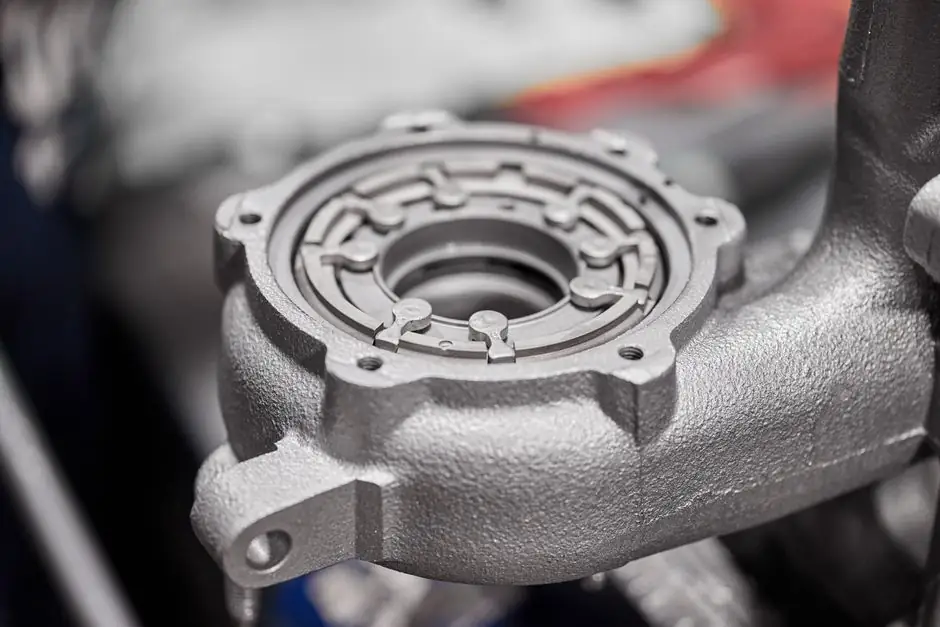
A diamond-like carbon (DLC) film on rings or rolling elements lets a ball bearing operate unlubricated in vacuum, with quoted dry friction coefficients of 0.008-0.1 and coating hardness of 1000-4000+ HV versus 650-850 HV for through-hardened bearing steel [S2][S4].
The combination addresses two failure modes that take conventional greased bearings out of service in space, semiconductor, and cryopump duty: lubricant outgassing that contaminates optical or process chambers, and adhesive wear on the raceway when no fluid film is present. DLC is amorphous carbon with mixed sp³ and sp² bonding, so it gives diamond-class hardness while the graphitic sp² fraction supplies solid lubrication without needing water vapour or adsorbed gas, unlike graphite [S6].
Vacuum-Specific Failure Modes DLC Is Specified Against
Liquid and grease lubricants outgas under high and ultrahigh vacuum, depositing hydrocarbon films on optical windows, EUV mirrors, wafer surfaces, and cryogenic radiation surfaces; a DLC-coated ball bearing replaces that film with a hard carbon solid lubricant and survives dry sliding [S2][S6]. Without fluid separation, uncoated steel-on-steel contacts scuff, smearing transfers material from one raceway to the other and accelerating spalling failure [S4]. DLC mitigates smearing because the coating's running-in layer transforms a small surface fraction into a low-shear contact zone that protects the steel counterface, even at contact pressures where PTFE would be extruded [S4].
Coating Variants: a-C:H, ta-C, Doped, and WC-C
IBC's published envelope groups DLC into four families: hydrogenated a-C:H for friction reduction with good substrate adhesion, hydrogen-free ta-C for maximum hardness and wear resistance, doped a-C:H:X for tailored properties such as superlubricity or electrical insulation, and tungsten carbide/carbon (WC-C) for chemically aggressive environments [S2]. NHBB's reference on miniature instrument bearings lists DLC alongside tungsten carbon carbide as a coating of choice for "extremely harmful operating conditions" where grease cannot survive [S7]. For vacuum duty specifically, hydrogen-free ta-C is generally selected over hydrogenated a-C:H to minimise hydrogen outgassing, although the literature also documents a-C:H deposited by plasma-assisted CVD on 100Cr6 bearing components for less demanding dry-service conditions [S3].
Process Routes and Film Thickness
DLC is applied by PVD, PACVD (plasma-assisted chemical vapour deposition), or filtered cathodic vacuum arc, in films typically only a few micrometres thick; Bekaert's Cavidur product specifies DLC thicknesses of 2-4 μm for valve-train components [S1][S4]. SKF's own DLC process is applied in "extremely thin layers of only a few microns" to any standard bearing, and the coating can be put on rings, rolling elements, or both depending on the friction and wear target [S4]. On ion-bond's commercial DLC service the value proposition is the same: very high hardness and anti-stick in a thin, low-addendum film suitable for precision substrates [S9].
Hardness, Friction, and Wear Numbers Behind the Choice
SKF documents DLC surface hardness around 1200 HV against 650-850 HV for bearing steel, and reports that the lowest friction coefficients occur when both ring and rolling elements are coated, although dry sliding wear life is greatly extended even with only one surface DLC-coated [S4]. IBC's ASTM G99 test data show dry friction dropping from μ 0.6-0.8 (uncoated) to μ 0.008-0.1 (DLC-coated) and lubricated friction from μ 0.08-0.12 down to μ 0.02-0.05, a 65-80% reduction across operating regimes [S2]. Piotrowska et al. (2025) compared 100Cr6 with a-C:H DLC in both laboratory pin-on-disc and real-life conveyor bearings under Renolit UNI 3 grease and dry friction, finding DLC on the bearing race lowers wear under abrasive dust exposure typical of aggregate handling [S3].
Cage, Substrate, and Adhesion Constraints
The historical blocker on DLC for load-bearing service is high internal stress, which limits how thick an adherent film can be grown and is the dominant reason the breakthrough for load-bearing DLC has been slow [S1]. NKE Austria offers steel bearing cages with DLC coating to extend cage life in harsh service, but the same film-thickness and adhesion constraints apply to non-rolling-element components [S8]. Adhesion is governed by substrate selection and interlayer chemistry rather than by the carbon source; filtered pulsed arc discharge on a properly prepared substrate is the method most often cited for growing thick, adherent DLC for articulating contact [S1].
Selection Criteria: Where DLC Wins, Where It Loses
Pick a DLC-coated bearing when the duty is dry or vacuum, the temperature range is wide, contamination of the surrounding chamber cannot be tolerated, and the bearing is loaded such that a 2-4 μm film is not overloaded on the first Hertzian contact [S1][S2][S4]. Skip DLC coatings for high-load applications, as the biomedical DLC literature notes that no indisputably successful commercial high-load applications exist today due to high internal stress leading to insufficient adhesion of thick coatings [S1].
Decision Comparison: a-C:H vs ta-C vs WC-C vs PTFE/MoS₂
On four criteria the options line up as follows. (1) Vacuum outgassing: ta-C (hydrogen-free) lowest, a-C:H higher due to bound hydrogen, WC-C moderate, PTFE and MoS₂ can outgas or lose shear strength under pressure [S2][S6]. (2) Dry friction coefficient: DLC family μ 0.008-0.1, PTFE and MoS₂ comparable in inert gas but PTFE extrudes and MoS₂ oxidises in humid air [S2][S4]. (3) Surface hardness: ta-C at the high end of 1000-4000+ HV, WC-C comparable, a-C:H lower within the DLC band, PTFE/MoS₂ orders of magnitude softer [S2]. (4) Load-bearing durability: DLC does not wear away at high pressure, whereas PTFE does; a-C:H on 100Cr6 has been field-validated in aggregate conveyor bearings under grease [S3][S4].
Standards, Testing, and Specification Anchors
Coating performance is anchored to ASTM G99 pin-on-disc test method for the published μ values, with vacuum-specific qualification typically performed by the bearing OEM against customer outgassing and torque telemetry rather than a single ISO or DIN number [S2]. For space mechanism service, NASA and ESA material selection lists historically reference DLC and WC-C as candidate solid lubricants, and a DLC-coated ball bearing is treated as a solid-lubricated assembly for screening purposes. Specification should call out: coating family (a-C:H or ta-C), thickness in μm, surface hardness in HV, dry friction coefficient envelope, hydrogen content for vacuum grades, and whether rings, balls, or both are coated. For additional context on choosing a ball bearing configuration where load capacity and cage design trade off, see the spec map on Conrad versus full-complement types.
Track next: (1) Updated OEM datasheets on ta-C thickness limits on M50 and Cronidur 30 substrates, since these steels dominate high-speed vacuum spindles; (2) field reports from semiconductor-tool builders on hydrogen outgassing rates of a-C:H vs ta-C at chamber base pressures below 10⁻⁹ mbar; (3) any new ISO/DIN standard activity on solid-lubricated rolling bearings, since current vacuum-duty qualification remains OEM-led rather than standards-led.
Spec-level background on the components involved: carbon fiber, and carbon steel.
Background reading: Conductive Carbon-Black POM: Specs, Grades, ESD Use Cases.