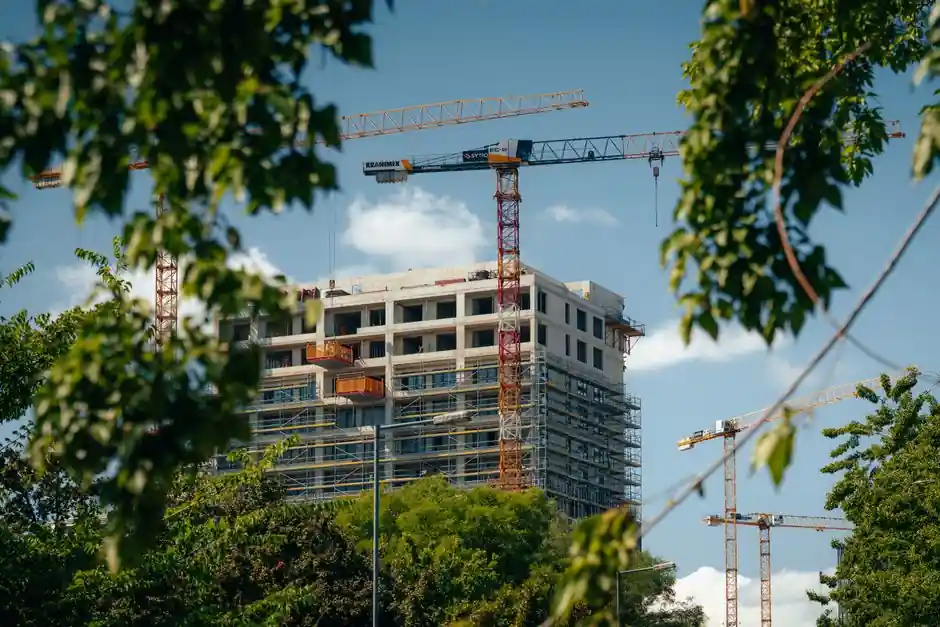
Self-climbing formwork can eliminate crane lifts for formwork repositioning, but it does not remove crane demand for materials, equipment, or site logistics.
The comparison with scaffolding depends on whether the crane is moving facade access, supporting formwork cycles, or handling material, and whether the climbing system is self-propelled or crane-dependent.
What Changes the Crane Hook-Time Equation
Self-climbing formwork uses the building structure and its own lifting equipment to move a work platform or formwork assembly vertically. Hydraulic or electric mechanisms can raise the complete system or defined sections without a crane repositioning the unit [S2][S3]. This removes one class of crane lift from the work sequence, not every crane movement on the project.
The practical comparison is between manual erection and dismantling of scaffolding and automated climbing cycles. Climbing scaffolding reduces time spent on manual erection and dismantling, lowering labor costs compared with traditional scaffolding [S2]. For concrete formwork, the associated climbing platform can support the formwork operation and reduce dependence on separate crane moves [S3][S4].
Access equipment remains a different selection problem. A suspended platform is facade-access equipment that may require crane-assisted installation and material handling, while climbing formwork is designed to climb through a vertical construction cycle. Comparing both under one crane-demand label can hide different installation, access, and material-handling duties.
Self-Climbing Versus Crane-Dependent Systems
Self-climbing systems normally shift the crane requirement from repeated positioning toward initial delivery and occasional supporting lifts. The construction technology report on automatic climbing formwork identifies crane independence as a benefit and describes hydro-mechanical lifting without a crane for the climbing operation [S4].
Cantilever climbing formwork can reduce crane movements between pouring cycles, while hydraulic climbing can further reduce dependence on crane moves [S6]. That distinction matters: a self-climbing unit may reduce or remove a specific formwork lift, while a cantilever or crane-dependent system can only reduce the number of movements without changing the basic lifting method.
Where the Savings Appear on the Construction Cycle
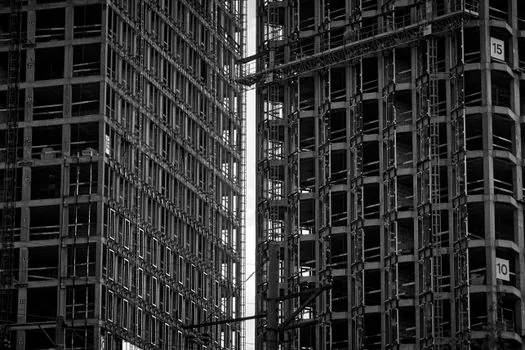
The main saving is cycle coordination, not a guaranteed numerical reduction in total site crane hours. A typical automatic climbing cycle starts with the first casting section, includes a second casting section, the first hydraulic climb, a third casting section, and then repeats through the operating phase [S4]. Once the sequence is established, the climb can occur without waiting for a crane allocation.
That removes a crane slot from the critical path when the following conditions are met: the platform is anchored to the concrete, the hydraulic circuit is operational, the attachment system is ready, and the crew can complete the prescribed operating procedure. The report identifies continuous anchoring, hydro-mechanical lifting, protected walkways, and working space between the wall and formwork as safety and operating features of the automatic climbing arrangement [S4].
Labor savings are also clearer than total crane savings. Traditional scaffolding consumes labor for erection and dismantling, whereas climbing scaffolding replaces part of that manual work with automated lifting and modular components [S2]. The economic case therefore depends on the number of cycles, the labor hours displaced, the planned reuse of the system, and the price of crane standby or priority access.
Further cycle planning data is covered in Climbing Formwork Crew Size and Lift Cycle Timing. Track actual lifting minutes separately from crane waiting time, because a short hook engagement can still consume a crane slot through mobilization, rigging, release, and queueing.
Projects That Benefit and Those That Do Not
Self-climbing formwork is strongest where the building repeats vertically and the same platform can move through many cycles. High-rise residential buildings, commercial complexes, and office towers are identified as suitable applications for attached lifting scaffolds [S2]. Bridges and chimneys can also use self-climbing scaffold systems when their geometry and attachment requirements support the method [S2].
Automatic climbing formwork had not been widely used in Singapore because of its high initial cost, local height restrictions, and the complications of less complicated projects. The construction technology report lists high initial cost, a local height restriction, and less complicated construction projects as reasons automatic climbing formwork had not been widely used in Singapore [S4]. Those are context-specific constraints, but they identify the commercial test: cycle count must justify specialization.
The decision should compare a repeatable vertical cycle against a one-off or irregular scaffold, rather than treating climbing as a universal replacement.
Safety, Attachments, and Operating Constraints
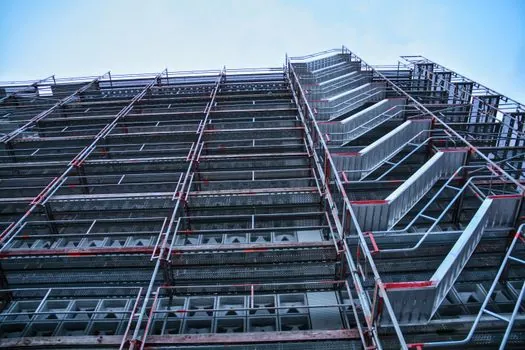
Powered climbing removes the crane from the climb but does not remove the need for a documented lifting procedure. A self-climbing scaffold includes attachment supports, an integrated frame, anti-tilt devices, fall-protection devices, a lifting mechanism, and control devices [S2]. Its lifting points must move synchronously to preserve frame level and stability [S2].
Before every operation, the responsible team must inspect the safety devices, follow the lifting and lowering procedures, and confirm that attachment and control functions remain serviceable [S2]. The platform cannot be treated as crane-independent if it lacks a safe attachment path, qualified operators, functional controls, or a planned rescue and access arrangement.
Hydraulic systems also add failure modes that a conventional crane-hook comparison may overlook: hose condition, hydraulic power availability, synchronized control, mechanical attachment condition, and the ability to lower the unit safely. A crane-related lift plan may be simpler for a non-climbing unit, but it can offer broader flexibility for irregular components. The correct procurement basis is whole-cycle risk, not only hook minutes.
How to Validate the Crane-Saving Claim
A site-specific comparison should record at least 4 measurable outputs: crane lifts eliminated per cycle, crane minutes avoided per climb, labor hours spent on erection and dismantling, and the number of planned climbing cycles. The same worksheet should capture hydraulic climb duration, attachment preparation, operator requirements, and any crane lift retained for initial delivery or material handling [S4].
For a direct test, compare 1 climbing cycle with 1 conventional access-materialization cycle over the same elevation. Record the crane queue time from request to hook release, the labor hours required to prepare the next pour, and the number of crane movements between casting cycles. Repeat the measurement over multiple cycles because startup procedures, first climbs, and normal operation have different resource profiles [S4].
Procurement should then apply 3 tests: the avoided crane cost must exceed the incremental system cost over the planned reuse, the labor released must be redeployed or removed, and the attachment and safety plan must suit the structure. The climbing formwork approach reduces crane dependence most clearly when a high number of repetitive climbs outweighs the capital and coordination burden.
The next verifiable signal is the site lift log: fewer formwork repositioning requests, stable hydraulic cycle times, and no increase in material-handling or emergency lifts would confirm that the reduction is operational rather than merely nominal.