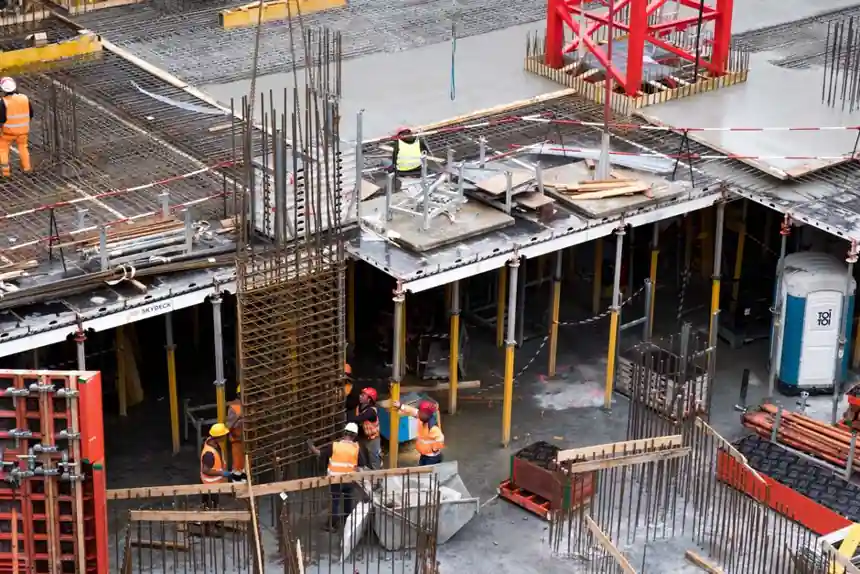
Self-climbing formwork can reduce labor and crane costs versus crane-dependent jump formwork, but the saving is conditional on cycle productivity, crew capability, and site logistics [S1][S4][S5].
The comparison covers repeated vertical concrete lifts using hydraulic self-climbing, crane-assisted guided climbing, jumpform, and slipform systems [S1][S2][S4].
What the systems actually change
Climbing formwork rises with the structure and normally combines wall panels, climbing brackets, a working platform, suspension points, and guide equipment. In a self-climbing arrangement, hydraulic rams lift the platform, main formwork, and secondary formwork without a crane [S1].
Jump formwork uses the same broad principle of moving vertically supported formwork upward, but it advances in discrete steps after the previous concrete section reaches the required strength.
These systems are not interchangeable labels. Crane-lifted climbing formwork depends on lifting equipment, while self-climbing systems use hydraulic or jack-based movement. Guided systems remain connected to rails or structure during raising, and normal jump form is detached and reattached by crane [S1][S3][S4].
The working method also determines the labor profile. Jump form requires crews to place concrete, monitor compaction, install reinforcement, finish surfaces, shift the system, and reset it for the next lift. A representative jump-form configuration includes platforms for finishing, concreting, and material storage [S4].
Why self-climbing formwork can lower labor cost
The clearest saving comes from removing repeated crane lifts. Self-climbing formwork requires no lifting equipment to move to the next pour cycle, which reduces crane coordination, rigging demand, and labor tied to lift planning [S1].
Crane-dependent jump form can still be productive, but its labor case is weaker when the crane is unavailable, delayed, or needed for other structural work. Crane time can be redirected to other construction tasks, potentially reducing the demand for dedicated lifting resources [S4][S5].
Reuse also changes the workload. Climbing formwork avoids dismantling and rebuilding conventional forms at each level, while its repeatable panels and brackets can move upward as a coordinated assembly [S1][S3]. That does not make labor zero: the concrete, reinforcement, placing, compaction, finishing, inspection, and platform work still require trained personnel.
The economic result therefore depends on labor hours per lift and the number of lifts.
Labor and cost drivers compared
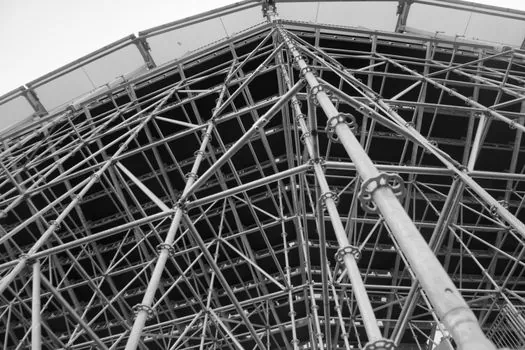
Self-climbing systems usually offer lower crane dependency, fewer lifting operations, and better continuity between cycles, but they carry hydraulic equipment, rail or anchor, platform, commissioning, and maintenance requirements [S1][S3].
Crane-dependent jump form has lower dependence on hydraulic climbing equipment and may fit projects without a continuous self-climbing installation. Its disadvantage is greater exposure to crane availability, rigging, lift sequencing, and resetting work [S3][S4][S5].
Normal jump form is crane-lifted and reattached at the next level. Guided jump form stays anchored to the structure during the crane-assisted raise, improving control, while self-climbing jump form rises on rails and does not require a crane [S4].
For the same 2 m section, self-climbing wins on labor and crane exposure, guided jump form offers a compromise, and normal jump form offers the simplest movement concept but more crane interface. No choice is automatically cheapest because a skilled workforce remains essential and jump-form systems are highly engineered, requiring accurate adjustment in all planes [S4].
Skilled labor is not interchangeable with cheap labor. A self-climbing system can reduce the number of repetitive handling tasks while increasing the competence needed for hydraulic operation, rail alignment, suspended-platform control, and concrete-quality management [S1][S4].
Where the labor reduction is credible
Climbing formwork fits repetitive vertical cores, lift shafts, bridge piers, towers, high-rise walls, and other tall concrete structures. Published uses include high-rise cores, bridge pylons, metro piers, elevator shafts, cooling towers, silos, and industrial structures [S1][S3].
The strongest case is a repetitive building core with a regular geometry and many identical lifts. That does not create a universal saving threshold; storey count matters only when geometry, access, and lift frequency support repetition.
This can protect schedule and avoid resetting labor after a weather hold, but only if the platform, tie arrangement, and climbing procedure have been engineered for the actual wind exposure.
Concrete appearance is another practical criterion. Self-climbing and jump formwork support repetitive panels for fair-finish walls, while slipform provides a continuous monolithic surface without jump joints [S3][S4]. Slipform is more relevant where continuous vertical extrusion is required than where a conventional floor-by-floor core cycle is the standard.
Where jump form can be the better choice
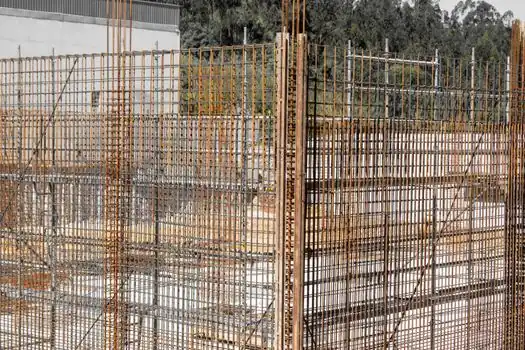
Crane-dependent jump form can be preferable when the project has reliable crane access but does not justify a hydraulic self-climbing installation. It may also suit geometry that is repetitive but changes substantially between lifts, provided the engineering design remains practical [S3][S4].
Jump form is less suitable as a blanket solution for low-rise work, irregular structures, or projects without the skilled crew required to operate a highly engineered system [S4]. For small isolated walls, the cost of acquiring, installing, adapting, and maintaining specialized climbing equipment may outweigh labor savings.
Single-sided climbing formwork transfers concrete pressure into the wall below through braces and wall struts rather than into an opposite formwork through ties [S1]. This variant suits dams, sluices, and similar structures, but it changes the engineering case and should not be evaluated simply as a cheaper replacement for a conventional jump-form core.
Slipform must not be treated as a labor-saving version of jump form. It advances continuously at roughly 300 mm per hour and is regarded as more economical for structures over 7 storeys in certain applications [S4]. Its operation, continuous concrete supply, surface-finishing workload, and quality controls differ from stepped jump cycles.
Cost model and total ownership
Purchase price is not the decisive comparison. The model must include formwork fabrication, hydraulic or rail equipment, anchors or guide rails, working platforms, crane allowance, crew hours, engineering, installation, inspections, and removal [S1][S4][S7].
Self-climbing equipment raises the mechanical-content side of the initial cost, while crane-dependent jump form shifts more cost into crane hire, rigging, lift coordination, and repeated reset labor. The hydraulic package also introduces servicing, hose and ram inspection, energy use, and specialist commissioning requirements [S1].
Crane savings must be counted only to the extent that the released crane hours produce useful site work. If the crane would otherwise stand idle, avoiding the lift is a direct schedule and cost benefit. If another package needs the crane immediately, the benefit is higher, because self-climbing can keep the concrete cycle moving without a crane request [S4][S5].
Total cost of ownership also includes productivity during the pour. A shorter cycle or fewer reset operations can reduce general site overhead and exposed work, while better continuity can improve concrete quality and reduce remedial finishing. These effects should be quantified against the actual lift plan rather than claimed as fixed percentages [S1][S3][S4].
The break-even point is reached when avoided rigging, crane, reset, and rework costs exceed the added hydraulic or rail equipment, specialist labor, commissioning, and maintenance. For a core with 20 repeated 2 m lifts, the hydraulic premium may be justified. For a short or irregular structure, the same calculation may favor crane-dependent jump form [S1][S4].
Engineering and procurement checks
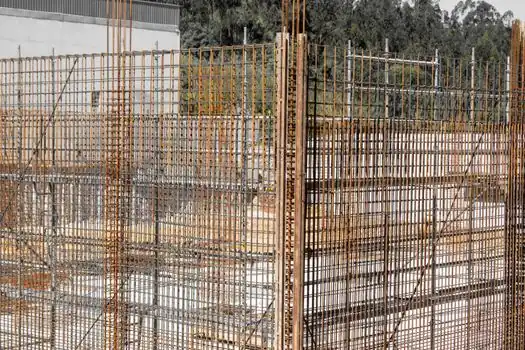
Designing slip, jump, and travelling forms is more complex than designing traditional formwork, particularly where crane-lifted work systems and layouts are involved [S7]. Temporary-works engineering must cover wind loading, dead load, concrete pressure, support transfer, climbing sequence, platform loads, and the condition of the structure below [S1].
The system should be checked against the lifting method, building geometry, concrete pour volume, reinforcement density, access routes, and expected crew size. The guide rail, suspension shoe, bracket, anchor, hydraulic ram, and working platform form one load path and cannot be priced as unrelated accessories.
For procurement, request an hours-based comparison covering workers per shift, crane lifts, setup duration, climbing duration, alignment checks, concrete-placement rate, and finishing effort. Ask for the assumed number and height of lifts, because the same equipment can produce different labor outcomes on different core geometries [S1][S2][S4].
Track three site signals during the first three lifts: actual labor hours against the baseline, crane requests and wait time, and rework or surface defects. These measurements reveal whether the claimed climbing formwork saving is an equipment characteristic or merely an assumed cycle-time benefit [S1][S4][S5].
A project with many repetitive core lifts, reliable access to skilled crews, and costly crane demand will often make self-climbing formwork the stronger labor-cost case. A project with fewer lifts, irregular geometry, or adequate crane availability may retain lower total cost with jump form, especially when the comparison also considers climbing formwork and crane hook time.