
Upgrading from one chain strand to two can increase load support and operating redundancy, but the project scope can extend beyond the price of a second chain to include sprockets, drives, frames, guards, and controls.
The decision is appropriate for pallets, mesh boxes, workpiece carriers, and rigid unit loads that need support at their outer edges; it is less suitable when a light-duty single strand already meets the load, speed, and incline requirements.
What Changes in a Single-to-Double-Strand Conversion
A single-strand chain conveyor places the load on one chain, normally with flights, while a twin-strand arrangement uses two parallel chains to support the load near its outer edges [S4]. For pallet handling, that geometry can leave the load center unsupported, making the second strand a structural addition rather than simple redundancy [S4].
The upgrade must also account for the conveyor chain, guide rails, return tensioners, drive and return stations, and the supported load path. Chain conveyors use a drive station with a geared motor and sprocket, a return station, guide rails, and a tensioning device that compensates for service elongation [S4]. A properly adjusted tensioner helps prevent chain jumping, while missing adjustment on a modified system can increase downtime and wear [S4].
For bulk-material drag systems, the distinction is different. En-masse drag conveying uses a single centered endless chain with flights on both sides, while scraper or paddle systems use a taller flight that pushes through the product [S2]. A second strand is therefore not automatically a capacity multiplier, and converting the wrong drag architecture can reduce usable trough cross-section and raise chain weight [S2].
Cost Components That Drive the Upgrade Price
PEER's double-strand roller chain consists of two rows of single-strand roller chains manufactured together and is heat treated to provide strength, durability, and resistance to wear.
Material selection can change both initial price and lifecycle cost. PEER states that its double-strand roller chain exceeds ANSI B29.1 standards, and all chain components are heat treated and pre-loaded during manufacturing. Stainless steel and protective treatments can raise purchase cost where corrosion, contamination, or wear resistance is required, but the correct comparison is service life against replacement and lubrication labor, not material cost alone.
Labor and installation are separate budget lines. Converting the conveyor may require longer shafts, matched sprockets, wider rails or frames, new guards, revised clearances, electrical changes for the drive, and commissioning tests. A published 10 ft, 44 in centers, two-strand, 30 FPM heavy-duty conveyor example with supports included was listed at $5,148.00. That configuration is a purchasable benchmark, not a universal upgrade quote.
Volume affects commercial pricing, but no project-specific quantity discount is documented in the research. A practical estimate should separate chain quantity, the number and size of sprockets, frame changes, drive changes, safety guarding, controls, freight, labor, and outage cost. Obtain at least two supplier quotes using the same chain size, pitch, material, load, speed, center distance, and duty cycle.
Single Strand Versus Double Strand on Decision Criteria
The main comparison turns on load geometry, capacity margin, structural stiffness, component cost, and serviceability. Single strand wins on purchase simplicity for light, narrow, horizontal work, while two strands gain support under wide loads and can provide operating redundancy when the drive arrangement supports it [S4].
<table><tr><th>Criterion</th><th>Single strand</th><th>Double strand</th></tr><tr><td>Purchase cost</td><td>Lower initial component cost</td><td>Higher chain, sprocket, shaft, frame, and labor cost</td></tr><tr><td>Load support</td><td>One central support line</td><td>Outer-edge support for pallets, mesh boxes, and carriers</td></tr><tr><td>Capacity</td><td>Limited by one chain and drive train</td><td>Greater mechanical reserve, subject to frame and drive limits</td></tr><tr><td>Service</td><td>Fewer chain-contact components</td><td>More wear surfaces, lubrication points, and tensioning checks</td></tr><tr><td>Best fit</td><td>Light parts on horizontal runs</td><td>Heavy, wide, or positively indexed unit loads</td></tr></table> <p>Double strand is not the correct option for every wide load. A two-strand roller chain adds moving mass, while the full system still depends on sprocket engagement, rail alignment, shaft strength, and drive torque. If the existing single-strand conveyor already satisfies the load, speed, flight spacing, and incline criteria, the upgrade should be rejected on lifecycle economics rather than justified by the word “double.”
Capacity, Flights, and Bulk-Material Constraints
Chain-conveyor sizing starts with chain tension, which includes friction between material and wear rails, inclined-run lifting force, chain dead weight, and the friction coefficient of the rail pairing; drive power follows from tension and conveying speed [S4]. Adding a strand changes this calculation, so retaining the original motor without checking the revised tension can create a larger maintenance problem than the original capacity constraint.
Flights are required when the conveyor inclines, accumulates material, or must present a defined position at the next station [S4]. Flight spacing sets the cycle rate and is incorporated into chain pitch, so a double-strand conversion may also require new flights and attachments rather than simply adding a parallel chain. The available duplex chain sizes and ANSI B29.1 manufacture claimed for the cited product span sizes 35 to 240 [S1].
For bulk drag conveyors, material depth can cause slippage between the upper material layers and the chain speed, reducing volumetric efficiency and accelerating wear [S2]. A square housing cross section is described as the efficient en-masse arrangement, while tall scraper flights can reduce usable cross-sectional area to around 50% [S2]. These findings mean that “single versus double” must be tied to the specific drag architecture, not treated as a universal bulk-conveyor rule.
Where Double-Strand Retrofit Creates Value
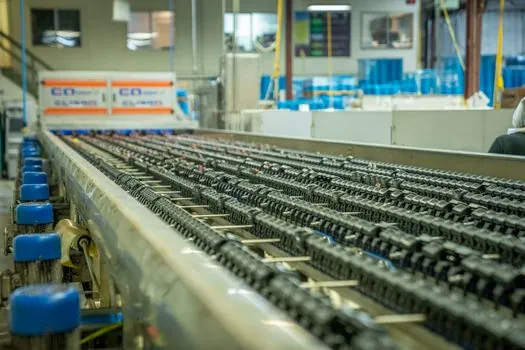
A custom multi-strand drag-chain installation handled cases weighing up to 3,000 lb and received two pallets from a robot palletizing conveyor before transfer to stretch wrapping [S3]. The same project used a low-elevation chain-driven live-roller conveyor and a pop-up chain transfer to redirect pallets through 90 degrees while preserving orientation [S3].
Another 2-strand drag conveyor, the CD280, is designed for rigid unit loads including pallets and specialty totes [S8]. These examples support two specific upgrade cases: reinforcing a pallet or tote path and increasing structural support across a wide load. They do not establish that every chain conveyor benefits from a second strand.
For rigid-load handling, a twin-strand chain conveyor can reduce twisting and unsupported span when paired with compatible flights, transfer plates, and guards. For bulk solids, an en-masse arrangement may provide lower operating cost because it uses a simple design with less routine maintenance, but its capacity depends on trough area, chain speed, commodity behavior, and flow direction [S2].
Maintenance, Energy, and Total Cost of Ownership
Chain conveyors require retensioning, lubrication, sprocket inspection, and wear-strip checks; insufficient lubrication raises friction and therefore drive power demand [S4]. A double-strand conversion can add inspection points and lubrication requirements, but it can also reduce chain stretch, premature wear, and unscheduled replacement if the added strand removes overload from the original chain [S1].
Total cost must include installation, maintenance, energy, spares, and production loss. The cited chain product is heat treated, preloaded to reduce initial elongation, and supplied with hot-dipped lubrication intended to extend wear life and reduce maintenance costs [S1]. Whether those features lower operating cost in a given installation depends on the environment, duty cycle, lubrication regime, and actual replacement interval.
Quiet operation remains a constraint. Steel chains running on steel rails are louder than belt conveyors, and the 2026 design guidance notes that chain conveyors generally cost more to buy than comparable roller or belt conveyors, with that difference offsetting over service life rather than at the purchase order [S4]. A retrofit can still be justified if it avoids manual handling, transfer damage, or an under-capacity bottleneck. A comparable example paired its cost discussion with improved product flow, ergonomics, and elimination of shipping damage in a custom multi-strand system [S3].
Sourcing and Acceptance Criteria
Specify the chain by ANSI size or manufacturer model, pitch, strand arrangement, material, attachment, working load, impact type, speed, duty cycle, and environment. The cited duplex chain is manufactured in accordance with ANSI B29.1 and uses heat-treated components with solid rollers designed to reduce impact loads on sprocket teeth [S1]. Confirm that the selected sprockets, attachments, and chain components form an approved matched set rather than relying on dimensional interchangeability alone.
Request documented pricing for chain, sprockets, shafts, bearings, guide rails, frame reinforcement, drive motor or gearbox, guards, take-up, controls, freight, installation, and commissioning. Chain baseline data should be compared with the $8.17 to $15.18 per foot range and 0.423 to 1.929 lb/ft weight range from the four cited products [S1], while the complete-system benchmark is $5,148.00 for the specified 10 ft, 44 in centers, 2-strand, 30 FPM conveyor with supports [S6].
Acceptance testing should verify chain tracking, sprocket engagement, take-up travel, running tension, noise, vibration, lubrication access, guard compliance, and load transfer. Track three signals after commissioning: chain elongation and adjustment frequency, drive current or power consumption, and wear on sprockets, bushings, rails, and wear strips. Those measurements determine whether the second strand delivered useful margin or merely added maintenance exposure.