
Furnace monitoring loops on heat-treat, annealing, and reheat furnaces typically run sensor elements from Type K/N thermocouples at 200°C to Pt100/Pt1000 RTDs at 650°C, and the calibrator covering that loop must exceed the upper bound of the working range, not just match it. Portable dry-block calibrators currently on the market for this duty span -45°C to 250°C (Labfacility Europa/Venus/Calisto [S1]) up to 30°C to 650°C (Digitron CS 650 [S3]) and 30°C to 660°C (Labfacility Jupiter [S2]), which brackets the heat-treat envelope without forcing a bath or fixed-point rig.
A dry block is a metal isothermal block with machined probe bores heated or cooled to a set point; the test thermometer and a reference probe are inserted into the same block so the indicated temperature is compared against a known standard under identical immersion conditions. For a furnace loop, the calibrator becomes a temporary replacement for the furnace itself, and its uniformity and stability budget sets the floor for the loop's measurement uncertainty.
Temperature Range Must Cover the Loop, Not the Sensor
Specifying a dry block that ends at the sensor's normal operating point is the most common furnace-loop mistake: reheat furnace over-temperature trips fire above the working set point, and you cannot test those trips if your calibrator stops at the working set point. The Labfacility Jupiter series covers 30°C to 660°C [S2] and the Digitron CS 650 covers 30°C to 650°C [S3], both wide enough to include typical over-temperature trip bands on heat-treat furnaces; the Labfacility Europa/Venus/Calisto series stops at 250°C and only fits low-temperature furnace zones such as paint cure ovens and pre-heat sections [S1].
For sub-zero furnace purge-gas checks or cryogenic pre-cool sections, the Dearto DTG series extends down to -100°C [S6], and the Ametek Jofra CTC-155 covers -25°C to 155°C for low-duty process loops [S5]. Match the calibrator's minimum to the coldest start-up condition you actually verify, not the room-temperature ambient.
Accuracy, Stability, and Uniformity Set the Uncertainty Floor
A loop calibration is only as good as the reference, and a dry block's published accuracy is a single number that hides three separate error sources: absolute set-point accuracy, short-term stability, and spatial non-uniformity (both axial and radial). The Digitron CS 650 specifies 0.1°C resolution, ±0.7°C accuracy from 30°C to 200°C and ±1.5°C above 200°C, and stability better than 0.1°C [S3]; the DwyerOmega DBCL-130 over -25°C to +130°C holds ±0.4°C display accuracy with well-to-well radial uniformity of 0.020°C [S7][S8].
Research-grade multi-zone blocks push much harder: a TU Ilmenau design with heat-flux sensors and a multiple fixed-point cell demonstrated ±4 mK reference stability and axial differences under ±55 mK across a 70°C to 430°C working range [S4]. Field-portable units do not hit that number, but the metric matters because if the dry block's radial gradient exceeds the sensor's own class tolerance, the calibration cannot validate the loop regardless of how good the reference probe is. A practical floor for furnace-loop work is radial uniformity under 0.1°C and stability under 0.05°C over a 10-minute dwell.
Insert Geometry and Multi-Probe Comparison
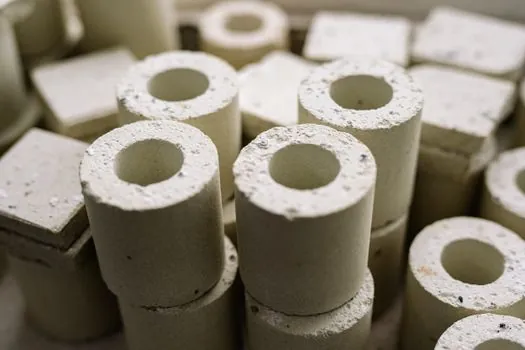
Calibrating a loop, not just a sensor, means putting the reference probe and the unit-under-test in the same thermal well so any drift in the transmitter, wiring, or cold junction shows up as a differential reading. The Labfacility Jupiter standard insert accepts up to six thermometers [S2], and the Digitron CS 650 offers 11 probe holes across mixed diameters [S3]; the Labfacility Europa/Venus/Calisto line uses a 35mm by 160mm calibration volume with distributed heating and cooling zones for good uniformity [S1].
Insert material matters as much as hole count: high-thermal-conductivity alloy blocks (as used in the Dearto DTG series [S6]) reach set point faster and recover faster when a cold probe is dropped in. For furnace loops with mixed sensor types, dual-bore inserts sized for both 6 mm sheath thermocouples and 4 mm Pt100 probes eliminate the need to swap blocks mid-calibration, which is the single biggest time-saver on a furnace shutdown.
Heating and Cooling Time, plus Field Portability
Furnace-loop calibrations usually run during a short outage window, so heat-up and cool-down set the labour cost. The Digitron CS 650 quotes 25 minutes heating time with natural cooling [S3]; the DwyerOmega high-temperature block covers ambient + 5°C to 450°C and includes 6 products bundled for furnace-loop work in the 2026-08 cart configuration [S8]. Weight is the second portability factor: the CS 650 comes in at 6 kg [S3], light enough for a technician to carry up a furnace platform, while a 660°C-class block typically lands between 8 kg and 12 kg.
Power input is a third factor often missed. The CS 650 runs on 100V to 240V [S3], which means it can be powered from a standard furnace-control panel outlet during outage work. Fixed-voltage units force a separate transformer and add a step that is easy to skip under time pressure. For loop calibrations that include a 4-20 mA verification leg, a dry block temperature calibrator with a reference indicator plus a separate loop calibrator covers the sensor half and the transmitter half in one toolbox.
Criteria-Based Comparison of Main Options

Three realistic furnace-loop choices line up against the four decision points that matter most. A low-range unit (Labfacility Europa/Venus/Calisto, -45°C to 250°C [S1]) fits cure-oven and pre-heat-zone loops with sub-250°C trip bands; mid-range (Dearto DTG, -100°C to 150°C [S6], or Ametek CTC-155, -25°C to 155°C [S5]) fits low-temperature process and laboratory loops; high-range (Jupiter 30°C to 660°C [S2] or Digitron CS 650 30°C to 650°C [S3]) fits heat-treat, annealing, and reheat furnace loops where the trip band reaches above 600°C. On portability the CS 650 is the lightest at 6 kg [S3]; on multi-probe capacity the CS 650's 11 holes [S3] out-rank Jupiter's six [S2]; on published uniformity the Dwyer DBCL-130's 0.020°C radial figure [S7] leads the portable class.
The mid-range portable class is the wrong pick when the loop carries an over-temperature trip above 200°C, because the calibrator physically cannot reach the trip set point to test it. Conversely, a 660°C block is overkill for a 150°C jacketed reactor loop: it costs more, weighs more, and its 25-minute heat-up to 650°C [S3] wastes outage time on every low-temperature check.
Standards, Documentation, and the Reference Side
Portable dry blocks used in regulated furnace loops are typically evaluated against the EA guideline formerly known as EA-10/13 (referenced in Labfacility documentation as EURAMET/cg-13/v.01) on the calibration of temperature block calibrators [S1], and high-accuracy work references fixed-point cells with sub-millikelvin uncertainty as in the TU Ilmenau multi-zone design [S4]. For furnace-loop work under an ISO 9001 quality system, the calibration certificate for the dry block itself must trace back through the reference probe and indicator to a national standards body, and the loop calibration record must capture reference reading, UUT reading, ambient, and dwell time at each set point.
Operators often pair the dry block with a loop tester for the 4-20 mA leg, and route both readings through the furnace's data historian so each loop calibration is fully reproducible. When the loop drives a trip through a condition monitoring system, the dry-block verification must cover at least three points spanning the working range plus one point inside the trip band, otherwise a drift in the trip channel can hide inside a one-point calibration.
For further reading on spec-driven instrument selection across the metrology bench, see the gauge block selection guide covering ISO 3650 grades and calibration roles and the LCR meter selection criteria for 2026 buyers. For the structural and field side of an outage, the DMM selection criteria for structural fabrication job sites covers hand-held electrical instrumentation that often rides in the same kit as the dry block.