
On a structural fabrication job, the digital multimeter (DMM) is the only instrument that simultaneously checks welder output, building-services distribution, and 24 V control wiring, so the meter spec must cover all three environments rather than the easiest one [S3].
That forces a minimum of CAT III 600 V per IEC 61010-1 on the voltage and current terminals, a fused 10 A (typically HRC 1000 V / 30 kA) input, and true-RMS AC conversion because variable-frequency drives and LED drivers no longer put out clean sinewaves [S3].
CAT rating and measurement environment, mapped to the real points you touch
IEC 61010-1 and IEC 61010-031 define four measurement categories, and the meter plus leads must be rated to a category equal to or greater than the environment, and to a working voltage at or above the highest phase-to-phase voltage present at the test point [S3].
On a structural fabrication site, the practical mapping is: CAT II 300/600 V (4 kV transient) for 120/230 V receptacle loads feeding portable welders and hand tools, CAT III 300/600 V (6 kV transient) for panelboards, busbars, motor starters, and three-phase distribution feeding overhead cranes, and CAT IV 300/600 V (8 kV transient) for any service-entrance or outdoor conductor work the crew may be asked to support [S3]. A CAT II 600 V meter is not acceptable on a 480 V panelboard, even though the nominal voltage is identical, because the prospective short-circuit energy is higher.
Accuracy, true-RMS, and resolution: what the spec sheet actually has to say
Calibration accuracy is consistently flagged as a primary selection criterion, not a footnote, and the global DMM market was valued at $1.92B in 2025, projected to reach $3.19B by 2034 at a 5.8% CAGR, which is why entry-level specs are now creeping up to mid-range performance [S4][S7].
For fabrication work, the floor spec is ±(0.5% + 2 digits) on DCV, true-RMS AC bandwidth of at least 1 kHz, and a 6000-count display (3.5 digit) minimum; industrial-grade instruments typically reach 50,000 counts and 0.025% basic DC accuracy [S3]. Input impedance of 10 MΩ on all voltage ranges prevents the meter from loading sensitive control circuits and skewing the reading; a low-impedance (Lo-Z) mode is a useful addition when hunting for ghost voltages on long cable runs in cable trays [S3].
Current, capacitance, and the secondary functions that earn their place
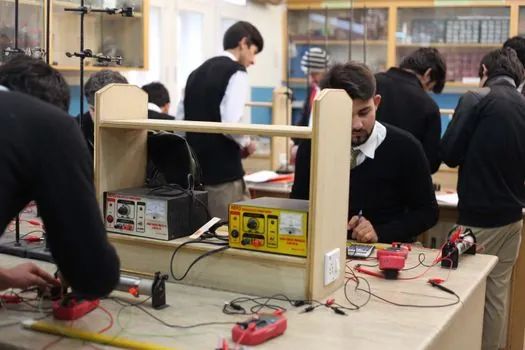
Modern DMMs combine voltmeter, ammeter, and ohmmeter with diode test, continuity buzzer, capacitance, frequency, and temperature, but the secondary functions that matter on a structural job are capacitance (for diagnosing motor start/run capacitors on crane hoists and HVAC), frequency (for verifying 50/60 Hz and VFD output), and temperature via a Type-K thermocouple (for bearing and enclosure checks) [S3][S5].
Current measurement must be on a fused input; high-energy rupture capacity fuses (HRC 1000 V / 30 kA) are the typical industrial grade, and a reading of OL on the current jack is a fuse-open indication, not a measurement [S3]. For capacitor testing specifically, a DMM with a dedicated capacitance mode applies a constant-current charge and times the voltage ramp, which is the right method for the 1 µF to 10 mF range typically found on motor-run and PFC capacitors on a fab site [S5].
Brand and form factor: portable, magnetic hanger, and IP rating
Brand loyalty is a poor selection criterion; the right instrument depends on the work, the environment, and the documentation requirements, not the badge on the front panel [S6].
For fabrication use the form factor has to survive a 1 m drop onto concrete, carry at least an IP54 rating against dust and weld-spatter splash, and include a magnetic hanger so the meter can be parked on a steel column while both probes are in use. A rubber overmold is mandatory, not optional. Wireless USB or Bluetooth data logging is useful for trending motor current over a crane start, but only if the meter's logging format exports to CSV and the site cybersecurity policy permits a radio link; otherwise, an infrared (IR) USB cable is the safer choice on plant networks [S6].
What the DMM is NOT for: complementary instruments on the same job
A DMM is not a substitute for NFPA 70E arc-flash PPE, a clamp meter is faster than a DMM for branch-circuit current above 10 A, and insulation resistance at 500 V or 1000 V requires a dedicated megohmmeter, not a DMM, because a DMM cannot generate the required test voltage [S3].
For dimensional checks during fabrication the DMM has no role at all, and that work belongs to calipers, micrometers, and dial indicators, as detailed in this Caliper vs Micrometer vs Dial Indicator: 2026 Spec-First Selection comparison. For coordinate metrology on welded fabrications a bridge or gantry CMM carries the spec, and the right machine depends on part envelope and tolerance, mapped in CMM Selection Criteria: Spec-First Map for Bridge, Gantry and Cantilever Builds. When electrical work crosses into process instrumentation, Flow Meter Selection Criteria: 2026 Spec Map for Process Engineers is the parallel buying reference.
Selection logic: a short, auditable list for the receiving clerk
For a structural fabrication electrician carrying one meter, the shortlist reads: CAT III 600 V (or CAT IV 600 V if the work touches service entrance), true-RMS AC, 10 MΩ input impedance, fused 10 A current input, ±(0.5% + 2 digits) DCV basic accuracy, 6000 counts minimum, capacitance and frequency modes, Type-K temperature, IP54, 1 m drop rating, magnetic hanger, and a digital multimimeter form factor documented to IEC 61010-1 [S3].
Trackable next nodes: IEC 61010-031 (probe assemblies) is the matching probe standard, IEC 61010-1 governs the meter itself, and the meter must be treated as a measurement accessory, not a safety device, with site lock-out/tag-out and NFPA 70E procedures applied separately [S3]. If a non-contact voltage detector or panel meter is also being specified, the digital panel meter reference covers the fixed-installation counterpart to the handheld DMM.
Spec-level background on the components involved: pressure transmitter.