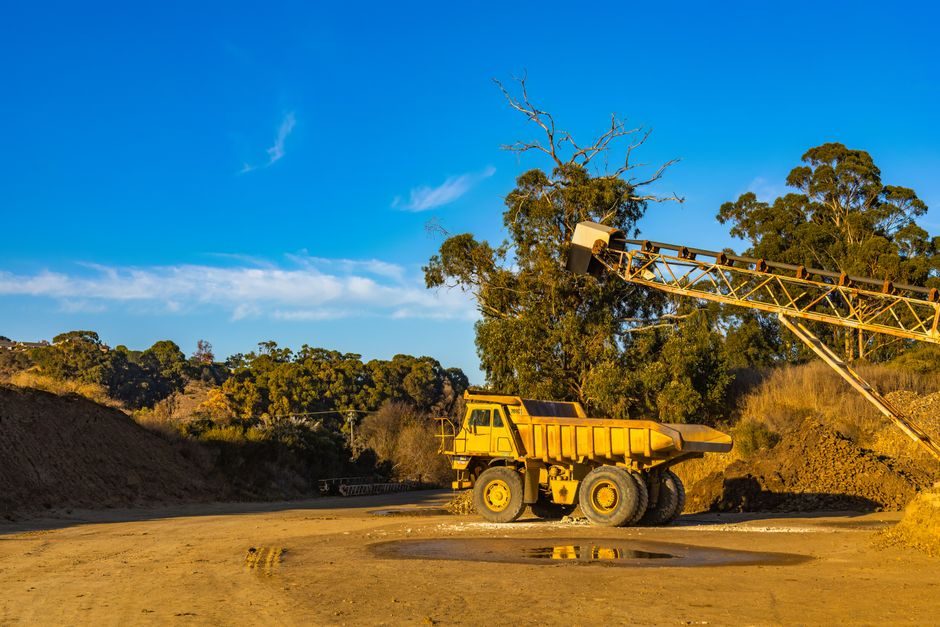
Selecting a dump truck starts with three numbers: GVW (gross vehicle weight, typically 11,800-49,000 kg for highway units and up to 600 t for ultra-class mining rigs), target payload (typically 60-75% of GVW on paved roads), and haul-cycle distance [S6].
For highway and aggregate haul, the workhorses span Class 1 panel/stake through Class 8 tractor-trailer end dumps; for off-road mining and large earthworks, the relevant category is the off-highway rigid-frame haul truck, covered in detail in the mining dump truck reference [S6].
Payload Class Bands and Axle Configuration
Single-axle rear-dump (4x2) chassis typically max out at 11,800-15,000 kg GVW and carry 5-7 t of aggregate, suiting landscaping and small-site dirt work [S1]. Tandems (6x4) push GVW to 25,400-36,300 kg with payload 13-20 t — the common spec for aggregate haulers and the format most US state DOTs allow at 80,000 lb [S1].
Super-dump configurations add a lift axle (trailing) plus a push axle, raising legal GVW to ~30,800 kg (68,000 lb) in many US states and yielding payload near 19 t without overloading the drive axles [S4]. Tri-axle (8x4) and quad-axle trailers paired with a day-cab tractor can run 36-40 t payload on the East Coast where 102-inch-wide spread-axle trailers are legal [S1].
For quarry and mining face work, off-highway mining dump trucks are rated by payload class: small (30-45 t), medium (60-90 t), large (100-150 t), and ultra-class (>290 t, with the largest units at 363 t payload per the Sogou encyclopedia entry on mining dump trucks) [S6].
Body Material, Liner and Tonnage Trade-Off
Standard dump bodies use ASTM A36 or A572 Grade 50 mild steel in 6-10 mm floor and 5-8 mm sidewall gauges; for severe impact and abrasive rock, Hardox 450 in 6-10 mm can triple body life at roughly 2.0-2.5x the per-tonne material cost [S6].
Aluminum bodies save 1,000-1,500 kg versus steel and are common in Class 7-8 transfer dump applications, but they are not suited to shot-rock or large-boulder loading; impact damage from oversize is the typical failure mode cited by aggregate haulers [S4].
Body volume alone is a poor selector — a 16 m³ struck body heaped with sand weighs more than the legal payload on a tandem, while the same body heaped with shredded mulch underruns by 40%; matching struck-and-heaped volume to material density (1,500-1,800 kg/m³ for sand, 1,300-1,500 for gravel, 800-1,100 for topsoil) is the design step most often skipped [S1].
Engine, Transmission and Drivetrain Sizing
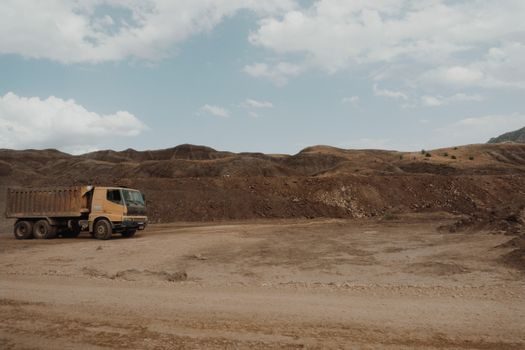
Class 8 highway dump trucks are typically powered by 11-16 L diesels in the 350-600 hp range paired with 6- or 10-speed automated manual transmissions; the spec-to-load rule of thumb is 15-20 hp per ton of GVW for on-road operation [S1].
For off-highway mining trucks, the dominant drivetrain is diesel-electric (AC drive) or diesel-mechanical (rigid-frame with torque converter and planetary drop box); the upper end of the ultra-class segment runs 2,500-4,000 hp AC electric drive with four wheel motors and dynamic retarding up to 4,000 kW continuous [S6].
For smaller off-road and articulated haulers (ADTs) in the 25-45 t payload band, a single 6-cylinder diesel in 300-450 hp with a powershift 7-speed gearbox is the norm, paired with 23.5R25 or 29.5R25 tires per the solid-tyre reference data on industrial off-road rubber [S7].
Tires, Brakes and On-Road Compliance
Standard highway dumps run 11R22.5 or 11R24.5 tubeless radial drive tires with load range H or L; for off-road articulated haulers, 23.5R25 and 29.5R25 are the common sizes, with bias-ply or solid-tyre variants on fixed-site machines per the industrial tire reference [S7].
Air brake compliance on US Class 7-8 units is governed by FMVSS 121 with ABS required since 1997; engine compression brake (Jake brake) or hydraulic retarder is standard on Class 8 tractor-trailer end dumps running mountainous routes [S1].
Tire load and speed ratings drive both payload decisions and DOT exposure: a 11R22.5 LR-H tire at 130 psi cold carries ~5,400 kg single, so a 6x4 tandem with 8 drive tires can legally support ~28 t on the drive axles before bridge-law enforcement becomes a problem [S1].
Selection Criteria: Highway, Off-Highway and Articulated
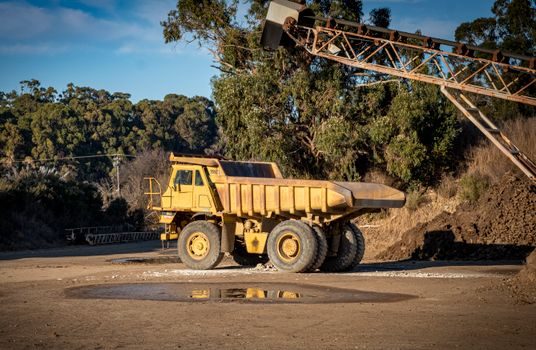
For aggregate hauling under 25 km one-way with a sealed road, a Class 8 tandem (6x4) end-dump or transfer-dump tractor-trailer is the lowest cost-per-ton option and offers the best dispatch flexibility for the loadboard-style booking model common in the US [S5].
For off-road mining or quarry face work under 5 km one-way on graded but unpaved haul roads, a 30-90 t off-highway rigid-frame mining dump truck with a Tier 4 Final / Stage V diesel-electric drive is the workhorse spec [S6].
For muddy pit-floor or soft-underfoot conditions with frequent route changes, an articulated dump truck (ADT) in the 25-45 t class with 6x6 drive, frame oscillation, and a tailgate ejector or ejector-body option is the resilient choice; the same logic drives concrete mixer truck sizing decisions on chassis match [S6].
Cost Levers and Sourcing Notes
New Class 8 tandem day-cab chassis list at roughly 145,000-180,000 USD; a complete end-dump with steel body, electric tarp, and air-ride suspension lands in the 165,000-220,000 USD range, with financing terms typically 36-84 months at 6-10% APR for well-capitalized operators [S3].
Used 3-5 year old Class 8 dumps with under 400,000 km typically transact at 55-70% of new; pre-qualification is widely available with a soft credit pull and 24-48 hour decision turnaround from US specialty lenders [S3].
Side-note: dispatch and load-matching software is now a baseline operational spend — cloud-based tools such as Dump Truck Dispatcher and loadboards like DTL are used by the majority of mid-sized US aggregate haulers to backfill deadhead miles and have measurably improved load factors versus phone-and-paper operations [S1][S5].
Common Sizing Pitfalls and Field Constraints
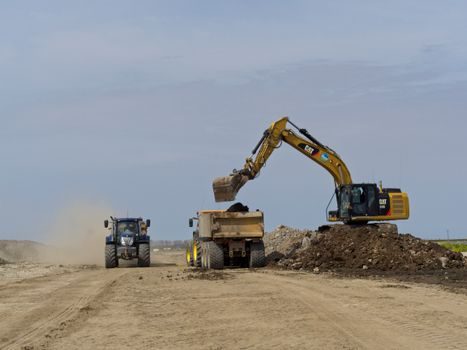
The single most common error is selecting a body volume that exceeds legal payload on dense materials: a 18 m³ steel body heaped with wet sand will hit 26-28 t payload and overload a 26 t GVW tandem, even though the same body heaped with woodchips is fine [S1].
Route-specific constraints regularly override spec-sheet choices — bridge-law states in the Northeast cap axle weight, Pennsylvania and New Jersey limit trailer width, and most US states require 80,000 lb GVW registration to be split across a tractor and trailer rather than a single rigid unit [S1][S4].
Body hoist cylinder sizing is the second-most-frequent misspec: a direct-lift telescopic hoist on a steel body must be rated to 150% of the loaded body weight to avoid stalling mid-raise on cold hydraulic oil; the same logic applies to the pneumatic actuator selection problem of derating a cylinder for worst-case temperature and pressure [S6].
Two trackable signals: DOT-published bridge-formula tables are revised annually and any GVW shift flows downstream to dump-truck spec within a quarter; second, mining-truck OEM AC-drive retrofit programs continue to expand Tier 4 Final coverage on 90-150 t units, and any 2026 model-year release will materially change total cost of ownership for off-highway fleets [S1][S6].
For component-level specifications, see dump truck, and linear guide.