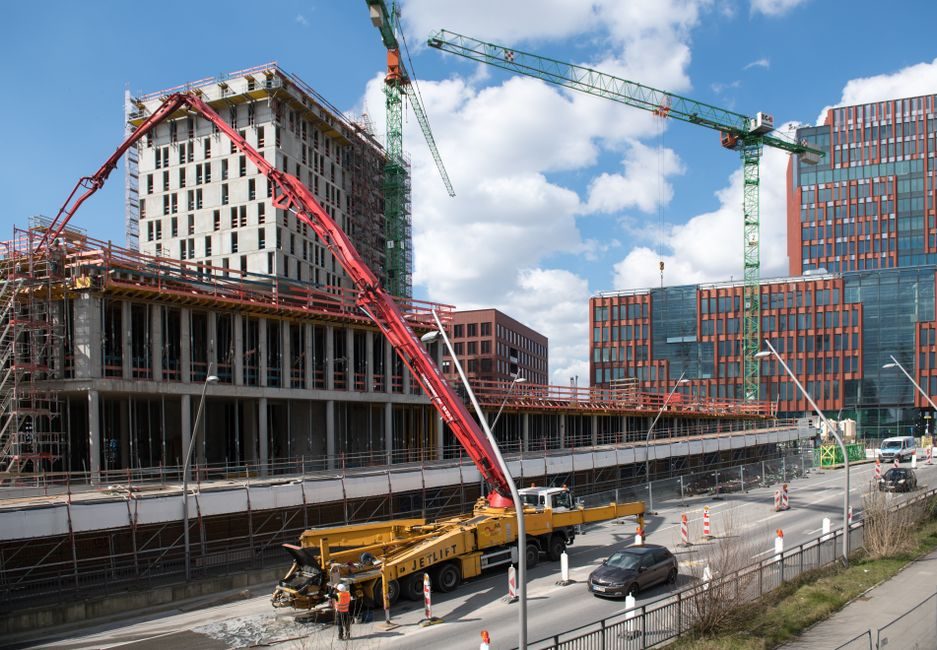
Specifying a concrete pump truck is a reach-plus-throughput exercise, not a horsepower exercise: the dominant decision variables are vertical reach in metres, horizontal reach in metres, theoretical output in cubic metres per hour, and the chassis axle count that the boom and outrigger load will ride on. The 2024-2026 supplier catalogue from Chinese OEMs — Zoomlion, Sany, Putzmeister, XCMG, Truemax — brackets the market between compact 17 m placing booms and 62 m+ city pumps, with 43-56 m five- and six-section roll-fold (RZ) configurations as the volume sweet spot [S4][S6][S7].
For readers cross-shopping drum and pump combinations on a single chassis, Concrete Mixer Truck Sizing: Drum Capacity, Drive Type and Chassis Match covers the matching drum-volume problem, while a deeper dive on the pump side sits in How to Choose a Concrete Pump Truck: Axle, Boom, Pipe and Chassis Specs. A primer on the machine family is at truck-mounted concrete pump and the broader concrete pump truck reference page.
Boom-Reach Bands: 17 m, 28-38 m, 43-52 m, 56-62 m
Boom reach is the single most cited selection metric because it dictates what the truck can pour in a single set-up without re-spotting or hand-placing hose [S1]. The 17 m class is the placing-boom / mini-pump format, typically a 4-section boom on a 3- or 4-axle chassis used for low-rise residential decks and confined urban sites [S6]. The 28-38 m band is the workhorse for 6-12 storey buildings and most industrial slabs, normally a 4- or 5-section RZ boom on 4 axles [S4][S7].
The 43-52 m band has become the 2024-2026 volume leader for high-rise and bridge piers: 5-section RZ folds on 5- or 6-axle chassis (Sitrak, Mercedes-Benz, Isuzu, MAN) are the default OEM offering from Zoomlion and Sany, with the 43 m Sitrak 5-section RZ and the 52 m Mercedes-Benz chassis as two of the most-quoted stock units in the used market [S4][S8]. The 56-62 m+ band targets super-tall cores and large infrastructure pours; 62 m Sany units on Benz chassis from the 2020 model year still trade actively in the 2026 used channel, and Putzmeister's 2026 TK-series trailer pumps (93 yd³/h class) sit alongside them as the stationary-output benchmark [S4][S8].
Theoretical Output and Pump Cylinder Sizing
Theoretical output (m³/h) is the second gate, and it scales with pump cylinder bore × stroke × strokes per minute divided by two for differential-cylinder pumps [S1][S2]. Most 43-52 m truck-mounted units in the 2024-2026 supply are rated in the 150-200 m³/h theoretical class, dropping to 80-120 m³/h for 28-38 m units and 60-90 m³/h for 17 m placing booms [S4][S7]. Real-world output is typically 60-75 % of theoretical once placing-boom cycle time, pipeline purge, and slump variability are netted out [S1].
Trailer and stationary pumps are the throughput tier above truck mounts: the 2026 Putzmeister TK 1007 trailer pump is rated at 93 yd³/h (≈71 m³/h) maximum output, demonstrating that even premium stationary units quote in the 70-100 m³/h envelope at high pressure, not the 200+ m³/h of a free-flow truck boom [S8]. Selection rule: if the pour rate needed exceeds what a single boom can deliver at 70 % real output, the next move is a second truck or a stationary boom-placing combination, not a larger cylinder bore that the chassis cannot absorb [S1].
Chassis, Axle Load and Outrigger Spread
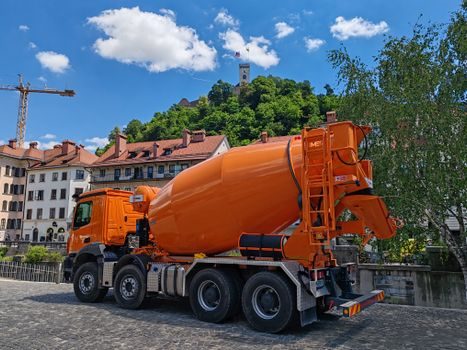
Chassis selection is governed by gross vehicle weight, axle count, and outrigger spread — not by engine power, because the pump hydraulics are PTO- or independent-engine driven [S4][S5]. The pattern in the 2024-2026 OEM catalogue is 3 axles for 17-28 m, 4 axles for 31-38 m, 5 axles for 43-47 m, 6 axles for 50-56 m, and 6-7 axles for 60 m+ booms [S4][S6]. Chinese suppliers ship predominantly on Sitrak, Mercedes-Benz Actros, Isuzu, MAN TGS, and FAW Jiefang cabs; Hunan Pengxiang Xingtong is one example of a Liuyang-based manufacturer with special-vehicle production qualifications that supplies pump trucks and truck cranes from the same platform [S5].
Outrigger spread — typically 7-10 m front-to-rear on 4-6 axle units — controls ground-bearing pressure and is the limiting factor on soft urban sites, not the boom mass [S1]. The general rule is 200-250 kPa allowable ground pressure under each outrigger pad with timber mats on unprepared ground; site survey of the pour location beats any spec-sheet number, and Chinese OEM selection guidance is explicit that the project object, the maximum required conveying distance, and the on-site bearing conditions must be matched to the chassis before the boom length is even discussed [S1].
Pipeline, Slump and Concrete Compatibility
Pipeline diameter, slump, and aggregate size form a coupled constraint that the boom length selection must respect [S1][S2]. Standard Chinese truck-mounted pumps ship with 125 mm delivery pipe; high-pressure units use 150 mm [S2]. Maximum aggregate size is then capped at roughly one-third of pipe bore, so 125 mm pipe accepts up to 40 mm aggregate and 150 mm pipe accepts up to 50 mm aggregate — a hard rule that downstream concrete supply has to honour, otherwise blockages at the elbow sections dominate the pour-stop budget [S1].
Slump for boom pumping is typically 120-180 mm at the pump inlet; below 100 mm the pipeline friction loss rises sharply, and above 200 mm the risk of segregation in the boom tip hose increases [S1]. For site-mix or dry-mix concrete (used in tunnel linings and sprayed-concrete applications), a separate concrete mixer truck sizing logic applies because drum geometry, not boom reach, drives the spec — see the linked concrete mixer truck sizing guide for the drum side. Admixture compatibility (polycarboxylate superplasticers vs naphthalene) and retarder dosage in hot-weather pours are the other two variables the pump selector has to flag to the batch plant, since a 90-minute setting-time slippage is enough to plug a 56 m boom.
Selection Criteria: Reach vs Throughput vs Mobility
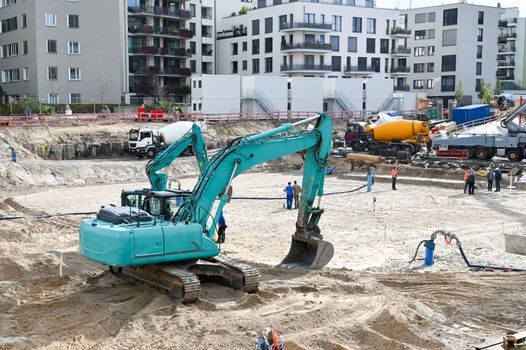
The three-way trade-off that every concrete pump truck selector faces is reach-versus-throughput-versus-mobility, and the right answer is site-specific [S1][S4]. For a tight urban site with 8-10 m access and 30+ storey pours, the 43-47 m 5-axle Sitrak/Actros boom on a 5-section RZ fold is the modal 2024-2026 choice because it balances a 43 m vertical reach against a body that still fits one-lane site roads and a 6 m outrigger spread [S4]. For long horizontal runs (e.g. dam aprons, bridge decks), stationary trailer pumps (90-120 m³/h) plus separate placing booms outperform truck-mounted booms on cost-per-cubic-metre, and the Putzmeister TK-series is the benchmark in this segment [S8].
The selection gates can be lined up in four columns: (1) required vertical reach ≥ boom vertical reach minus 5 m working margin; (2) required horizontal reach ≥ boom horizontal reach minus 3 m; (3) hourly pour demand ≤ 0.7 × theoretical output; (4) chassis payload rating ≥ wet-pump unit weight + concrete remaining in the pipeline [S1]. Failing any one of the four means the spec is wrong, not the unit. Pre-2020 used units (e.g. 2020 Sany 62 m on Benz, 2023 Zoomlion 52 m on Mercedes-Benz) still meet these gates for most applications and dominate the 2026 second-hand market as a result [S4][S9].
Failure Modes and Sourcing Constraints
The most common boom-pump field failure is pipeline blockage at the boom tip elbow, almost always traceable to a slump drop, an oversized aggregate, or a retarder overdose — not to a pump hardware defect [S1]. The second is outrigger punch-through on unprepared ground, mitigated by timber mats and a documented ground-bearing-pressure check. The third is hydraulic overheating on long continuous pours exceeding 60 minutes at maximum output, which forces a derate to roughly 70 % of nameplate — so the spec rule of selecting 1.3× the average hourly demand as theoretical output is not paranoia, it is the only way to keep cycle time inside the concrete's working life [S1].
Sourcing constraints in 2026 are dominated by chassis lead time (Sitrak, Actros, MAN TGS allocations running 3-6 months) and by emissions-tier documentation for export markets — Euro V/VI homologation paperwork for Africa and the Middle East, and EPA Tier 4 Final for North America, which Chinese OEMs can supply but typically with longer lead time [S5][S7]. Used-equipment channels (Teila Group, Bangbo, BAMBO Machinery) hold 2020-2023 Zoomlion 52 m, Sany 56-62 m, and Putzmeister TK units in continuous stock, with pricing, model-year, and chassis documented per unit [S4][S9]. Watch two signals: any Chinese OEM release of a 70 m+ boom on a 7-axle chassis, and any tightening of Euro VII / China VII emissions rules for the 2027 model year, both of which would re-rank the 43-52 m segment as the new standard rather than the volume sweet spot [S4][S6].