
Dump trucks, also called dumpers, tippers, or tip trucks, are open-box haulers with a rear-hinged bed lifted by hydraulic rams to deposit loose material such as sand, gravel, or demolition waste [S2]. The market shows 8,216 active used listings on TruckPaper.com as of 2026-07-15, sorted by gross vehicle weight rating (GVWR) classes 3 through 7 [S3].
Classification is driven by three independent axes: drive/axle configuration (4×2, 6×4, 8×4, and the EU "centipede" seven-axle layout), body geometry (rear-tipping, side-tipping, bottom-dump), and operating environment (highway, construction, quarry, open-pit mine) [S2]. A flatbed/flathead body, common in off-road mining and farm service, drops the material in a controlled forward flow rather than the rear-tipping pattern of a standard dump [S1]. For an overview of the broader dump truck family and chassis vocabulary, the encyclopedia entry is the cleanest starting point.
Standard and Semi-Trailer Rear-Dump Family
Standard dump trucks in the US typically use one front steering axle plus one (4×2) or two (6×4) powered rear axles with dual wheels, with optional lift axles that raise off the ground when empty to cut tire wear [S2]. The federal bridge formula caps vehicle weight by axle spacing, so adding a trailing 11–13 ft (3.35–3.96 m) behind the rear tandem is what turns a standard into a Super Dump, with a tag axle rated as high as 13,000 lb (5,897 kg) and overall GVW up to 80,000 lb (36,287 kg), carrying 26 short tons of payload or more [S2].
EU heavy trucks run two, three, or four axles; the four-axle eight-wheeler is limited to 32 metric tonnes (35 short tons) GVW, while the seven-axle "centipede" puts steering on axle 1, drive on the rear two, and four lift axles in between [S2]. Semi-trailer end dumps transfer the load to a ground-supported trailer, trading maneuverability for higher volumetric capacity than a standard straight truck. For heavier off-highway work, the mining dump truck class operates as a separate machine class sized by payload tonnes rather than GVWR.
Side-Dump, Bottom-Dump, and Roller Configurations
Side dump trucks tilt the bed to one side using a hydraulic ram at the front, allowing faster discharge in confined spaces and windrowing material along a road shoulder, with the trade-off of higher centre of gravity when fully raised [S2]. Bottom-dump / belly-dump trailers open gates along the hopper floor to lay material in a windrow, which is the dominant pattern for aggregate spreading on highway paving jobs. A transfer dump adds a separate "B" trailer that loads through a connecting chute, with the aggregate conveyor on the B-box driven by a dedicated engine, increasing total payload without exceeding bridge-formula limits.
Roller and high-lift tailgate variants are body-level options rather than truck types: a "High Lift Tailgate" uses pneumatic rams to swing the gate up and over the dump body, increasing volumetric capacity for light materials like mulch or coal [S2]. TruckPaper.com listings show coal-chute and side-mounted-ladder configurations on the same GVWR Class 3 chassis, confirming that body hardware is a layer on top of the truck class, not a re-classification [S3].
Off-Road, Flathead, and 4WD Rigid Classes
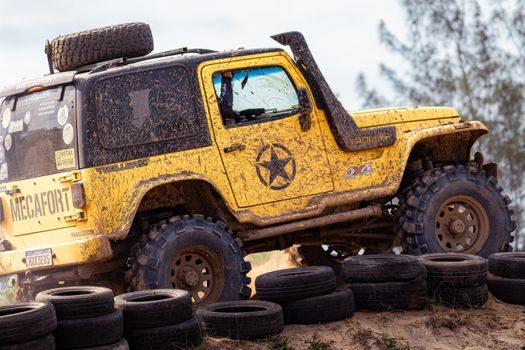
Lishun's FLATHEAD DUMP TRUCK SERIES offers 5 flatbed/flathead models (N5, N8, N15, N20, N25) plus two MINING DUMP TRUCK SERIES models (K5, K8), the N-prefix indicating 4WD flatbed variants sized by payload class [S1]. Off-road and 4WD rigid dump trucks use single rear axles with flotation tyres, articulated frames, and elevated ground clearance to operate on haul roads, mud, or soft ground where on-highway trucks would bog down. The RHD (right-hand-drive) agricultural variant and farm hand-tractor mounted dumpers sit in the same flatbed family but at lower speeds and payloads, reflecting farm-duty duty cycles rather than mining duty cycles [S1].
Construction and quarry service usually falls to on-road tandem rigs in GVWR Class 7 (26,001–33,000 lb) or Class 8 above 33,000 lb, with steel bodies and air-ride suspension, as visible in the active TruckPaper.com inventory dated 2026-05-26 through 2026-07-09 [S3]. For plant-side reference on how concrete mixer trucks sit next to dump trucks in the same haulage fleet, the mixer installation spec map is a useful parallel. Where the spec calls for a boom-haul neighbour rather than a drum, the concrete pump truck types article maps reach and chassis choices that often share yard space with rigid dump fleets.
Class Selection by GVWR and Drive Layout
GVWR bands 1–8 in the US system line up with duty intensity: Class 3 (10,001–14,000 lb) covers light pickup dumps like the Chevy Silverado 5500HD with steel bodies, Class 6 (19,501–26,000 lb) covers single-rear-axle medium-duty rigs such as the Ford F650 and F550 Super Duty, and Class 7 (26,001–33,000 lb) covers tandem-axle vocational chassis such as the Ford F-750 dump body listed on 2026-05-26 [S3]. Engine and driveline pairings track those bands: a 240 hp Cummins with Allison automatic and steel end-dump configures a Class 6 NON-CDL Ford F650; a 6.4 L Power Stroke diesel in a 2009 F550 4×4 with 19,500 lb GVW sits at the bottom of the same class [S3].
EU GVW is expressed in metric tonnes with a 32 t cap on the standard four-axle eight-wheeler, against the 36.3 t (80,000 lb) cap on a US Super Dump using a trailing axle [S2]. Wheelbase choice is the third decision variable: standard straight dumps have shorter wheelbases than semi-trailer end dumps, giving them better maneuverability on residential and urban job sites at the cost of lower volumetric capacity per cycle [S2].
Dump Body Material, Tailgate, and Hydraulic Options
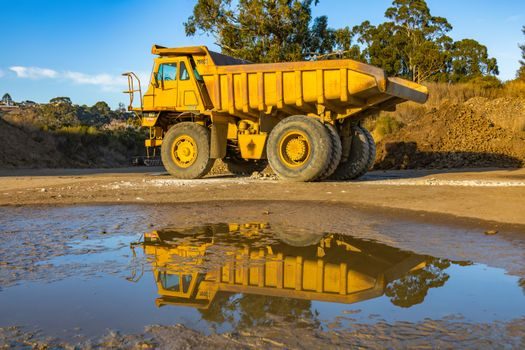
Steel remains the default body composition for Class 6 and 7 vocational dumps as listed on TruckPaper.com, with the Ford F650 Super Duty explicitly tagged "Composition: Steel" alongside a 2023 model-year listing [S3]. High-lift or scissor-lift tailgates use pneumatic or hydraulic rams to clear material that would otherwise stick in the bed, and are flagged in Florida-based Class 6 listings as "Highlift / Scissor lift – Dump" [S3]. Side-mounted ladders, coal chutes, and bluetooth stereos are operator-experience options, not structural class changes; they ride on the same GVWR-3 chassis as the 4×4 coal-chute truck out of Courtdale, Pennsylvania [S3].
Hydraulic architecture inside the body is split between a single vertical ram mounted under the front of the body and a horizontal ram-and-lever arrangement between the frame rails [S2]. The vertical-ram pattern suits lighter Class 3–5 chassis, while the horizontal underbody ram pattern is the typical fit on Class 6 and 7 tandem rigs because it gives a higher lift angle without raising the body's centre of gravity during the dump cycle. Trailing-arm and tag-axle hydraulic circuits are sized to the 13,000 lb load rating and toggle up clear of the road surface when empty [S2].
Selection Criteria: Truck Type vs Duty Cycle
Match the body geometry to discharge pattern first: rear-tipping standard and Super Dump for stockpiling, side-tip for windrow or confined-space discharge, bottom-dump for aggregate paving trains, transfer dump for high-payload GVW without bridge-formula penalty [S2]. Match drive layout to ground: 4×2 and 6×4 for paved roads and graded haul roads, 4WD flathead (N5/N8/N15/N20/N25) for soft ground and farm work, off-road rigid for quarry and mine haul [S1][S2].
Match GVW to payload: under 26,000 lb GVWR (Class 3–6) for pickup and NON-CDL fleet work in Ford F550/F650 territory; 26,001–33,000 lb (Class 7) for tandem construction dumps; 33,000 lb and above (Class 8) for heavy vocational and Super Dump configurations [S3]. For mine and large-quarry duty above ~100 t payload, step out of the on-road GVWR framework entirely into the mining dump truck class. Reach-style off-highway haulers and articulated dump trucks are not interchangeable with on-road semi end dumps because tyre load rating, frame articulation, and service-brake thermal capacity differ by an order of magnitude.
Trackable near-term signals: TruckPaper.com listing counts (8,216 on 2026-07-15) and update dates (2026-05-26 through 2026-07-10) [S3]; SANY's commercial dump-truck line covering both electric and non-electric powertrains for mining, construction, and large-scale infrastructure [S4]; and Lishun's 30+ years of export across 26+ countries with 4,000+ staff on a 10,000+ m² site [S1].