
Dust collection ductwork operates almost exclusively under negative pressure, so a gasket's first job is inward leak control rather than outward fugitive emission — a distinction that flips the usual flange-gasket logic used in process piping [S4].
Selection therefore pivots on three measurable variables: conveyed dust abrasiveness (grain size, moisture, ignition risk), continuous operating temperature at the seal face, and the SMACNA leakage class the system was designed against [S4]. For a primer on the role of compression sealing between two flange faces, the gasket fundamentals page covers the baseline terms used throughout this guide.
Why Dust Collection Gasket Logic Differs From Process Piping
SMACNA HVAC duct leakage class ratings were developed for low-pressure sheet-metal systems and are the reference document NordFab uses to qualify its clamp-together ducting for dust and fume removal at negative pressure; the same class ratings are not interchangeable with positive-pressure conveying lines that rely on tape or gaskets as the primary sealant [S4].
In practice, a dust collector duct joint sees 4–15 in.wg vacuum, intermittent pulse-jet shock loads of 60–90 psi from cleaning cycles, and a fine abrasive or combustible particulate stream — any of which can shear a soft rubber square-section if it is the wrong durometer or filler [S3]. A common field failure is a flat rubber gasket extruding into the gap on a 12 in. flange under 8 in.wg during a hopper bridge event.
Material Options Lined Up Against Service Variables
For dry, ambient-temperature dusts under 120°C, EPDM or neoprene sponge/solid gaskets on roll-formed flanges give the best price-to-resilience ratio; SBR is often substituted where ozone exposure is limited [S1]. Flat rubber, cork, and non-asbestos compressed-fibre sheet stock are typically rated to about 200°C and 1000 psi, making them the entry point for low-pressure general service [S3].
For hot fume service 200–450°C (welding fume, foundry baghouse outlets, kiln dust), graphite-laminate and exfoliated graphite with metal foil inserts hold a seal where organic elastomers would char; spiral-wound gaskets with graphite filler push that envelope toward 1000°C and roughly 2000 psi in metal-to-metal flange geometries [S3]. For wet or chemically aggressive dusts (limestone, fertilizer, flue-gas desulphurisation by-product), PTFE envelope gaskets resist acid condensate that would swell EPDM, while compressed non-asbestos fibre with aramid binder is the workhorse for abrasive, dry streams. Ring-type joint gaskets, typically metal, cover circular flange interfaces up to 1000°C and 1500 psi where the seal face is tongue-and-groove or RTJ [S3].
Mechanical and Chemical Performance Factors
Chemical compatibility is checked first because a gasket that swells in service stops being a seal — EPDM fails in mineral-oil aerosol, nitrile fails in ozone-rich vent streams, and standard SBR hardens above ~110°C continuous [S1][S3]. Specifying engineers should size to operating temperature and pressure, not to maximum nameplate, because elastomers lose roughly 50% of their sealing stress within 20°C of their continuous rating [S3].
Mechanical stress on a dust collector flange comes from bolt clamp load, thermal cycling between ambient and upset conditions, and pulse-jet pressure spikes during filter cleaning. Compressed-fibre gaskets tolerate flange face finish Ra 3.2–6.3 µm and minor out-of-flatness, while spiral-wound and Kammprofile designs need a machined finish and controlled bolt torque to reach their rated 2000–2500 psi envelope [S3]. Environmental factors — UV on outdoor duct, ozone near corona discharge, and moisture in outdoor hoppers — are listed in supplier selection guides as equal-weight constraints to chemistry, not afterthoughts [S3].
Joint Geometry and Quick-Clamp Versus Bolted Flanges
Quick-clamp rolled-flange duct (the NordFab Q-F style and equivalents) is dominant in woodworking and light-industrial dust collection because it can be re-seated without tools, but it depends on a continuous bead gasket that compresses uniformly under the clamp band — a square-cut mitre joint with a butt-seam gasket will leak regardless of gasket quality [S4].
Bolted flange joints in heavier fabrication (baghouse inlets, cyclone outlets, rotary-valve transitions) use either flat ring gaskets to ASME B16.21-type dimensions or, on raised-face duct flanges, a spiral-wound or Kammprofile element. Kammprofile combines a solid metal core with serrated faces covered by a soft filler (typically graphite), giving the resilience of soft cut sheet with the blowout resistance of metal — the standard choice for thermal cycling between ambient and 600°C on cement and steel mill dusts, rated to 1000°C and 2500 psi [S3]. The same metal-jacketed family wraps a graphite or non-asbestos filler inside a metal envelope and is preferred for exchanger and header joints to 2000 psi [S3].
Common Failure Modes in Dust Collector Service

Leak paths in field service usually trace back to four causes, in order of frequency: incorrect material for the chemistry (rubber dissolved or hardened), under-compression of the gasket at the bolt pattern, gasket extrusion into the flange gap on high-vacuum joints, and abrasion wear from conveyed particles on unprotected gasket edges [S3][S4].
Ignition risk adds a separate constraint in combustible-dust service (grain, sugar, aluminium, pharmaceutical powders). The North American NFPA 652 framework and the European ATEX 2014/34/EU equipment directive both push the spec toward anti-static / static-dissipative elastomers, often loaded with carbon black to a surface resistivity below 10^9 Ω, in conjunction with bonded grounding straps across the joint — a detail that has no counterpart in HVAC ductwork. A spark at a leaking flange is the most common root cause cited in dust collector incident investigations, and the wrong gasket material can act as the ignition source rather than the seal.
Who a Standard Rubber Flat Gasket Is NOT Right For
If the service temperature crosses 200°C, if the dust is hygroscopic and the duct sees condensation, or if the dust carries an oil mist, drop the standard rubber square-section from the shortlist — the binder will char, swell, or wash out, and the next filter change cycle will pull contaminated air past the seam [S1][S3].
Equally, a spiral-wound or Kammprofile gasket is overkill on a quick-clamp rolled-flange joint: the flange face is not machined, the bolt load is uncontrolled, and the soft filler between metal windings will not seat against a half-millimetre out-of-flatness. Specifying engineers who copy flange-gasket data sheets from process-piping datasheets onto dust collector ductwork consistently pay 3–5× the gasket unit cost and still see higher leak rates than a properly sized EPDM or graphite-laminate on the actual joint [S3][S4].
Sourcing and Standards Anchors
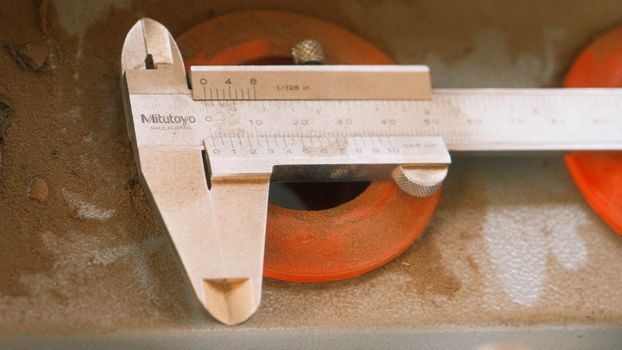
Suppliers with in-house cutting and waterjet or oscillating-knife capacity can convert any approved sheet stock into finished gaskets on the same lead time as standard grommets, which removes the usual "minimum order quantity" friction on retrofit jobs — a 50-year-old gasket-cutter's stock of rubber, fibre, plastic, metal, PTFE, and spiral-wound sheet is representative of the material menu most dust-collection projects need [S1].
Standards to anchor the specification against, in order of relevance: SMACNA HVAC duct leakage classes for the duct itself [S4], ASME B16.21 for non-metallic flat ring gasket dimensions on raised-face duct flanges, ASME B16.20 for metallic ring-joint and spiral-wound gaskets on high-temperature joints, and the ATEX 2014/34/EU equipment directive plus NFPA 652 for combustible-dust ignition control. For a closer look at how elastomer hardness and temperature limits line up across gasket families, the high-temperature O-ring selection guide covers adjacent durometer and service-limit logic that translates directly to dust collector gaskets, and the outdoor mechanical seal selection logic page maps the same UV / ozone / weather variables onto seal materials.
Trackable signals for the next six months: a revision watch on the SMACNA leakage-class tables referenced for dust collection ductwork [S4], any updates to the ATEX 2014/34/EU guidance for non-electrical equipment including static-dissipative gaskets, and a check on the ASME B16.20 / B16.21 reprint cycle if a major foundry or cement retrofit is being scoped.
Spec-level background on the components involved: dust detector, and dust mask.