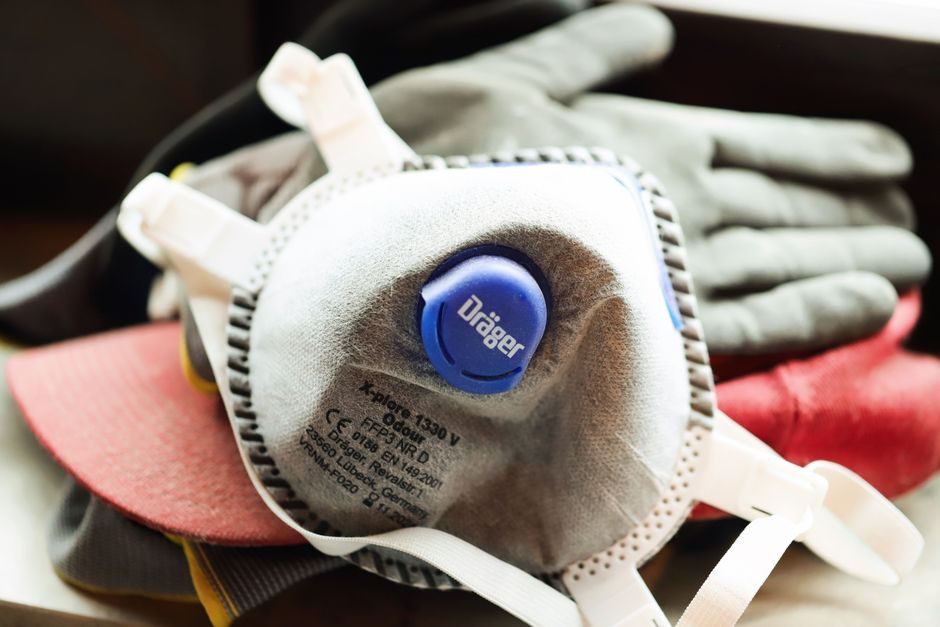
A respirator programme's true cost is decided by filter-change frequency, fit-test labour and disposal, not the unit price on the procurement screen; on heavy construction sites the purchase ticket is routinely under 30% of the 3-year spend [S1][S5].
Total Cost of Ownership, as a financial lens, captures acquisition plus operation, maintenance, training and end-of-life costs over a defined service life — a framework popularised by Gartner and used in industrial and medical procurement alike [S1][S2].
Defining dust mask TCO: what sits beyond the box price
TCO for a dust mask programme covers unit cost, consumables, fit-testing, training, storage, decontamination, disposal, downtime from leakage, and compliance penalty exposure across the asset's service life [S1].
The framework was designed to expose hidden cost layers that the initial invoice never shows; in dust-mask procurement this matters because disposable and reusable respirators have radically different cost curves and the cheapest box on the desk often loses on a 12-month view [S1][S5].
Busch Vacuum's equipment-side TCO guidance states that the initial purchase price is "only a fraction" of lifetime expense — a principle that maps directly onto PPE programmes where filter cartridges, fit-test kits and disposal drums recur every quarter [S5].
Cost-line breakdown: the five drivers that move the number
Line 1 — unit price. Disposable FFP2/FFP3 respirators sit in a low absolute price band, while reusable elastomeric half-masks carry a higher one-time outlay but shareable filter cartridges; the crossover point usually appears between month 3 and month 6 on a 5-day-week wearer [S5][S6].
Line 2 — filter replacement cycle. Particulate filters on dusty construction or woodworking sites clog in 1–4 weeks, while low-dust environments may run 4–8 weeks; each swap is a recurring line item that dominates the consumable column of any multi-year model [S1][S5].
Line 3 — fit-testing labour. Qualitative or quantitative fit testing (QLFT/QNFT) consumes 15–30 minutes per wearer per session and is required annually or after weight/dental change, per common occupational-hygiene practice — a labour line that scales with headcount, not mask count [S1][S6].
Line 4 — storage, decontamination and disposal. Used respirators are biohazard-adjacent waste in many jurisdictions; sealed bins, contracted pickup, and replacement inventory tied up in storerooms all carry a real carrying cost [S1][S3].
Line 5 — productivity loss from poor seal. A leaking respirator forces re-work, task stoppage, or medical referral; one TCO reference notes that the price tag can represent less than 10 percent of the total cost of a piece of equipment when energy, maintenance, and repair fees are added over its lifetime [S6].
Disposable vs reusable vs powered: comparing the options on TCO criteria

On the four TCO criteria that matter for procurement — unit cost, replacement cadence, fit-test overhead, lifecycle waste — disposable FFP masks win on price-per-unit but lose on per-wearer-year, while reusable elastomeric masks win on per-wearer-year but demand upfront capital and cleaning discipline [S1][S5].
Powered air-purifying respirators (PAPRs) add a battery-charging infrastructure line and a higher acquisition cost, but reduce fit-test sensitivity because loose-fitting hoods tolerate a wider facial geometry range — relevant on sites with high workforce turnover [S1].
The selection pattern across heavy-construction TCO models is straightforward: headcount below ~20 wearers and short project duration → disposable; headcount above ~50 with multi-year exposure → reusable; hot/humid work with beard or dental variability → PAPR hood over elastomeric facepiece [S1][S5][S6].
Who dust mask TCO analysis is for, and where it overreaches
TCO modelling pays off for safety managers running a 50+ wearer programme across multiple sites, for procurement comparing reusable vs disposable across a 12-month horizon, and for finance auditors reviewing PPE as a recurring operating line rather than a capital line [S1][S2].
It overreaches for a one-off 2-week domestic task where a single box of disposables is the rational answer, and for any purchase decision where the user has no control over fit-test scheduling or filter inventory — TCO is a decision tool, not a number you can read off a datasheet [S1][S5].
For installation-side cost lines — seal check, strap tension, donor mask sizing — see the dust mask installation map, which carries the procedure detail this TCO piece deliberately leaves out.
Total cost of ownership in practice: a worked lens

The Gartner-era definition treats TCO as acquisition cost plus operating cost plus end-of-life cost minus residual value, discounted over service life — a structure identical to the hospital-medical-device case study where a D41 ST-analyzer's 1,333-hour annual run and CZK 2.3/kWh electricity price fed a 10-year model [S1][S2].
The same discounting logic applies to a dust-mask programme: 100 wearers, 250 working days, filter swap every 20 days, one fit-test per wearer per year, and a contracted waste pickup per quarter — each line is monetised separately, then summed and discounted to a present-value figure [S1][S2][S5].
Graco's manufacturing-side TCO note also flags that "energy costs, maintenance, and repair fees" must be priced in even when they look small; for respirators the analogue isopropyl-alcohol wipe cost, battery replacement on PAPRs, and the labour minute-cost of donning/doffing logs [S6].
Limitations, failure modes and the data that has to be honest
Where TCO breaks down for dust masks: filter-change frequency is site-specific and any model that uses the manufacturer's clean-room rating as the field assumption will understate consumption by a factor of 2–4 on silica or wood-dust jobs [S1][S5].
Fit-test labour is the line most often omitted from procurement models, and it is the line that decides whether a reusable programme beats a disposable one at the 12-month mark — a sensitivity worth running as ±50% in any TCO spreadsheet [S1][S6].
A second failure mode is treating "comfort" and "compliance" as soft variables; in practice, a 10% improvement in wearer compliance shifts the seal-leak productivity line by a much larger amount than any unit-price negotiation, and a TCO model that ignores compliance will pick the wrong mask [S1][S2].
Sourcing, standards and trackable signals

Filter performance for dust respirators is rated under EN 149 (filtering facepiece) and EN 143 (particle filters for reusable masks); the TCO lens sits on top of those conformity gates, not in place of them, and any TCO comparison across mask types must keep the certification class constant [S1].
For programmes that sit alongside face-shield selection, the face-shield TCO breakdown applies the same five-line structure to eye protection and is useful as a parallel reference when PPE is procured as a bundle. Generic TCO methodology for industrial assets is summarised in cast-iron 20-year lifecycle TCO and the same five-line schema maps across capital equipment and consumable PPE.
The underlying component specifications are covered under total station, and dust detector.