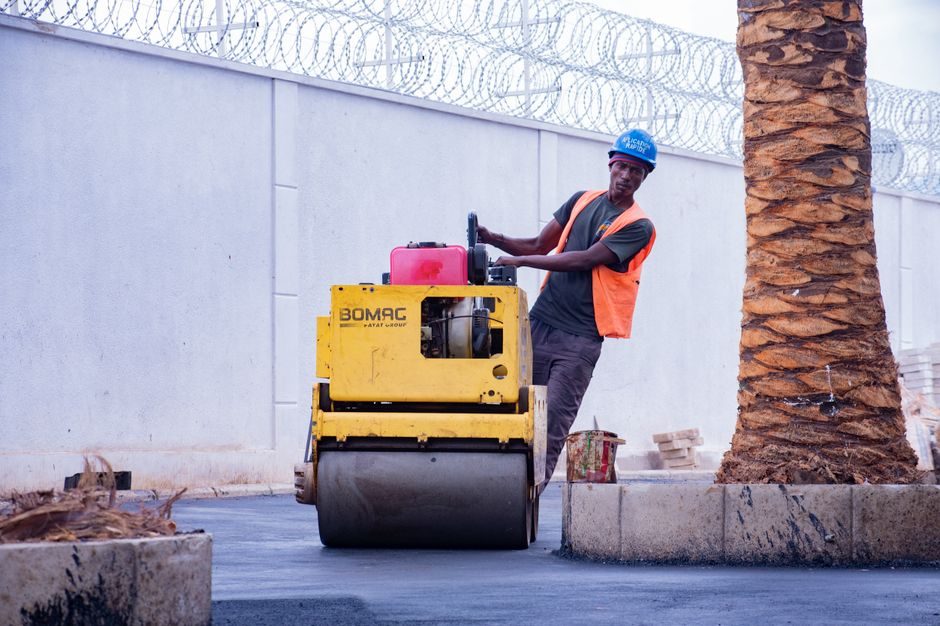
Dynamic compactors span a wide price band in 2026: handheld and walk-behind gasoline units are listed around USD 1,000 from Chinese wholesale catalogs, while heavy impact-rammer rigs for land reclamation are quoted in the USD 1,000,000–1,500,000 range per piece by audited Jiangsu manufacturers [S1][S3].
That price spread — three orders of magnitude — is the single biggest reason a buyer needs a spec-gate approach before talking to a supplier, because the machine a 200 m² driveway job needs and the machine a 2 million m² coastal reclamation needs share almost no components [S1][S3].
Definition and Scope: What Counts as a "Dynamic Compactor" in 2026
On Chinese B2B catalogs the term "dynamic compactor" is used as an umbrella covering gasoline vibrating plate compactors, hydraulic reversible plate compactors, ride-on vibratory rollers, and heavy free-fall impact rammers (also called dynamic compaction rigs) [S1]. The unifying engineering principle is that energy is delivered to the ground dynamically — by eccentric rotating mass, by reciprocating piston, or by crane-dropped weight — rather than by static rolling weight alone [S1].
Entry-level units on the Anhui-Hefei wholesale market are typically C90 Honda gasoline engines driving a single-direction vibrating plate, sold as "Factory Outlet" SKUs and aimed at paver and trench backfill work [S1]. At the top of the catalog, Jiangsu manufacturers list 1-piece MOQ impact-rammer rigs priced at USD 1,000,000–1,500,000 with audited-supplier status, used for deep ground improvement on mine tailings, hydraulic fill and reclamation sites [S3].
Selection Criteria: Five Spec Gates That Decide the Machine
The five spec gates that govern a 2026 dynamic compactor purchase are: (1) compaction depth requirement (shallow ≤ 0.6 m vs deep 5–40 m), (2) soil type (cohesionless sand vs cohesive clay vs mixed fill), (3) impact or vibration mechanism, (4) prime-mover class (gasoline ~6–9 kW, diesel 100–400 kW, no prime-mover for crane-dropped weights), and (5) mobility (walk-behind, ride-on, or crane-suspended) [S1][S3].
Misalignment between soil type and mechanism is the most common specification error: vibratory plate compactors work in granular soils down to about 0.3–0.6 m, while impact-rammer dynamic compaction rigs are required when the target is 5–40 m deep on loose saturated sands or mine spoils [S1][S3]. A buyer who specifies a USD 1,000 plate compactor for a 15 m deep fill will see no measurable improvement and will blame the equipment.
Type Comparison: Four Main Machine Families Side by Side
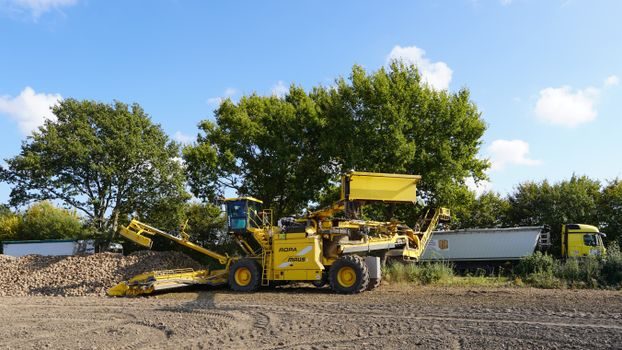
The four main families in 2026 line up against the spec gates as follows: gasoline vibrating plate compactors (USD 1,000–3,000 class, 0.2–0.6 m depth, cohesionless soils, walk-behind) [S1]; hydraulic reversible plate compactors (USD 3,000–12,000 class, 0.3–0.8 m depth, mixed soils, walk-behind); ride-on vibratory rollers (USD 15,000–80,000 class, 0.4–1.0 m depth, road base and landfill); and heavy impact-rammer dynamic compaction rigs (USD 1,000,000–1,500,000 class, 5–40 m depth, loose saturated sands and mine tailings) [S1][S3].
Within the heavy end, the trade-off is weight-per-drop versus drop height: heavier weights with lower drop give controlled deep densification, lighter weights with higher drop give broader energy transfer. A buyer quoting on the USD 1,000,000–1,500,000 Jiangsu unit should confirm the tamper mass (typically 10–30 t), drop height (10–30 m), and grid spacing (typically 5–12 m) before signing a PO [S3].
Who It Is For vs Who It Is NOT For
Dynamic compactors in the USD 1,000–12,000 walk-behind class are built for paving contractors, utility trench crews, and small landscaping outfits that need ≤ 0.8 m compaction on granular base [S1]. They are NOT suitable for deep ground improvement, saturated soft clay treatment, or any job where the specification calls for SPT N-value improvement below 5 m.
Heavy impact-rammer rigs at the USD 1,000,000–1,500,000 price band are for civil engineering contractors handling port reclamation, airport runways on hydraulic fill, mine tailings densification, and industrial site preparation on loose saturated sand [S3]. They are NOT for small residential plots, indoor slabs, or any project where vibration-sensitive structures sit within roughly 1.5× the drop-height radius of the tamper footprint.
Use Cases Mapped to Machine Class
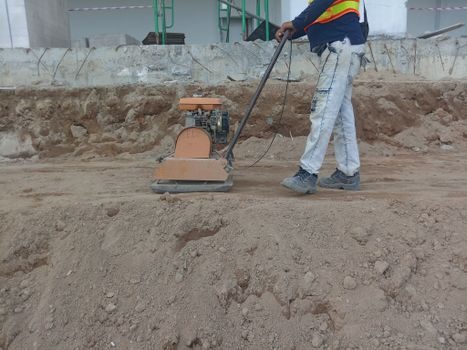
Paving and paver-bedding work on a 200–2,000 m² site typically uses a C90 Honda gasoline vibrating plate compactor in the USD 1,000 bracket from the Anhui-Hefei supply cluster [S1]. Trench backfill on utility installs through mixed granular-cohesive soils calls for a hydraulic reversible plate in the USD 3,000–12,000 band, with the reversibility feature being the spec gate that separates a productive unit from a frustrating one [S1].
Road base compaction on subgrade and aggregate lifts in the 0.4–1.0 m range calls for ride-on vibratory rollers in the USD 15,000–80,000 band, and is the class most often confused with light static rollers. The genuine buy signal is drum vibratory amplitude, not static drum weight — a 4 t static roller without vibration will not hit 95 % Proctor on a 300 mm aggregate lift.
Limitations, Failure Modes and Sourcing Risks
Three failure modes dominate 2026 buyer complaints. First, under-powered prime mover: a gasoline plate compactor specified for clay-rich cohesive soil will skate on the surface and never reach density, because clay absorbs vibratory energy without particle re-arrangement [S1]. Second, grid-spacing error on heavy impact-rammer work: a Jiangsu USD 1,000,000+ rig dropped on a 5 m grid wastes roughly 40 % of the energy budget on overlapping craters, while a 12 m grid leaves untreated columns [S3]. Third, supply-chain risk on spare eccentric bearings, the wearing part on every vibratory plate; sourcing the unit from a manufacturer with domestic service stock is the only mitigation.
MOQ discipline is the other sourcing lever. The Jiangsu heavy-rig suppliers list 1-piece MOQ at full catalog price, while the Anhui-Hefei gasoline-plate cluster commonly quotes 5–50 piece MOQ for export containers [S1][S3].
Standards, Sourcing Channels and 2026 Price Anchors

For compaction depth and method selection, the working references are ISO/TR 21244 and the US FHWA NHI-05-039 manual on ground improvement methods, both of which classify dynamic compaction as one of several deep-improvement techniques and set the energy-per-area envelope (typically 200–400 kJ/m² for loose saturated sand) [S3]. For machine safety, the engine-driven walk-behind class falls under EU Stage V exhaust and US EPA Tier 4 final for diesel variants — a buyer shipping to Europe or California must confirm the engine plate before booking.
The dominant 2026 sourcing channels are Made-in-China.com wholesale listings (Anhui-Hefei cluster for gasoline plates, Jiangsu cluster for heavy rigs), direct OEM contact for engineered heavy units, and used-equipment auctions in the 10–80 t ride-on roller class [S1][S3]. Anchor prices from the June 2026 catalog: gasoline vibrating plate around USD 1,000 ex-factory [S1]; heavy impact-rammer rig USD 1,000,000–1,500,000 per piece, 1-piece MOQ, audited Jiangsu supplier [S3]. Comparable ground-improvement cost-lever logic is documented for adjacent civil-engineering categories such as the Diaphragm Wall Grab Price & Cost Guide 2026 and the Laser Level Buying Guide 2026, where spec-gate and MOQ are the same decision drivers.
Closing signals to track over the next 90 days: any post-June 2026 Jiangsu supplier update on tamper mass options above 30 t, and any Stage V / Tier 4 final engine-plate compliance note on Anhui-Hefei gasoline exports to the EU — both data points are the most reliable early warning of a 2026 H2 price reset on the walk-behind and heavy-rig bookends.
For component-level specifications, see dynamic compactor, linear guide, and crossed roller guide.