
Centralized e-axle architectures, where one or two motors drive a single axle through a multi-speed or fixed-ratio gearbox, remain the volume backbone in 2026, with established Tier 1s Dana, ZF Friedrichshafen, GKN, and Meritor holding the dominant supplier positions in OEM platforms [S2].
Patent filings between 2012 and 2026 show four distinct e-axle innovation clusters: centralized axle-integrated motors with multi-speed transmissions, integrated steering-drive axles, in-wheel hub motors, and axial-flux high-RPM units targeting 52,000 RPM with 20% powertrain mass reduction [S1]. Global EV sales passed 17 million units in 2024, a 25% year-on-year increase, and the IEA's Global EV Outlook 2025 projects 20 million units in 2025, or one in every four new cars sold worldwide [S3].
Two Structural Paradigms: Centralized vs Distributed
Centralized axle-mounted e-axles drive wheels through a differential and gearbox, while distributed in-wheel hub motors place the motor inside each wheel for independent torque vectoring, with both paradigms represented across WIPO-tracked filings under IPC codes B60K and H02K [S1].
Academic work from the University of California, Davis (2016) framed the design trade space between single-axle, dual-axle, and in-wheel configurations for battery EV powertrains, and a 2017 Lingnan Normal University analysis found hub motors offer distinct packaging, stability, and control advantages over centralized layouts in low-volume platforms [S1]. Most production EVs in 2026 still use a single-speed reduction gear at a fixed ratio between 7:1 and 10:1, paired directly with the motor, because electric motors produce peak torque from zero RPM and remain efficient to 15,000 RPM and beyond [S3].
Tier 1 Leader Strategies: Dana, ZF, GKN, and Meritor
Dana's Spicer Smart Axle and dual-planetary electric axle (EP, 2023) signal major Tier 1 entry into modular e-axle architectures, and the company leverages a global manufacturing footprint to supply major automakers with lightweight, integrated axle solutions [S2].
ZF Friedrichshafen focuses on integrated axle functions and advanced driver assistance systems, with the ZF 8HP 8-speed automatic and ZF-supplied two-speed rear-axle transmission on the Porsche Taycan representing the mature endpoint of ICE transmission engineering now being reapplied to EV multi-speed e-axles [S2][S3]. GKN (now part of Dowlais/American Axle heritage) and Meritor round out the established Tier 1 set, with Meritor WABCO specializing in heavy-duty truck axles and all-wheel-drive systems [S2].
Among these leaders, the 2026 e-axle ranking for volume platforms is led by ZF and BorgWarner on the OEM contract side, with Dana gaining ground through modular dual-planetary units; for related traction-motor procurement context, see the E-Axle Market Share 2026 breakdown.
Chinese Cost-Effective Challengers: FAW, SAIC, and Sunmile

Chinese OEMs and Tier 1s including FAW, SAIC Motor, and Guangzhou Sunmile are reshaping the lower-cost e-axle segment, with Sunmile holding three EP patents in the centralized multi-speed cluster alone, ranging from a 2018 two-speed unit to 2021 four-speed high-efficiency variants [S1][S2].
FAW's wide range of affordable axles targets budget-conscious carmakers in emerging markets, and the company focuses on affordability and basic functionality rather than premium integrated features [S2]. The Chinese cost-effective challenger tier competes primarily on price per kW of e-axle output, not on torque-vectoring sophistication, and feeds the domestic EV market where single-speed units dominate entry-level platforms [S3].
Technology Disruptors: Divergent3D, Local Motors, and Axial-Flux Startups
Additive manufacturing entrants Divergent3D and Local Motors use 3D-printed lightweight axle structures, with Divergent3D's Blade technology aimed at high-performance vehicles and reduced part count through topology-optimized metal printing [S2].
Axial-flux permanent-magnet (AFPM) motor designs represent a parallel disruption track, with patented dual-rotor architectures targeting 20% lighter powertrain mass, 52,000 RPM operating speed, and roughly 15% lower energy consumption versus conventional radial-flux traction motors when scenario-optimized [S1]. These axial-flux and high-RPM designs cluster in a separate patent space with engineering-maturity signals distinct from multi-speed e-axle filings [S1].
Integrated Steering-Drive and Torque Vectoring: Geely's Patent Dominance
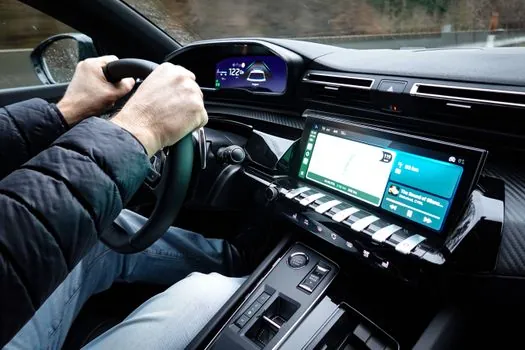
Integrated steering-drive axles combine propulsion and steering actuation in a single assembly, eliminating the conventional steering rack and enabling independent torque and direction commands per wheel, with Zhejiang Geely Holding Group holding dominant filed positions across EP and HU jurisdictions via a dual-motor architecture [S1].
The Geely dual-motor layout dedicates one motor to traction through a transmission mechanism and a second motor to steering actuation, targeting autonomous and next-generation vehicle platforms where steer-by-wire and drive-by-wire converge [S1]. The IP space around integrated steering-drive is differentiated, meaning limited competition, and shows 3+ patent families concentrated at Geely rather than fragmented across many assignees [S1].
Selection Criteria: When to Specify Multi-Speed, Single-Speed, or In-Wheel
For high-speed cruising efficiency, multi-speed e-axles (Porsche Taycan pattern, 2-speed shift at 70 km/h) reduce motor RPM at highway speed and recover measurable range, at the cost of added mechanical complexity and NVH tuning burden [S3].
For mass-market single-motor platforms, single-speed reduction gears in the 7:1 to 10:1 ratio range remain the default because they minimize moving parts, cost, and packaging volume while keeping the motor in its peak efficiency zone for typical urban duty cycles [S3]. For autonomous and premium AWD platforms, integrated steering-drive or independent in-wheel hub motors enable torque vectoring and per-wheel control at the cost of unsprung mass penalties on hub layouts and packaging constraints on steering-drive units [S1].
Standards, Sourcing, and IP Signals to Track

Patent assignees are tracked under IPC codes B60K (vehicle propulsion) and H02K (dynamo-electric machines) by WIPO, with PatSnap Analytics and similar IP tools mapping assignee concentration, jurisdiction spread, and filing velocity across the four e-axle clusters [S1].
Key engineering specifications to monitor through 2026: motor speed targets of 52,000 RPM in next-generation traction units, 20% powertrain mass reduction from axial-flux dual-rotor designs, 15% energy consumption improvement on scenario-optimized AFPM units, fixed reduction ratios in the 7:1 to 10:1 band for single-speed e-axles, and the 70 km/h first-to-second shift point used in the ZF two-speed Taycan transmission [S1][S3]. As one analyst note put it, "the multi-speed EV transmission is moving from niche to necessity" for high-performance and long-range platforms where single-speed highway efficiency losses become commercially material [S3].
Trackable signals through the rest of 2026: axial-flux production part numbers entering Tier 1 supply, Geely licensing activity on integrated steering-drive IP, and the 2026 OEM RFQ cadence for dual-planetary e-axle modules in the 150-300 kW class. For related context on the upstream motor market driving these architectures, see the EV Traction Motor Demand 2026-2030 analysis, and for a granular e-axle supplier tier map, the Pressure Transmitter Suppliers 2026 spec map covers the Tier 1/2/3 selection logic in an adjacent instrumentation segment.
Spec-level background on the components involved: pressure transmitter, flow meter, and industrial valve.