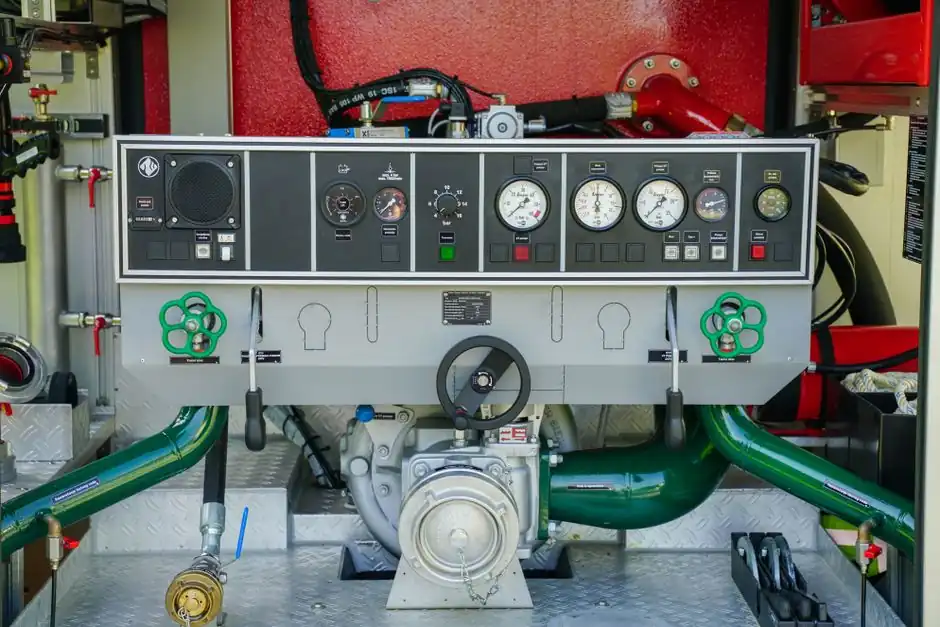
Electric-driven high-pressure plunger pumps span 0.13 GPM to 240 GPM (0.49 to 908 LPM) at 100 PSI to 10,000 PSI (6.9 to 689 BAR) in the commercial envelope, with ceramic-plunger triplex models pushing peak pressure to 300 MPa (~43,500 PSI) on the ultra-high-pressure end [S1][S2].
Selection is driven by four axes: required flow, peak pressure, duty cycle, and the hazardous-area classification of the installation site. Each of those axes maps to a different certification body, so specifiers must align the ATEX/IECEx zone, ISO quality-system audit, and any marine or process-plant class requirement against the specific pump model and serial number before purchase, not after.
Operating Envelope and How Performance Is Set
Flow and pressure in a plunger pump are not independent ratings; they sit on a single characteristic curve defined by plunger diameter, stroke length, and crankshaft speed [S3]. Reducing speed or shortening stroke at the same plunger diameter moves the operating point down both axes, which is how a single AR-style electric triplex is derated from rated flow to a lower GPM without changing hardware [S3].
The 2026 commercial catalog still shows brass, nickel-aluminum-bronze, and stainless steel fluid ends as the three default material options, with stainless specified for severe-service chemistry and NAB used for seawater and offshore duties [S1]. Reverse-osmosis supply-vessel packages quote 228 L/min at 345 bar as a representative steady-state point, showing the upper end of the medium-pressure class used in marine desalination [S5].
Triplex Versus Quintuplex and Wobble-Plate Architecture
Triplex (three plungers, crankshaft-driven) and quintuplex (five plungers) are the two architectures specified for continuous-duty industrial and oilfield service; wobble-plate (axial) pumps replace the crankshaft with a cam and run the plungers parallel to the input shaft, trading peak pressure for compact size [S3].
Plunger diameter in the 16–200 mm range and stroke from 20 mm to 120 mm are the two physical levers on the characteristic curve: smaller diameter and shorter stroke raise pressure at the cost of flow, while larger diameter and longer stroke raise flow at the cost of pressure ceiling [S2]. For a fixed motor horsepower, doubling pressure roughly halves flow, which is why high-pressure cleaning and hydrostatic-testing skids pair a small-bore, long-stroke triplex with a relatively modest electric drive.
Material and Surface-Finish Choices That Drive Service Life
Ceramic plungers with a surface finish of Ra 0.004 µm are the benchmark for extended packing life; BBP rates its 3ZH family at a 4-year wear-part service interval on that finish [S2]. Cylinder heads in aluminum are adequate for general cleaning, brass is the default for soap and chemical injection, and stainless steel is the rule for corrosive and high-temperature fluids [S3].
Plunger scoring is the dominant failure mode: hard feed water, dirt ingestion, and cavitation each take chips out of the plunger or even crack a solid ceramic rod, after which the packing follows within weeks [S3]. The mitigation is a stacked set of guards, including inlet filtration, an NPSH margin on the suction side, and feed-water temperature held below the vapor-formation point for the local static head, rather than any single component swap.
Certification Path: ISO 9001, ATEX/IECEx, and Class Society Marks
Build quality is normally evidenced by an ISO 9001 certificate issued to the pump manufacturer, not to a distributor; the certificate scope statement must name positive-displacement reciprocating pumps or the relevant product family, and the certificate must be verifiable through the issuing accreditation body's online register [S7][S2]. For hazardous-area use, the pump data plate must carry an ATEX or IECEx marking string that includes the equipment group, category, gas or dust group, and temperature class, and the certificate number must be cross-checked against the ATEX 2014/34/EU notified-body database or the IECEx OD database before order release.
For offshore and marine work, additional class society marks (ABS, DNV, BV, LR) are typically specified in addition to ISO 9001, and the reverse-osmosis supply-vessel case shows the 345 bar / 228 L/min rating being delivered as a class-approved package, not a stock pump with paperwork added later [S5]. The audit failure mode is a valid ISO 9001 certificate on a different product line, or a legitimate ATEX certificate that does not cover the exact model and serial number range ordered; both are common and both are caught only by reading the certificate scope text line by line.
Selection Criteria and Comparison Matrix
The main options line up against four decision criteria: peak pressure, flow, duty cycle, and hazardous-area rating. Comparing the BBP 3DP20 (350 kg plunger load, 20 mm stroke, 50 kg bare-pump weight) against the 3ZH120 (7,000 kg plunger load, 120 mm stroke, 1,800 kg) shows the spread: the 3DP20 sits in the compact ultra-high-pressure cleaning and metering band, while the 3ZH120 covers oilfield water injection and high-flow fracturing [S2].
For battery-driven mobile electric units, the practical ceiling is 1,200 PSI at 1/4 to 8 GPM, with sub-85 dB noise and up to 74% system efficiency compared to sub-25% for gas-powered equivalents, which is the figure that should be compared against diesel or AC-grid stationary drives when total cost of ownership is being argued [S4]. Stationary AC-grid pumps are not constrained by battery energy density, so high-flow applications, including floodwater removal, sewage treatment, and large-volume irrigation, remain outside the mobile-electric envelope and require either grid AC or engine drive [S4].
Application Fit and Where Electric Plunger Pumps Are Not the Right Tool
Electric plunger pumps fit soft wash, power washing, lawn care, mosquito control, portable sanitation, disinfection sprayers, agricultural sprayers, evaporative cooling and misting, and chemical injection or metering; they are a poor fit for floodwater removal, sewage treatment, irrigation, or any application discharging large fluid volumes, where larger mobile gasoline pumps or stationary AC-grid units are specified instead [S4].
On a process skid, the same electric triplex is typically specified for hydrostatic testing, reverse-osmosis feed boosting, and high-pressure water descaling; the BBP decision matrix maps 200–2,000 PSI cleaning and metering onto the 3DP family and continuous process duty, including descaling, jetting, and oilfield injection, onto the 3ZH family, with pressure and flow at the rating point calculated from the characteristic curve rather than read off a marketing brochure [S2].
Common Audit Failure Points and How to Verify a Certificate
The four recurring audit failures on plunger-pump certificates are: an ISO 9001 certificate held by the trading company rather than the actual manufacturing site, an ATEX or IECEx certificate that covers a different model number or a different temperature class, a class society letter that names the wrong rated pressure or flow, and a quality manual that has not been reissued after a product-line change. To verify, the auditor pulls the certificate PDF, reads the scope text, and checks the model-number list against the serial number on the data plate of the unit being delivered. [S3]
The supplementary documentation that should sit in the vendor's technical file alongside the certificate is the characteristic curve for the exact plunger diameter being shipped, the packing and seal kit list with current part numbers, the NPSH-r curve for the rated speed, and the torque or horsepower demand at the rated operating point, so the buyer can confirm motor sizing on the same form the manufacturer used. For oilfield and process-plant orders, the same file should also reference material certificates for the fluid end and any NACE MR0175 compliance statement if the service is sour.
Two trackable signals to watch over the next procurement cycle: first, whether the manufacturer's ISO 9001 certificate scope text explicitly names high-pressure reciprocating pumps or only a generic "industrial pumps" line, and second, whether the ATEX or IECEx certificate is issued under the latest edition of IEC 60079-0 or only an earlier revision, since the edition number controls whether the certificate is accepted in the destination jurisdiction.
The underlying component specifications are covered under lighting equipment and electric lamps, plunger pump, and safety certification.
This topic is covered further in Cylindrical vs Conical Ladle Shells: Heat Loss and Pouring Control in 2026.