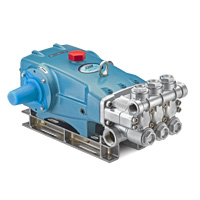
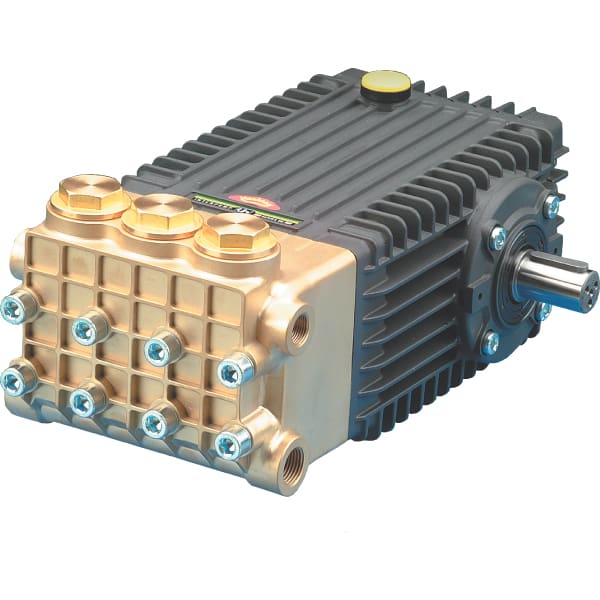
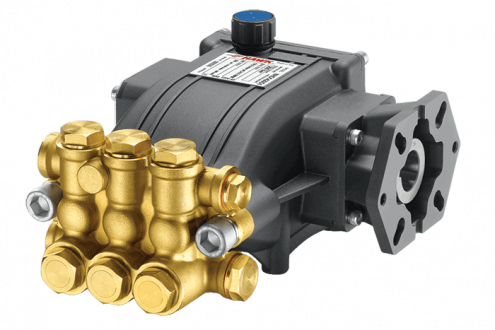
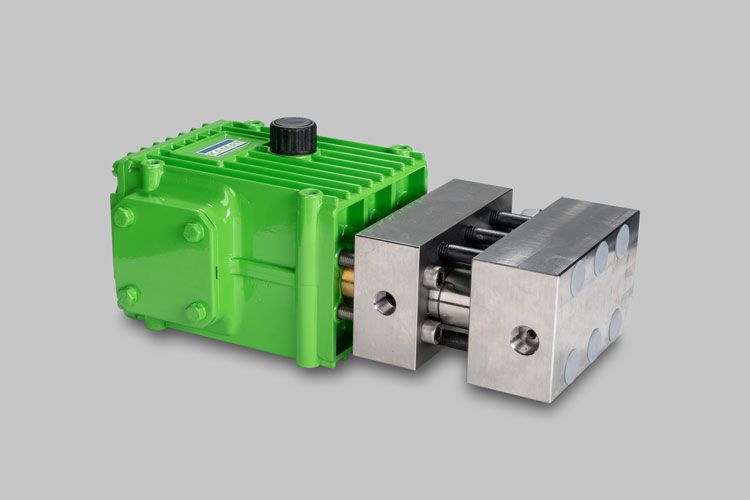
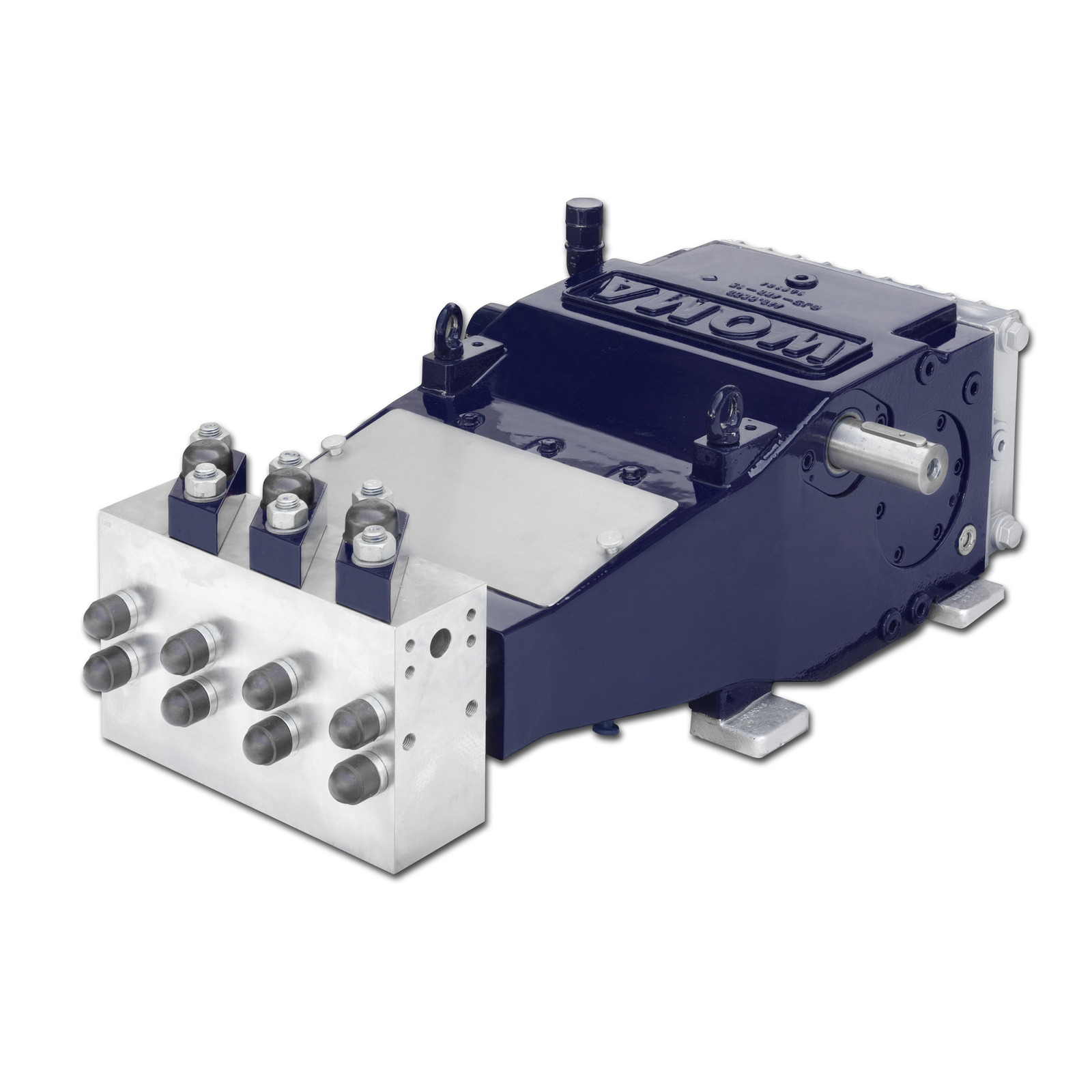
A plunger pump is a reciprocating positive-displacement pump in which a smooth, polished plunger slides back and forth through a stationary high-pressure seal to draw fluid in and force it out. Because the packing does not travel with the element, plunger pumps reach far higher discharge pressures than seal-on-piston designs, commonly 70 to 2,070 bar (1,000 to 30,000 psi) and, in heavy industrial and waterjet duty, several thousand bar.
They are the workhorse behind high-pressure cleaning, hydroblasting and surface preparation, reverse-osmosis desalination, waterjet cutting, oil-and-gas injection and well service, and precision chemical metering. This guide covers how they work, the triplex and quintuplex configurations, the specifications that drive selection, and the API and ISO standards that govern process-grade units.
Photo: Hammelmann Oelde, CC BY-SA 3.0, via Wikimedia Commons
This guide is aimed at procurement and design engineers specifying high-pressure pumps. It covers 6 chapters from working principle, pump configurations, drive technologies, wetted materials, and key specification parameters, to selection decisions, with 7 selection FAQs and manufacturer comparisons. All parameters reference the API 674 and ISO 13710 standards for reciprocating positive-displacement pumps, API 675 for controlled-volume metering pumps, and ANSI/HI guidelines.
Chapter 1 / 06
What is a Plunger Pump
A plunger pump is a reciprocating positive-displacement pump. A crankshaft converts rotary motor motion into the back-and-forth stroke of one or more plungers, each running inside its own cylinder. On the suction stroke the plunger retracts, chamber volume grows, pressure falls, the suction check valve opens and the discharge check valve closes, so fluid is drawn in. On the discharge stroke the plunger advances, volume shrinks, pressure rises, the suction valve closes and the discharge valve opens, so fluid is expelled. The two spring-loaded check valves are actuated by the chamber pressure itself, not by the crankshaft, which is what makes the action self-timing and self-priming once wetted.
The defining feature, and the source of the name, is the seal. In a piston pump the high-pressure sealing rings are mounted on the piston and travel with it through the bore. In a plunger pump the high-pressure seal, called the packing, is fixed in a stuffing box, and the plunger, a hard, perfectly cylindrical rod, slides through that stationary packing. This stationary-seal arrangement has two consequences that define the whole product class: the plunger surface can be made hard, smooth and dimensionally precise (commonly solid ceramic), and the packing can be re-tensioned or replaced from the outside without disturbing the cylinder. The result is reliable sealing at very high pressure, which is why plunger pumps cover roughly 70 to 2,070 bar (1,000 to 30,000 psi) in general industrial use and climb to several thousand bar in waterjet and descaling service.
Reciprocating pumps are among the oldest mechanical pumps, with the basic suction-and-force principle predating modern industry by centuries. Their relevance grew sharply with three modern demands: ultra-high-pressure water for cutting and cleaning, high-pressure injection and well-service work in oil and gas, and precise low-flow chemical dosing. Each of these needs a pump whose flow is set by mechanical geometry rather than by a pressure-dependent impeller. A centrifugal pump loses flow as the system pressure rises and stalls at its shut-off head, whereas a plunger pump delivers essentially the same volume per revolution whether it is pushing against 50 bar or 1,500 bar, which is exactly the behavior these high-pressure duties require.
Because flow depends on displacement and speed rather than on discharge resistance, the pump curve is nearly a vertical line: flow is almost constant across the pressure range, and any blockage downstream causes pressure to climb until something gives. This is the single most important behavioral fact for anyone integrating a plunger pump. Every installation must include a pressure-relief or safety valve and, in most cases, a pulsation dampener and a suction stabilizer. A plunger pump deadheaded against a closed valve with no relief path will rupture a line or the pump itself, not simply spin uselessly the way a centrifugal pump does.
Four engineering metrics determine plunger pump quality and total cost of ownership: rated discharge pressure, delivered flow at that pressure, volumetric efficiency, and the wear life of the consumable packing and valves. The first two define what the pump can do; the last two define how often it stops to be serviced. A plunger pump is a serviceable machine by design, with packing, valves and plungers treated as scheduled wear parts, so the real selection question is not only the rated duty point but the cost and interval of keeping the pump at that duty point over years of operation.
Chapter 2 / 06
Pump Configurations and Types
Plunger pumps are classified first by the number of plungers, because that single choice sets the flow pulsation, the vibration, and the size of dampening hardware. Each plunger delivers flow only during its discharge half-stroke, so a single plunger produces a strongly pulsating output. Phasing several plungers evenly around the crankshaft overlaps their delivery strokes and smooths the combined flow. The table below compares the common configurations on residual flow pulsation, the practical figure that drives dampener sizing and downstream stability.
Configuration
Plungers
Crank Phasing
Approx. Flow Pulsation
Typical Use
Simplex
1
single
very high
Metering, dosing, lab
Duplex
2
180°
~20%
Legacy mud pumps, low speed
Triplex
3
120°
~5 to 6%
Cleaning, RO, process, well service
Quintuplex
5
72°
~2 to 3%
API 674 process, pipeline test
Simplex pumps use one plunger and are reserved for controlled-volume metering and dosing, where flow is deliberately small and a pulsation dampener or a smoothing control system handles the rest. Their advantage is mechanical simplicity and precise stroke-length flow adjustment. Duplex pumps, two plungers phased 180 degrees apart, were the classic configuration for oilfield drilling-mud service and other low-speed heavy duty, but their pulsation is still around 20 percent, so modern designs lean toward more plungers.
Triplex is the dominant configuration in the field. Three plungers phased 120 degrees apart hold residual flow pulsation near 5 to 6 percent, a sweet spot of smooth flow, compact frame, and manageable cost. The overwhelming majority of high-pressure cleaning blocks, reverse-osmosis feed pumps, waterjet direct-drive crankshafts, and oil-and-gas injection pumps are triplex. Quintuplex pumps add two more plungers, dropping pulsation to roughly 2 to 3 percent, and are specified where the lowest possible pulsation and the smoothest pressure are worth the extra cost, such as API 674 process duty and pipeline hydrostatic testing.
A second classification is by stuffing-box and fluid-end style. Packed-plunger pumps are the standard high-pressure design, with chevron packing in a stuffing box around each plunger. They always weep a small, controlled amount of fluid past the packing, which lubricates and cools the running surface, so they are best suited to clean, non-hazardous media such as water. Seal-less diaphragm-balanced pumps, exemplified by the Wanner Hydra-Cell, replace the packing with a hydraulically balanced multiple-diaphragm element. The diaphragm sees only about 0.21 bar of differential regardless of discharge pressure, so the medium is fully contained, the pump can run dry, and small abrasives are tolerated, at the cost of a lower maximum pressure (standard models around 172 bar) and higher unit cost.
A third axis is the duty class, which maps configuration and build quality to the application. The table below pairs the major duty classes with their typical pressure envelope and representative manufacturers, so a buyer can locate the right family quickly before drilling into individual models.
Duty Class
Typical Pressure
Typical Flow
Representative Makers
Commercial cleaning / RO
7 to 690 bar
0.5 to 908 L/min
CAT Pumps, General Pump, Hawk, Udor
Industrial high pressure
up to ~3,500 bar
10 to 1,000+ L/min
KAMAT, Hammelmann, Woma
API 674 process
to ~700 bar
duty specific
Ruhrpumpen RDP, PSG Mouvex, Gardner Denver
Controlled-volume metering
to ~350 bar
mL/h to L/min
ProMinent, Milton Roy, LEWA
Seal-less diaphragm-balanced
to ~172 bar
low to medium
Wanner Hydra-Cell
Chapter 3 / 06
Drive Technologies and Standards
How the plungers are driven separates the product families and, especially in ultra-high-pressure work, decides whether a project is even feasible. There are two main drive architectures: the direct-drive crankshaft and the hydraulic intensifier. The choice is governed mostly by the target pressure, with a practical crossover in the waterjet world around 4,480 bar (65,000 psi).
Direct-drive crankshaft pumps connect an electric motor, through a reduction gear or belt, to a crankshaft that strokes the plungers directly. They are mechanically simple, efficient because there are no hydraulic conversion losses, and cover the vast majority of cleaning, process, injection and waterjet duty up to the low tens of thousands of psi. Because they wear at the plunger and packing as the only conversion stage, their maintenance is concentrated in a few well-understood consumable parts. This is the configuration of essentially every commercial and industrial triplex pump discussed in this guide.
Hydraulic intensifier pumps, used at the extreme top of the pressure range, drive a large hydraulic piston with oil, which acts on a much smaller plunger to multiply the pressure by the area ratio. They are complex, including a hydraulic power unit, oil reservoir, manifold and intensifier assembly, and at very high pressure their overall efficiency falls (intensifiers running near 90,000 psi are generally under 60 percent efficient). In waterjet cutting the rule of thumb is that above roughly 4,480 bar (65,000 psi) the direct-drive crankshaft is no longer practical and an intensifier is required; below that, direct drive is usually the more efficient choice. Intensifiers earn their keep on multi-nozzle, high-volume, thick-material cutting where their longer service life offsets the lower efficiency.
Process-grade plunger pumps are specified against published standards, which is essential for oil-and-gas, petrochemical and water-treatment procurement because it fixes mechanical robustness, testing and documentation requirements. The table below summarizes the standards a buyer is most likely to cite, with their scope.
Standard
Issuer
Scope
API 674
API
Reciprocating positive-displacement pumps for process and oil-and-gas duty
ISO 13710
ISO
Reciprocating positive-displacement pumps for petroleum, petrochemical and gas industries
API 675
API
Controlled-volume metering pumps (packed-plunger and diaphragm)
ANSI/HI 7.8
Hydraulic Institute
Controlled-volume metering pump piping guideline
API 688
API
Pulsation and vibration control for positive-displacement machinery, including reciprocating pumps
API 674 (Positive Displacement Pumps, Reciprocating) is the central standard for heavy-duty process plunger pumps; its third edition defines the mechanical, material, testing and documentation requirements for severe service. ISO 13710 is the closely aligned international standard for the same class of pumps in the petroleum, petrochemical and natural-gas industries, and manufacturers such as Ruhrpumpen build their RDP triplex and quintuplex ranges to both. API 675 governs controlled-volume (metering) pumps, where accuracy of delivered volume rather than raw pressure is the headline requirement, and it covers both packed-plunger and diaphragm metering types. For pulsation-sensitive installations, API 674 carries its own pulsation and vibration design approaches and API 688 is the dedicated reference for the pulsation and vibration study of positive-displacement pumps (API 618 is the parallel standard for reciprocating compressors, not pumps), and a properly sized pulsation dampener (a gas-charged chamber isolated by a bladder or diaphragm) is added to smooth the residual flow ripple even on a triplex or quintuplex unit.
Chapter 4 / 06
Wetted Materials and Fluid End
The fluid end, the part of the pump that contacts the pumped medium, decides corrosion life, abrasion life and contamination risk. Three component groups matter most: the plunger wear surface, the manifold (fluid-end body), and the consumable seals and valves. Selecting them wrong leads to scored plungers, leaking packing, pitted manifolds or, in chemical service, product contamination.
Plungers are most often solid ceramic, typically high-purity alumina (Al2O3) or zirconia, because ceramic is extremely hard, gives a low-friction running surface against the packing, and resists the fine abrasion that destroys steel plungers in dirty water. Where ceramic is unsuitable, hardened or ceramic-coated stainless steel is used. The plunger surface finish is as important as the material: a polished, concentric plunger is what allows the stationary packing to seal at high pressure with acceptable wear, and any scoring of the plunger immediately shortens packing life.
Manifolds are matched to the medium. 316L stainless steel is the default for water, condensate, light hydrocarbons and many chemicals; nickel-aluminum-bronze suits seawater and brackish reverse-osmosis service; duplex 2205 stainless adds chloride and stress-corrosion resistance for seawater and brine; and nickel alloys such as Hastelloy handle aggressive acids and oxidizers. Heat-treated stainless block-style manifolds are standard on commercial triplex pumps because they combine corrosion resistance with the fatigue strength needed for cyclic high-pressure loading.
Packing and valves are the scheduled wear parts. The stationary high-pressure packing is usually a stack of chevron (vee) rings in PTFE, UHMW polyethylene or graphite-impregnated fabric, with elastomer O-rings (NBR for general water, FKM for hydrocarbons and moderate chemicals, FFKM for aggressive media). The suction and discharge check valves use hardened stainless or stellite-faced seats with spring return, and in abrasive duty the valve and seat hardness is raised to extend interval. The table below maps common media to a sensible fluid-end material set; use it for first-pass selection only, and always confirm against the manufacturer corrosion chart for the exact concentration, temperature and abrasive load.
Medium
Plunger
Manifold
Seals
Clean water / cleaning
Solid ceramic
316L or NAB
UHMW packing, NBR O-rings
Seawater RO feed
Solid ceramic
Duplex 2205 or NAB
FKM O-rings
Light hydrocarbons
Ceramic or coated steel
316L
FKM packing and O-rings
Acids / oxidizers
Ceramic
Hastelloy / nickel alloy
PTFE packing, FFKM O-rings
Abrasive slurry (light)
Solid ceramic
Hardened stainless
Graphite packing, hard valve seats
Chapter 5 / 06
Key Specification Parameters
Reading a plunger pump datasheet means separating the geometry-fixed numbers from the duty-point numbers. The same pump can list dozens of figures, but a handful drive the selection: rated pressure, delivered flow, drive speed and power, volumetric efficiency, required suction conditions (NPSH), and pulsation. Each is explained below, with the formulas that connect them.
Rated pressure is the maximum continuous discharge pressure the fluid end and packing are certified for. It is the number that places the pump in its duty class, from commercial cleaning blocks (around 7 to 690 bar, or 100 to 10,000 psi) to heavy industrial units reaching about 3,500 bar, to ultra-high-pressure waterjet duty above 3,450 bar. Always separate continuous rated pressure from any short-term peak rating, and confirm the relief valve is set below the rated pressure.
Flow rate is fixed by geometry and speed, not by discharge pressure. The theoretical flow is the swept volume per stroke times speed times the number of plungers: Q = (pi/4) x D squared x s x n x z, where D is plunger diameter, s is stroke, n is crankshaft speed in rev/min and z is the plunger count. Because the relationship is geometric, you change flow by changing speed (a variable-frequency drive is the standard method) or by changing plunger diameter, never by throttling the discharge. Throttling only raises pressure until the relief valve opens.
Volumetric efficiency is the ratio of delivered flow to theoretical flow, and it accounts for the small losses past the packing and the brief back-flow while the check valves close. It typically runs from about 97 percent at low speed (near 200 rev/min) down to roughly 88 to 92 percent at high speed (near 1,750 rev/min), so a high-speed selection trades a few percent of efficiency for a smaller, cheaper frame. Drive power follows directly from pressure and flow; a convenient field estimate is P (kW) is approximately Q (L/min) times p (bar) divided by 520, which already folds in a representative pump efficiency near 87.5 percent. This single relationship explains why higher pressure forces lower flow at a fixed motor size.
The table below collects the core specification parameters, the unit they are stated in, and what each one controls during selection. It is the quick-reference a buyer can lay next to a manufacturer datasheet.
NPSH (net positive suction head) deserves special attention on reciprocating pumps. Because each plunger accelerates and decelerates every stroke, the instantaneous suction demand peaks well above the average flow, so the suction line must supply more than the steady-state number suggests. If the available NPSH falls below the required value, the chamber pressure dips below the fluid vapor pressure, vapor bubbles form and then collapse violently as pressure rises, and the pump cavitates: knocking noise, fluctuating output, and rapid erosion of valves and plungers. The cure is a short, large-diameter, well-flooded suction line, often a charge pump or suction stabilizer, lower speed, and keeping the fluid well below its boiling point.
Chapter 6 / 06
Selection Decision Factors
To turn the preceding five chapters into a specific model, follow the decision sequence below. Most selection mistakes come not from a single wrong number but from deciding the easy parameters first and discovering a constraint conflict at the end. These eight steps double as a fixed RFQ template.
Pressure and flow duty point: Fix the required discharge pressure and the required flow together, because hydraulic power is their product. Confirm whether the pressure is continuous or peak, and leave margin so the relief valve sets below the rated pressure.
Configuration: Choose simplex for metering, triplex for the broad middle of cleaning, RO and process duty, and quintuplex where the lowest pulsation is worth the cost. More plungers mean smoother flow, smaller dampeners and longer valve life.
Drive architecture: Direct-drive crankshaft for the great majority of duty up to the low tens of thousands of psi; hydraulic intensifier only at ultra-high pressure above roughly 4,480 bar (65,000 psi) in waterjet work.
Wetted materials: Match plunger, manifold and seals to the medium per Chapter 4. Ceramic plungers for abrasive water, duplex or nickel alloys for chloride or acid service, and the right elastomer family (NBR, FKM, FFKM) for the chemistry.
Containment and emissions: Packed plunger for clean, non-hazardous media where a small controlled weep is acceptable; seal-less diaphragm-balanced (Hydra-Cell style) where any leakage of toxic, flammable or high-value media is unacceptable.
Suction and NPSH: Verify available NPSH against the required value with margin, design a short flooded suction line, and add a charge pump or suction stabilizer if the margin is tight. This is the most common cause of premature valve and plunger failure.
Standards and certification: Specify API 674 / ISO 13710 for process and oil-and-gas duty, API 675 and ANSI/HI 7.8 for metering duty, and require the certified performance curve and the wetted-material corrosion chart before ordering.
Total cost of ownership: Add the scheduled cost of packing, valves and plungers, plus the labor and downtime to change them, to the purchase price. A pump rated exactly at the duty point but serviced often can cost more over five years than a slightly larger, slower, longer-lived unit.
One last dimension that buyers routinely underweight is serviceability and spare-parts logistics. A plunger pump is a wear machine: packing, valves and plungers are consumables changed on a schedule, so local spare-parts stock, kit availability, and clear service documentation determine real uptime more than the headline efficiency number. Established makers, including CAT Pumps, KAMAT, Hammelmann, Ruhrpumpen, PSG Mouvex and Wanner, maintain spare-parts channels and rebuild kits, which is what keeps a high-pressure line producing five and ten years after commissioning. Confirm the rebuild interval, the kit part numbers and the lead time before you commit, not after the first packing change.
FAQ
What is the difference between a plunger pump and a piston pump?
Both are reciprocating positive-displacement pumps, and the difference is the seal. In a piston pump the high-pressure seal rings travel with the piston inside the cylinder bore. In a plunger pump the high-pressure packing is stationary in the stuffing box and a smooth, polished plunger slides back and forth through it. Because the seal does not move with the element, the plunger surface can be made hard and perfectly cylindrical, and the packing can be re-tensioned or replaced without re-boring the cylinder. This is why plunger pumps reach much higher discharge pressures, commonly 70 to 2,070 bar (1,000 to 30,000 psi) and beyond, while piston pumps dominate lower-pressure, higher-flow duties.
How do I calculate the flow rate of a plunger pump?
Theoretical flow rate is the swept volume per stroke multiplied by speed and the number of plungers: Q = (pi/4) x D squared x s x n x z, where D is plunger diameter, s is stroke length, n is crankshaft speed and z is the number of plungers. Because the pump is positive displacement, flow is set by geometry and speed, not by discharge pressure, so the curve is nearly a vertical line. Real delivered flow is lower than theoretical by the volumetric efficiency, which runs roughly 88 to 97 percent depending on speed, valve dynamics and packing leakage. To change flow you change pump speed (VFD) or plunger diameter, not the discharge valve.
Why does a triplex pump pulsate less than a duplex or simplex pump?
Each plunger delivers flow only during its discharge half-stroke, so a single plunger (simplex) produces flow for about half the cycle and zero for the rest, giving very high pulsation. Phasing more plungers around the crankshaft overlaps their delivery strokes. A triplex (three plungers at 120 degrees) holds residual flow pulsation near 5 to 6 percent, and a quintuplex (five plungers at 72 degrees) drops it to roughly 2 to 3 percent. Lower pulsation means smoother pressure, lower vibration, smaller pulsation dampeners and longer valve and packing life, which is why API 674 process duty favors triplex and quintuplex designs.
What pressure and flow ranges can plunger pumps reach?
General-purpose industrial plunger pumps cover roughly 70 to 2,070 bar (1,000 to 30,000 psi). Commercial triplex blocks such as CAT Pumps span about 7 to 690 bar (100 to 10,000 psi) and 0.5 to 908 L/min (0.13 to 240 US gpm). Heavy industrial units such as KAMAT triplex pumps reach up to about 3,500 bar with drive power into the hundreds of kilowatts. Ultra-high-pressure waterjet duty begins above 3,450 bar (50,000 psi); above roughly 4,480 bar (65,000 psi) a direct-drive crankshaft pump is no longer practical and a hydraulic intensifier is used. Higher pressure almost always means lower flow at a given drive power, because hydraulic power is the product of pressure and flow.
What materials are used for the plunger, packing and valves?
The plunger wear surface is usually solid ceramic (aluminum oxide or zirconia) or ceramic-coated stainless steel, chosen for hardness and a low-friction running surface against the packing. The fluid-end manifold is 316L stainless steel, nickel-aluminum-bronze, duplex 2205 or Hastelloy depending on the medium. The stationary packing is typically chevron (vee) stacks of PTFE, UHMW polyethylene or graphite-impregnated fabric, with NBR, FKM or FFKM elastomer O-rings. Suction and discharge check valves are hardened stainless or stellite-faced seats with spring return. Abrasive or corrosive service drives the choice toward ceramic plungers, duplex or nickel-alloy manifolds and harder valve seats.
What is NPSH and why do plunger pumps cavitate?
Net positive suction head (NPSH) is the margin of inlet pressure above the fluid vapor pressure available at the pump suction. Reciprocating pumps are sensitive to it because the plunger accelerates and decelerates each stroke, so the instantaneous suction demand peaks well above the average flow. If available NPSH falls below the required value the chamber pressure dips below vapor pressure, vapor bubbles form and then collapse violently as pressure rises, which is cavitation. Symptoms are knocking noise, flow and pressure fluctuation, and rapid erosion of valves and the plunger. Fixes include shortening and enlarging the suction line, adding a charge pump or suction stabilizer, lowering speed, and keeping the fluid well below its boiling point.
When should I choose a seal-less or diaphragm plunger pump instead of packed plunger?
Choose a seal-less design when any external leakage is unacceptable: toxic, flammable, volatile or high-value media, or strict emissions limits. A packed plunger pump always weeps a small controlled amount past the packing, which lubricates and cools it. A hydraulically balanced multiple-diaphragm pump such as the Wanner Hydra-Cell replaces the packing with a diaphragm that keeps the diaphragm differential near 0.21 bar regardless of discharge pressure, so the medium stays fully contained, the pump can run dry, and it tolerates small abrasives. The trade-off is lower maximum pressure than a heavy packed plunger pump (standard Hydra-Cell models reach about 172 bar) and higher unit cost, so packed plunger remains the default for clean high-pressure water duty.
Plunger Pump Manufacturers
Source-backed product routes. Open a company dossier for procurement scope and cited evidence.
General Pump's Minnesota headquarters includes distribution and manufacturing facilities, and its official history describes its plunger-pump development.
Published product fact
General Pump TSP Series 66 pressure-cleaning pumps with official stated flows from 3.6 to 5.0 GPM.