
Engineered quartz slabs contain 90-95% natural quartz aggregate bound by 5-10% polymer resin, delivering Mohs hardness 7, conchoidal fracture behaviour, and a non-porous surface that needs no sealer in service [S2][S3].
U.S. market pricing for quartz surfacing spans $50-$150 per sq ft, with popular veined patterns clustering at $80-$100 per sq ft; European countertop installs land at $130.8-$163.5 per sq m (120-150 EUR) depending on style, pattern, and thickness [S2].
Material definition: what "quartz" means in a 2026 spec sheet
Quartz in building use is an engineered composite, not a quarried slab: ground natural quartz, ancillary minerals, and 5-10% polymer resin are mixed, vibrated, and cured at high temperature, then polished to a controlled thickness [S3]. The output carries a Mohs 7 rating and breaks conchoidally because the SiO2 tetrahedra structure has no cleavage planes, which is the metallurgical reason it holds a polished edge without chipping along grain [S2].
The engineered format is the key difference from natural stone. Because colour, grain, and veining are blended in a controlled vat, slab-to-slab variation is held to a tight batch tolerance, which is the property spec writers actually care about when 100+ matching tops are needed on one site [S3][S4]. Compared with granite or marble, engineered quartz is harder, fully non-porous, and exempt from the periodic sealing regime that natural stone still demands [S3].
Selection criteria: the four gates that decide a quartz spec
For commercial and multi-unit builds, four filters separate the shortlist: hardness/Mohs, porosity, batch colour consistency, and slab dimensional accuracy, all of which engineered quartz addresses out of the factory [S3][S4].
Hardness and impact resistance come from the 90-95% quartz content and are the reason engineered quartz is specified over natural marble on hotel vanities and reception counters [S3]. Non-porosity is the resin binder's contribution, and it is the single biggest hygiene argument: the surface does not absorb liquids, does not need sealing, and resists bacterial colonisation and staining in commercial kitchens and restrooms [S3][S4]. Batch colour consistency is the operational argument: a project requiring dozens of slabs gets reproducible texture, which is what kills natural stone on large fit-outs [S3][S4]. Dimensional accuracy is the fabricator's argument: a controlled process yields predictable thickness tolerances, which simplifies CNC cutting and reduces on-site rework [S4]. The full set of trade-offs an engineer has to weigh on a build is laid out in our construction-tools selection logic reference, where the same hardness-versus-finishability decision shows up in tool and consumable picks.
Style and slab family comparison
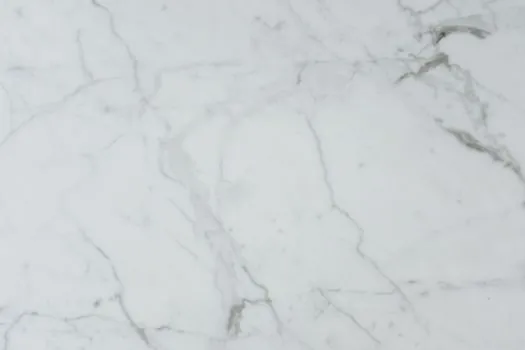
Four engineered-quartz style families dominate 2026 commercial specs: veined, solid colour, fine-grain/sanded, and bold or dramatic patterns, each tuned to a different traffic and lighting profile [S5].
Veined quartz mimics natural marble, suits hotel lobbies and reception desks, and reads well with backlit feature walls, but its visual variation pushes the batch-consistency problem to the limit [S5]. Solid colour quartz is the workhorse for multi-unit apartment kitchens, multi-unit bathrooms, and commercial restrooms where uniformity across hundreds of rooms is the design brief [S5]. Fine-grain or sanded-texture quartz is the hospital, school, and retail-checkout pick because the muted pattern hides day-to-day wear [S5]. Bold or dramatic patterns are reserved for bar tops, feature walls, and high-traffic reception counters where the slab is meant to be a focal point rather than a background [S5]. For spec-driven buyers comparing these options against a hard criteria list, our advanced-material spec map lays out the same kind of attribute-by-attribute pass for adjacent engineered surfaces.
Who engineered quartz is for, and where it is the wrong call
Engineered quartz is the right spec where the spec writer needs high scratch and impact resistance, a non-porous and low-maintenance surface, and reliable batch-to-batch colour across many slabs, which describes most hospitality, healthcare, retail, and multi-unit residential interiors [S3][S4].
It is the wrong spec where the brief calls for genuine natural-stone appearance with full geological variation, for outdoor facades exposed to long-term UV (resin binder yellows and degrades under sustained sun), for high-heat cooktop surrounds with no heat shield (thermal shock at edges is a known limit), or for budget countertops where a 12 mm solid-colour ceramic or laminate will pass the same use test at a fraction of cost [S2][S3]. The same engineering "this is not the right material" judgement comes up in our glass-quartz optical-grade spec guide, which covers the high-purity branch of the same mineral family.
Fabrication and on-site considerations
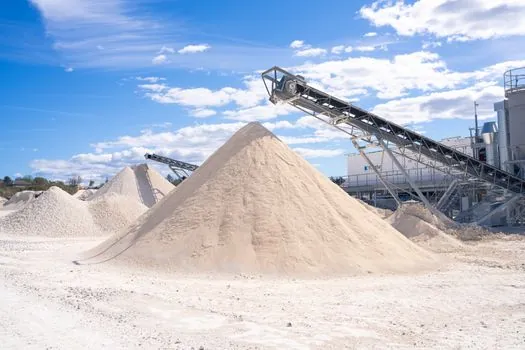
For large builds, three on-site factors decide whether the slab choice survives install: batch verification under the project's actual lighting, slab size for minimum-joint runs, and CNC tooling matched to the 90-95% quartz aggregate [S5].
Spec writers should require sample slabs and review them under the warm, cool, daylight, and LED lighting present on site, because a quartz colour that reads neutral in a warehouse can shift several shades under 3000K versus 5000K illumination [S5]. Maximum slab size, typically 3200 x 1600 mm in mainstream lines, drives joint layout for long reception tops and island runs, and the layout should be locked before slabs are ordered to keep batch colour continuous [S5]. Fabrication has to plan for the Mohs 7 hardness: water-cooled diamond tooling, slower feed rates, and proper dust extraction are the baseline, and the fabricator should be certified for engineered stone rather than only natural stone [S3]. For the heavier end of the build, where slabs, setting equipment, and material handling overlap, the same decision logic in our construction-machinery selection guide applies.
Standards, sourcing, and the maintenance contract
No single ISO or ASTM standard governs the "quartz surfacing" product category end-to-end; spec writers therefore work to property-level requirements (Mohs hardness, water absorption, stain resistance, dimensional tolerance) declared on the manufacturer's technical data sheet, and they require batch colour samples before release [S2][S3][S4].
Greener sourcing is a real angle for engineered quartz: no natural stone is quarried for its own sake, the aggregate is largely a byproduct of other quarrying and mineral operations, and the polymer resins used by the major lines are increasingly bio-based [S3]. The maintenance contract is short by design: no sealing, pH-neutral cleaners, no abrasive pads, and immediate wipe-down of staining agents such as coffee, wine, and turmeric, which the non-porous resin binder otherwise blocks from migration into the slab [S3][S4]. Quartz can also be upcycled at end of life into aggregate for terrazzo and road base, which closes most of the embodied-energy gap versus natural stone shipped intercontinental [S2].
The quartz material properties deep-dive is the right starting reference for engineers and buyers writing these next-year specs.
Related analysis: Clutch and Brake Selection for Pulp and Paper: Spec Map.