No single polymer survives every marine duty cycle. The working envelope for submerged and splash-zone plastics is set by water absorption (screened per ASTM D570), long-term creep under hydrostatic load, UV resistance in HALS-stabilised grades, chemical compatibility with dissolved salts and biological secretions, and cyclic impact retention, with HDPE piping systems additionally covered by ISO 4427 for operating pressures up to 25 bar at 20°C [S1].
Approval routing follows the application rather than the resin: DNV and Lloyd's Register cover non-metallic hulls, pipe fittings, rudder bearing bushings, and acrylic windows for submersibles, while Bureau Veritas certifies marine materials and equipment under Class Rules aligned with IMO and EU regulations, so the procurement specification must name the class society before the polymer [S1]. Within the engineering plastic family, ABS, HDPE, UHMW-PE, PTFE, and marine PVC foam are the materials with documented track records in hull, interior, and underwater hardware service.
Five property gates that decide a marine plastic
ASTM D570 water-absorption rate is the first filter: non-polar backbones in HDPE and PTFE drive uptake toward zero, while polar nylons absorb enough water to swell, warp, and lose tensile margin within months of immersion [S1]. The second gate is creep under sustained hydrostatic load, where UHMW-PE and HDPE retain dimensional stability far better than commodity polyolefins, a property that also drives the use of plastic pipe systems for shipboard water and ballast service. UV stability is the third gate and is formulation-dependent: standard ABS chalking and cracking under direct salt-air sun within a season, while HALS-stabilised grades (and marine formulations such as Trident E-ABS) are engineered specifically for that exposure [S1][S2]. Chemical resistance to dissolved salts, fuels, and biological secretions, plus cyclic impact retention against wave and vibration loading, round out the five gates; a material that passes all five is what fabricators and class surveyors accept as "marine-grade".
HDPE, UHMW-PE, PTFE, and ABS side by side
HDPE and UHMW-PE share a non-polar polyethylene backbone, giving both near-zero water absorption, but UHMW-PE extends the wear and abrasion envelope and is the default for bearing, chute, and high-friction wear surfaces; the broader HDPE family covers sheet, board, and pipe applications where the same corrosion resistance is needed at lower cost [S1]. PTFE sits at the top of the chemical-resistance and temperature ladder and is the natural choice for gland packings, valve seats, and any seal interface exposed to aggressive fuels or hydraulic fluids, and it is also a common constituent in plastic-rubber composite sealing systems. Marine-grade expanded ABS (Trident E-ABS) is classified under ASTM D4673 for material grouping and grade designation, and the expanded-cell formulation reduces weight while adding UV stabilisers that standard ABS lacks, making it the right call for painted interior cabinetry facings, bulkhead panels, headliner substrates, and console surrounds where standard ABS would fail from salt air and UV exposure [S2]. Expanded PVC foam board fills a different slot, serving as a low-weight, easy-to-fabricate substrate for marine interiors that do not see structural load.
Where each polymer belongs on a boat
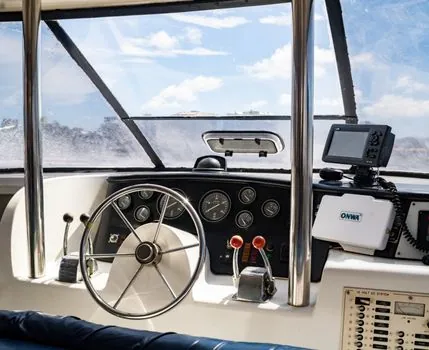
Component-level specification lines up cleanly with duty cycle. HDPE sheet handles structural and corrosion-loaded applications: cutting boards, fish boxes, bait wells, rub rails, and tank linings where impact, moisture, and cleaning chemicals coexist. UHMW-PE goes on the high-wear interfaces: hatch rollers, bumper strips, rudder bearing bushings, and similar sliding-contact parts. PTFE seals and seats handle the chemical and temperature extremes at valves and pump interfaces. Trident E-ABS is specified for interior structural-appearance parts, including cabinetry facings, door panels, bulkhead finishing panels, headliner substrate, console and instrument panel surrounds, and storage compartment liners in enclosed spaces, all applications where the panel must take paint, hold a fastener, and resist UV through a cockpit window or open deck [S2]. Expanded PVC foam board sits behind those ABS surfaces as a lighter, easier-to-fabricate non-structural panel where a painted finish is acceptable and structural load is low.
Selection criteria by depth, load, and exposure
Depth and pressure drive the first branch. For continuously submerged service, non-polar polyolefins (HDPE, UHMW-PE) and PTFE are the default because water absorption stays negligible and long-term creep is well characterised; nylons and other polar polymers are excluded from the candidate list once the part is fully submerged for more than a seasonal duty cycle [S1]. For splash-zone and atmospheric service, UV-stabilised grades matter more than hydrostatic creep, which is where HALS-stabilised ABS and PVC foam become competitive. Load type filters the next step: cyclic impact and wear point toward UHMW-PE, static structural pressure points toward HDPE, chemical and temperature extremes toward PTFE, and appearance plus paintability plus stiffness toward expanded ABS. Fabrication method closes the decision: ABS bonds with ABS cement and two-part adhesives and routes on standard woodworking tooling, while HDPE and UHMW-PE demand plastic-specific welding (hot-gas, extrusion, or butt-fusion) and tolerate adhesive bonding only with surface-prepped, primed joints [S2]. When a project crosses into high-pressure or large-diameter process piping, PE piping systems qualified to ISO 4427 or ASTM F714 at the rated 25 bar / 20°C envelope are the correct reference, with the jointing method (butt-fusion or electrofusion) called out in the same specification.
Failure modes and limits to engineer around
The most common marine-plastic failures are predictable and traceable to a missed property gate. Swelling and dimensional drift in polar polymers (notably unmodified nylon) trace to ASTM D570 water-absorption exceedance. Surface chalking, microcracking, and impact loss in standard ABS trace to missing UV stabiliser packages. Creep deformation in load-bearing PE components traces to under-specifying the design stress against long-term creep data at service temperature. Galvanic and chemical attack at interfaces trace to missing chemical-resistance checks against cleaning agents, fuels, and biological secretions. Each of these has a known mitigation (switch polymer family, add HALS package, derate stress, specify chemical-resistant grade), and the procurement specification should call out which gate is being tested rather than relying on a generic "marine-grade" label, because no universal certification exists for that term [S1]. Material selection and installation should also align with applicable class rules; for boat work in North America, the American Boat and Yacht Council (ABYC) governs construction practices for over 90% of boats built, and the plastic specification should be cross-referenced to the relevant ABYC section alongside any class society requirement [S2].
Standards, approvals, and sourcing signals
The standards stack for marine plastics is layered, not unified. ASTM D570 governs the water-absorption test that screens candidate resins, ASTM D4673 governs ABS classification by group, class, and grade, ISO 4427 and ASTM F714 cover PE piping systems up to 25 bar at 20°C, and DNV, Lloyd's Register, and Bureau Veritas each run their own approval paths for non-metallic materials in hulls, pipe fittings, rudder bearing bushings, and acrylic windows for submersibles [S1]. The procurement document should therefore name the resin, the ASTM grade where applicable, the class society approval route, and the joining or fabrication standard in the same line item, rather than carrying a generic "marine-grade plastic" callout. Sourcing in US coastal markets typically runs through regional fabricators (for example, Miami-area custom plastic suppliers serving marine, retail, and construction accounts), with cut-to-size sheet, rod, and bonded assemblies delivered against the same spec line [S3]. Two trackable signals to watch through the rest of 2026: any expansion of DNV or Lloyd's Register type-approval coverage for non-metallic rudder bearing bushings and submersible acrylic windows, and any revision of ABYC sections that cite plastic substrates for structural-appearance interior components, since both moves reset the approved-materials list that surveyors will accept on the next haul-out. Engineers specifying boat hardware in parallel with rotating equipment can also reference the roller bearing selection for marine: 2026 spec gates, types, and corrosion playbook for the bearing side of the same duty cycle.