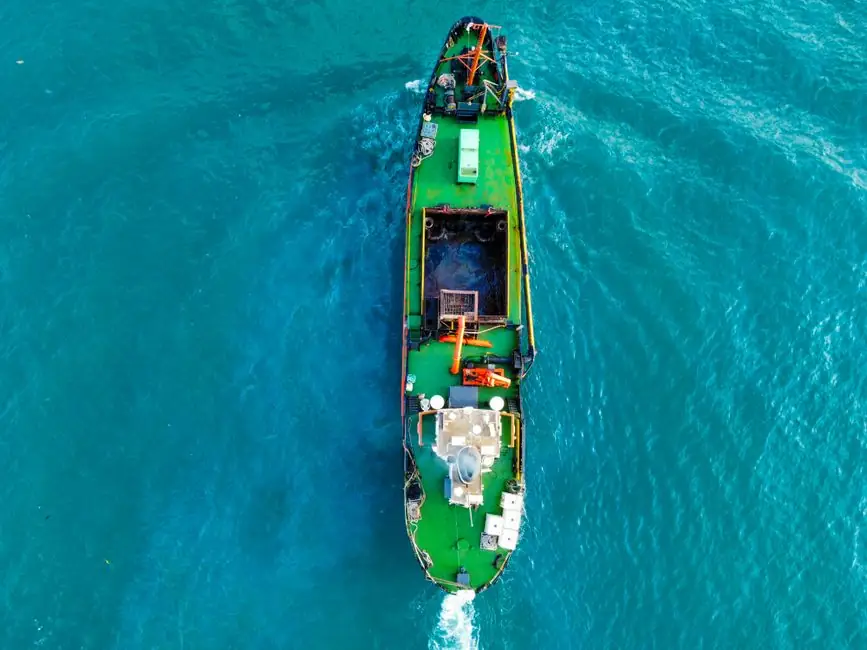
Marine propulsion and deck-machinery duty is one of the harshest environments for a roller bearing: continuous saltwater mist, cyclic axial thrust from the propeller, shaft deflection under seaway loading, and limited access for re-lubrication. Specification engineers in 2026 work from a shortlist of three families, spherical, cylindrical, and tapered roller bearing, with needle rollers used only for low-speed, lightly loaded linkages [S2][S3].
Roller bearing inventory for marine service in 2026 is dominated by Chinese and Indian OEM/ODM suppliers holding ISO 9001 and offering class-society documentation on request; typical bore ranges for propulsion-shaft applications span 80–400 mm, with spherical roller bearings (e.g. WSBC 23028 CA/W33, WSBC 24024-2CS) being the most-listed items in marine rebuilds [S2][S5].
Why the marine duty cycle breaks standard catalogue bearings
Saltwater exposure drives pitting corrosion on through-hardened rings well before the rolling-contact fatigue life is reached; this is why marine specifications require 42CrMo or 40Cr case-hardened rings with a controlled surface finish (Ra ≤ 0.2 µm on raceways) and why stainless variants (AISI 440C or 316 rings) are limited to instrument and steering pivots, not main propulsion [S2][S5].
Operating temperature on most merchant-ship gearboxes and shaft lines stays inside -20 °C to +120 °C at the bearing housing, but aft-ferrule and stern-tube greasable bearings can spike to 150 °C under tug-service overload; this defines the upper bound for standard nitrile-rubber (NBR) seals and is the switching point to fluoroelastomer (FKM/Viton) or PTFE-based lip seals [S2].
Sustained radial load on a 200 mm-bore propeller-shaft intermediate support typically lands at 80–250 kN, with a superimposed axial (thrust) component of 20–60% of radial, which is the load mix that disqualifies pure deep-groove ball bearings and pushes the choice toward cylindrical roller (radial-dominant) or spherical roller (combined load + misalignment) families [S2][S3].
Type-by-type comparison: cylindrical, spherical, tapered, and crossed-roller
For pure radial load with minimal misalignment (e.g. line-shaft plummer blocks between gearbox and propeller), NU- and N-type cylindrical roller bearing variants offer the highest specific load rating and the lowest friction-generated heat, and they tolerate axial displacement of the shaft from thermal growth [S2][S3].
For combined radial+thrust load with up to 1.5° static misalignment (typical of marine gearboxes and azimuth thruster mounts), spherical roller bearings such as the WSBC 23028 CA/W33 with a 140×210×53 mm envelope are the default; their two rows of barrel rollers self-align and accommodate shaft deflection under seaway loading [S2].
For combined load on applications that demand high axial stiffness in both directions (rudder carriers, main propeller thrust bearings on smaller vessels), tapered roller bearing pairs set face-to-face or back-to-back are used, with the pair preload set to give 0.10–0.15 mm of axial endplay; crossed-roller guides are limited to low-speed steering-gear slides and davit slew rings where pure moment load dominates [S1][S2].
Materials, cages, seals, and lubricants that survive saltwater

Standard marine ring material is case-hardened 42CrMo (DIN 1.7225) through-hardened to 58–62 HRC, with a black-oxide or phosphate anti-corrosion coating applied to non-raceway surfaces; full-hardness stainless (AISI 440C) is reserved for steering-pivot and small-instrument use where corrosion risk outweighs load capacity [S5].
Cage selection rules the maintenance interval: pressed steel cages are the cost-default for inboard, sheltered service; machined brass (CuZn40Pb2) cages are mandatory for high-temperature stern-tube and azimuth-thruster positions where grease washout is a risk; glass-fibre-reinforced polyamide 6.6 (PA66-GF25) cages are now widely accepted for temperatures up to 120 °C and reduce cage-block failures caused by grease starvation [S2][S5].
Sealing defaults to a 2RS (rubber-contact, both sides) or 2CS (non-contact, both sides) shield arrangement on inboard applications, with 2F3 (single FKM contact seal) and PTFE-lip seals reserved for wet or semi-wet positions; on grease-lubricated stern-tube arrangements, an additional O-ring on the adapter sleeve is common [S2].
Class-society approval, documentation, and sourcing in 2026
Class-society approval (DNV, LR, ABS, BV, CCS) is the gating documentary step for any bearing mounted in the propeller-shaft line, rudder carrier, or primary thruster of a classed vessel; approval is typically held by the bearing manufacturer rather than the shipyard, and the test certificate is delivered as a 2.2 or 3.1 document per EN 10204 [S5].
Spark Bearing (Wuxi) holds ISO 9001 and is referenced as a one-stop roller/ball/tapered supplier with a 12-year production history, supplying WSBC 23028 CA/W33 spherical units used in heavy industry and rebuilds of marine auxiliary gearboxes; JUNYUE/DAC (Dongguan) lists a marine and oilfield sub-line with the largest in-stock oilfield-bearing pool in the China market, and Tianjin SEMRI (SEMRI/TFN brands, founded 2005) covers pillow-block and small marine auxiliaries [S2][S3][S5].
Schaeffler/INA, founded 1946 in Nuremberg and part of the Schaeffler Group, remains the global benchmark for marine-class cylindrical and spherical roller bearings and is the de-facto reference for class-society type approvals in Europe and East Asia [S6]. For non-classed workboats, fishing fleets, and inland vessels, Indian needle-roller and cylindrical-roller suppliers (e.g. irineedles.com listings) offer short lead-time spares at lower price points, but documentation is typically limited to a 2.1 test certificate rather than full 3.1 traceability [S4][S6].
Selection procedure for a marine propulsion-shaft bearing
The minimum data the spec engineer must lock before selecting a bearing is: bore and pitch diameter, radial load (kN), axial thrust (kN), rotation speed (rpm), misalignment envelope (degrees), ambient and housing temperature, lubrication method (grease or oil), and class-society requirement; without all of these, any catalogue cross-reference is invalid [S2][S5].
Calculate L10h life using the SKF/FAG ISO 281 formula: L10 = (C/P)^p × 10^6 revolutions, with p = 10/3 for roller bearings, P the equivalent dynamic load, and C the basic dynamic load rating from the manufacturer catalogue; marine propulsion-shaft bearings are typically sized to L10h ≥ 100 000 h at the rated propulsion duty [S2].
Confirm that the housing fits the bearing OD and the locking method (adapter sleeve H31xx series, or tapered bore on the shaft) is compatible with the planned assembly tool; the crossed-roller guide is not a substitute for a propulsion-shaft support, and the roller chain family is a separate transmission component, not a bearing, despite the name overlap [S1].
Common failure modes and field rejects
White-etching cracking (WEC) under the raceway surface, driven by hydrogen diffusion from water-contaminated grease, is the leading cause of premature marine roller-bearing failure on re-lubricated stern-tube arrangements; specifying grease with a water-resistance rating per ASTM D1264 and adopting an oil-mist or oil-bath lubrication on high-speed positions reduces WEC onset by an order of magnitude [S2].
False brinelling from vibration during sea-transit of an unrotated shaft is the second-highest reject cause on bulk carriers; this is countered by specifying a shipping bracket that rotates the shaft 90° every 30 days, and by selecting cylindrical or spherical roller bearings (which are less sensitive to micro-slip at the contact patch) over ball bearings for the affected positions [S2][S3].
For related non-marine duty cycles, see the mining roller bearing selection: 2026 spec gates and supplier map which shares the 42CrMo / brass-cage baseline, and the roller bearing selection for material handling: 2026 spec map which covers lighter-duty conveyor and roller conveyor requirements.
Limitations, exclusions, and when not to use a roller bearing
Roller bearings are not the right answer for: water-lubricated composite stern-tube bearings (rubber or thermoplastic cutless bearings handle that role), for very high axial-only thrust beyond the spherical-roller thrust range (white-metal or tilting-pad thrust bearings are specified instead), or for ultra-low-speed oscillating service under 1 rpm where boundary lubrication breaks down (plain bearings win) [S2].
Any bearing supplied without a 2.2 or 3.1 EN 10204 certificate, or without a class-society type-approval letter for classed vessels, should be rejected at goods-in inspection; the cost saving on a non-certified marine bearing is consistently wiped out by a single unscheduled dry-dock within 36 months [S5].
Trackable 2026 signals to watch: DNV and LR type-approval register updates for new spherical roller series, ISO 4406 cleanliness-code tightening on oil-lubricated stern-tube arrangements, and any move by Chinese OEMs (Spark, JUNYUE, SEMRI, and equivalents) to hold direct class-society type approvals rather than project-by-project certification.