General fabrication shops working with nickel alloys should pick a grade family first and a UNS number second: solid-solution nickel alloys (Nickel 200/201, Monel 400, Inconel 600/625, Incoloy 825, Hastelloy C-276) behave like 300-series austenitic stainless in the weld shop, with similar thermal expansion, similar work-hardening, and similar heat-input discipline [S4].
Wrought Nickel 200 (UNS N02200, W.Nr. 2.4060/2.4066) is commercially pure 99.6% nickel with useful magnetic, magnetostrictive, and high thermal/electrical conductivity properties, supplied in bar, plate, pipe, and sheet for caustic alkali, food, synthetic fibre, electronic, and aerospace components [S3]. Nickel 200/201, Monel 400, Inconel 600/625, and the Hastelloy C/B/G families are all carried in sheet, plate, coil, bar, pipe, tube, wire, and mesh forms by mainstream service centres, which keeps the supply chain uniform across grade families [S2].
Commercially pure nickel: Nickel 200 and Nickel 201
Nickel 200 is the 99.6% wrought grade (UNS N02200, W.Nr. 2.4060 and 2.4066), selected for caustic alkali, food, synthetic fibre, and chemical shipping drum service where product purity must be preserved [S3]. Its 0.15% max carbon means it is NOT the right pick above roughly 315°C service, where graphitization becomes a concern; Nickel 201 (0.02% C max) is the standard substitute for those higher-temperature caustic duties [S3].
From a fabrication standpoint, Nickel 200/201 work-harden rapidly, so heavy forming needs intermediate anneals, and weld procedures mirror those used on austenitic stainless: clean joint, no sulphur marking, stringer beads, controlled heat input [S4]. For most general-fab buyers the decision between 200 and 201 is purely a carbon-content call driven by the maximum service temperature, not a corrosion call. Detailed metallurgy of these and related Ni-Cu grades is catalogued on the nickel alloy reference page.
Ni-Cu alloys: Monel 400 and Monel K-500
Monel 400 (Ni ~67%, Cu ~31%) is the workhorse Ni-Cu grade and one of the few materials that resists hydrofluoric acid, concentrated alkalis, and seawater in the same part; Monel K-500 adds age-hardening capability for shaft, fastener, and pump-impeller service where higher strength is needed [S2][S4]. Compared to Nickel 200, Monel 400 trades some of the caustic-alkali resistance for much better resistance to HF vapour, brine, and sour hydrocarbons, which is why the same fab shop will stock both [S2].
Welding Monel follows the same austenitic-stainless ruleset as the rest of the solid-solution family, with two practical notes: the weld pool is sluggish compared to carbon steel, and contamination from copper or carbon steel tooling leaves coloured oxides that must be ground out before any corrosion-critical service [S4]. For buyers comparing Ni-Cu to nickel-chromium grades, the rule of thumb is HF or seawater service points to Monel; oxidizing acid chloride or nitric service points to Inconel/Incoloy.
Ni-Cr and Ni-Fe-Cr: Inconel 600, 625, Incoloy 800, 825
Inconel 600 (Ni-Cr-Fe) and Inconel 625 (Ni-Cr-Mo with Nb) cover the oxidizing and acid-chloride duties that pure nickel cannot handle; Inconel 625 in particular is widely used in seawater, chemical processing, and aerospace exhaust because of its Mo and Nb content [S2]. Incoloy 800/800H/800HT and Incoloy 825 (Ni-Fe-Cr with Mo and Cu) bridge the gap to austenitic stainless, with 825 being the standard pick for sulphuric and phosphoric acid service in general fab work [S2][S4].
For a fab shop choosing between these, the practical decision matrix is straightforward: Inconel 600 for high-temperature nitriding/oxidation (furnace, heat-treat fixtures); Inconel 625 for welded assemblies needing strength plus acid-chloride resistance; Incoloy 800H/HT for high-temperature creep service; Incoloy 825 for hot sulphuric acid and mixed acid chloride service [S2]. These nickel-chromium grades are also the typical stepping stone for fab shops moving from stainless into titanium alloy territory on chemical-process skids.
Ni-Mo and Ni-Cr-Mo: Hastelloy C-276, C-22, B-2/B-3
Hastelloy C-276 (UNS N10276) and C-22 are the Ni-Cr-Mo grades fab shops bring in when the corrosion environment is mixed acid, wet chlorine, or any case where 316L stainless, Inconel 625, or Monel 400 have failed; Hastelloy B-2 and B-3 are the Ni-Mo pair reserved for pure hydrochloric acid at all concentrations up to the boiling point, where even C-276 is marginal [S2]. Selecting a Hastelloy C variant for general fab also unlocks ASME welding qualifications (e.g. F-No. 43 groupings) that are commonly held by the same shops that weld 625 and 825 [S4].
For procurement and stock rationalization, distributors typically carry C-276, C-22, B-2, B-3, and G-30/G-35 in plate, sheet, bar, pipe, and weld filler form [S2]. When a process engineer is asked which of these to call out on a P&ID, the defensible answer is: C-276 as the default mixed-acid grade, C-22 when localized pitting/crevice resistance is critical, B-family only for HCl service without oxidizing contaminants, and only then escalate to higher-Ni grades or special clad [S2][S4].
Welding and fabrication discipline for solid-solution nickel alloys
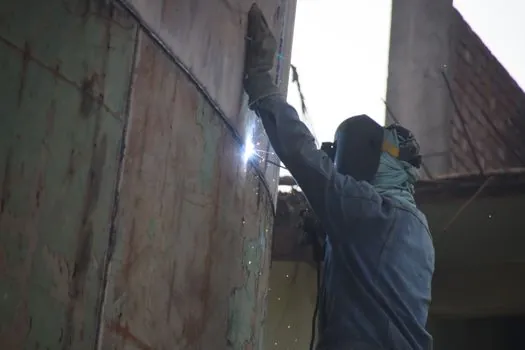
The solid-solution nickel alloys (Nickel 200/201, Monel 400, Inconel 600/625, Incoloy 825, Hastelloy C-276) cannot be strengthened by heat treatment, so their joint performance comes from filler metal selection, joint cleanliness, and heat input control, not from a post-weld heat treatment [S4]. Their physical properties are close enough to 300-series austenitic stainless that shops already qualified on 304/304L and 316/316L can usually extend procedures with a matching filler (e.g. ERNiCrMo-3 for 625, ERNiCu-7 for Monel 400, ERNi-1 for Nickel 200) [S4].
Three shop-floor rules consistently show up in nickel-alloy weld procedure guidance: (1) thorough removal of sulphur, lead, and phosphorus contaminants (no marker pen, no carbon-steel wire brush), (2) stringer beads with interpass temperature held low to prevent hot cracking in Ni-Cu and Ni-Cr-Mo grades, and (3) match-filler or over-alloyed filler rather than autogenous welds in corrosion service [S4]. For a fab shop deciding whether to take on a nickel-alloy job, the alloy steel welding skillset transfers about 70% of the way, with the remaining gap being the contamination and heat-input discipline above.
Decision matrix by corrosion environment and temperature
The cross-grade comparison that most fabricators and process engineers actually use maps the dominant corrosion threat and temperature window to one or two candidate grades: caustic alkali at any temperature → Nickel 200 below ~315°C, Nickel 201 above; hydrofluoric acid vapour or seawater → Monel 400 (or K-500 if strength is needed); high-temperature oxidation or nitriding 600–1100°C → Inconel 600, 800H, or 601; hot sulphuric/phosphoric acid → Incoloy 825; mixed acid, wet Cl2, or acid chlorides → Inconel 625 or Hastelloy C-276/C-22; pure HCl without oxidizers → Hastelloy B-2/B-3 [S2][S3][S4].
Two cross-cutting rules sit on top of that matrix: pick the lowest-Ni grade that survives the corrosion test (Nickel 200 < Monel < Inconel 600 < Inconel 625 < Hastelloy C-276 on raw material cost), and only escalate to higher-Ni grades when a documented corrosion case history or ASTM G48 / G36 test data justifies the spend [S2][S4]. Shops that buy nickel alloys in volume should also standardise on a small set of UNS numbers per grade family (e.g. N02200, N04400, N06600, N06625, N10276) to keep filler wire stock and welder qualifications manageable [S2][S3].
Stock forms, supply chain, and what to verify on a PO
Standard stocking forms for solid-solution nickel alloys are sheet/plate/coil, bar/rod, pipe/tube, wire/mesh, and precision strip, all of which are available through the same distributor network that supplies Inconel, Hastelloy, Monel, and Incoloy lines [S2]. Nickel 200 specifically is offered in bar, plate, pipe, and more from US distributors for fast delivery, with the standard UNS N02200 designation and dual W.Nr. 2.4060/2.4066 listed on the mill cert [S3].
On a purchase order, the items that actually prevent a fab-shop rejection are: UNS number, ASME/ASTM product specification (e.g. B168 for Inconel plate, B162 for Nickel plate, B564 for fittings), ASME Section IX welding compatibility for the chosen filler, and a PMI (positive material identification) report verifying Ni, Cr, Mo, Fe, Cu content within spec [S2][S3][S4]. The editorial selection of nickel alloy grades for rail service covers the same grade families but with the additional creep and fatigue envelopes that transport specifiers need.