
The decision depends on housing loads, thermal exposure, production volume, machining requirements, tooling investment, sealing, and electrical grounding, not on material name alone [S2].
Core Housing Requirements and Material Options
An automotive gearbox housing must provide strength, air tightness, corrosion resistance, and low weight, while also supporting bearing and shaft loads, maintaining alignment, containing lubricant, and providing mounting and sealing surfaces [S1][S2]. These requirements make the housing a structural enclosure rather than a simple cover.
The studied automotive gearbox shell was made from AlSi9Cu3 with a casting-shrinkage allowance of 6‰, and its leakage problem was addressed by adding high-pressure point cooling at the affected position [S1].
Typical engineered options include polycarbonate for molded enclosures and A380 die-cast aluminum for comparable housing applications [S5].
Comparison by Stiffness, Heat, Mass, and Production
Die-cast aluminum provides the higher stiffness and structural strength of the two material families, while polycarbonate has a reported tensile strength of 55–75 MPa compared with 317 MPa for A380 aluminum [S5][S6]. Aluminum also has a density of 2,740 kg/m³, versus 1,220 kg/m³ for polycarbonate, so a plastic housing can have lower mass even though its stiffness is lower [S5].
Thermal performance generally favors metal: polycarbonate melts at 267 °C, while A380 melts at 595 °C [S5]. For a gearbox housing, use a polymer only when its glass-transition temperature, heat-deflection temperature, creep response, and lubricant exposure remain acceptable under the highest local temperature.
Cost depends on program scale. Plastic injection molding is attractive for lower volumes and complex parts, while aluminum casting becomes more competitive when near-net geometry removes extensive machining and secondary operations [S2].
When Die-Cast Aluminum Is the Better Choice
Specify die-cast aluminum for a housing carrying significant bearing loads, shaft-reaction forces, high flange loads, or elevated vibration where polymer creep could permit alignment loss [S2][S4]. Aluminum is also the practical choice when the housing must provide electrical grounding, conductive shielding, or EMI/RF attenuation, because plastic is an insulator and cannot perform those functions without added conductive components or coatings [S5].
Reported capability for HPDC housings includes cast tolerances of ±0.1–0.3 mm and H7-machined bearing bores [S4]. Those values are supplier capability data, not universal acceptance limits, so the drawing, load case, and quality plan must govern the final specification.
When Engineering Plastic Is the Better Choice
Specify engineering plastic when the housing is not the primary load-bearing member, operating temperature is modest, electrical isolation is required, or exposure to coolants, salts, and chemicals makes polymer resistance attractive [S5]. A plastic housing can integrate ribs, clips, sensor covers, and cable-entry features without separate metal parts, although the exact economic benefit depends on resin, geometry, and production volume [S2].
The principal constraint is time-dependent deformation. Polymer stiffness and dimensional stability are generally lower than those of die-cast aluminum, and sustained loads can create creep even when a short-term test appears adequate [S5]. The Engineering Plastic Tg vs HDT material selection guide provides the temperature-screening framework needed before a resin is assigned to a gearbox application.
Plastic is a poor default for a hot, highly loaded housing because heat can lower stiffness, lubricant compatibility can vary by resin, and molded bosses or mounting features can deflect under torque reaction [S4][S6]. If a polymer is selected, specify a glass-fiber-reinforced grade with elevated heat-deflection temperature, test creep under the actual bearing and flange load, and verify chemical compatibility with the gearbox oil, sealants, cleaners, and coolants.
Sealing, Machining, and Manufacturing Failure Modes
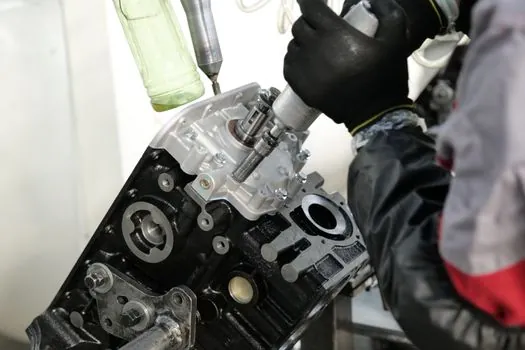
Aluminum die casting is repeatable, but porosity, cold separation, and leakage can reduce the qualified yield of automotive aluminum gearbox shells [S1]. The studied shell required simulation of filling and solidification; high-pressure point cooling at a leakage location corrected the identified defect, with the result verified after optimization [S1].
Vacuum-assisted HPDC is the relevant route when a housing must survive T6 solution treatment because trapped gas can blister the casting [S4]. Inspection should include dimensional verification, internal-porosity evaluation, and machining of bearing bores, flange faces, oil galleries, and sensor bosses [S4].
For a plastic housing, the analogous failure risks are sink marks, weld lines, short shots, fiber orientation, voids, creep at bosses, heat distortion, and seal-interface movement. These defects are controlled through resin selection, gate and rib design, fiber direction, molding conditions, and post-mold inspection. Plastic cannot provide inherent grounding or RF shielding, so conductive hardware or a conductive coating would be additional parts and cost rather than material properties [S5].
Process and Program Selection
For medium-to-high production, HPDC is appropriate when complex geometry, repeatability, thin walls, and short cycles justify permanent tooling [S2]. Gravity or permanent-mold casting can serve lower-volume or heat-treated structural requirements; A356, for example, can be supplied in T5 or T6 conditions for those applications [S2]. Sand casting suits prototypes, large housings, and lower-volume programs where permanent tooling is uneconomic [S2].
The comparison should use total finished-part cost rather than casting price alone. A valid comparison includes annual volume, tooling amortization, wall thickness, machining allowance, bearing-bore tolerance, leak testing, heat treatment, scrap yield, inspection, and expected program life [S2]. International alloy designations are not automatically interchangeable; confirm chemistry, mechanical properties, condition, heat treatment, and the applicable material specification before approving a substitute [S2].
For electrical or thermal performance, consider the aluminum alloy route when grounding and heat spreading have measurable value. For corrosion-isolated or lightweight covers, assess the engineering plastic route against creep, heat, and oil compatibility rather than relying on tensile strength alone.
Practical Selection Rule by Use Case

Use die-cast aluminum for an automotive transmission housing with bearing supports, oil galleries, pressure-containing seams, and a 4 mm-class wall, but validate porosity, leak tightness, and machining stability [S1]. Parts can be heat-treated to T6 where needed, while ±0.1–0.3 mm casting tolerance and H7-machined bearing bores are reported production capabilities [S4].
Use engineering plastic for a low-load accessory gearbox, cover, sensor enclosure, or lightweight unit where operating temperature, chemical exposure, and electrical isolation favor the resin. Do not use it as a substitute for a structural aluminum transmission shell without testing sustained torque reaction, bearing loads, seal pressure, and dimensional drift.
Before releasing either material, record the maximum housing temperature, gearbox-oil exposure, flange and bearing loads, required leak class, bearing-bore tolerance, annual volume, and allowable corrosion interface. These values determine whether the housing needs a structural aluminum alloy, an engineered polymer, or a hybrid metal frame with plastic covers.