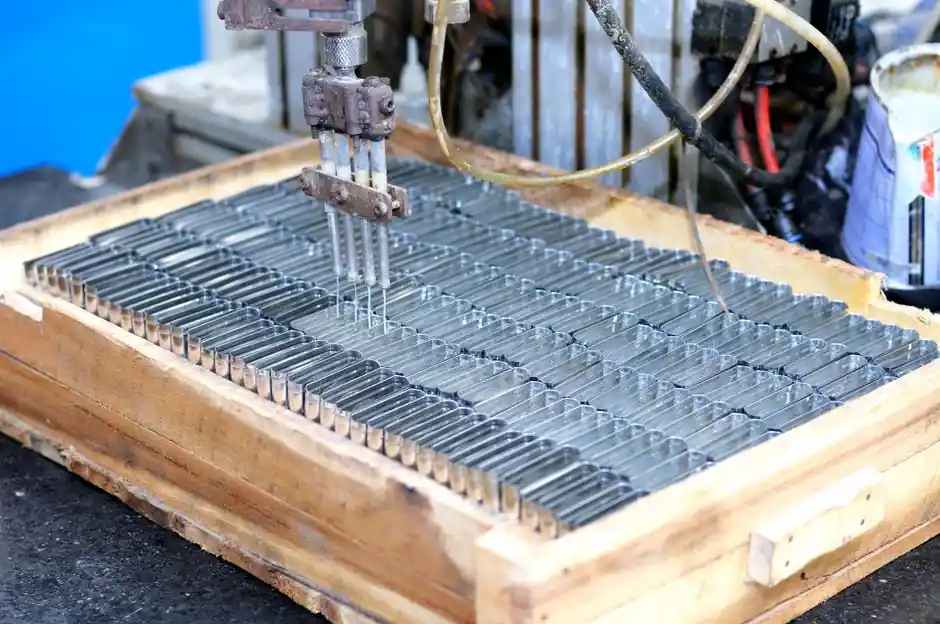
For small precision housings, zinc die casting offers stiffness, repeatability, and thin-wall capability [S3].
Engineering plastics remain the lighter, lower-cost option for housings that do not require metal-level stiffness, impact performance, heat resistance, or electromagnetic shielding. The correct choice depends on load, temperature, dimensional stability, production volume, and post-molding requirements [S2][S3].
Material Decision by Load, Temperature, and Precision
Zinc die casting is the stronger, stiffer option for small precision housings. Zamak 5, also identified as ZP5, ZnAl4Cu1, or ZDC1, is widely used in Europe and offers improved creep performance over Alloy 3, with a reported tensile strength of approximately 330 MPa and yield strength near 295 MPa [S1][S2].
Engineering plastics cover a broad performance range. This is not a universal plastic grade comparison, because glass reinforcement, orientation, weld lines, temperature, and strain rate can shift molded-part properties substantially.
The 1971 comparative study of zinc die casting and five engineering thermoplastics found die-cast zinc stronger, stiffer, and more thermally resistant than the tested polycarbonate, polyacetal, nylon, ABS, and polypropylene under identical procedures.
As a practical rule, specify zinc when the housing carries shock, supports a press fit, retains a close-tolerance shaft, shields electronics, or operates near heat sources. Specify an engineering plastic when the housing is lightweight, electrically insulating, chemically exposed, or produced in a geometry better suited to injection molding.
Comparison Against the Four Production-Critical Criteria
On dimensional control, zinc offers the better route for small metal components, with repeatability stated as less than ±0.001 inch, equivalent to approximately ±0.025 mm, for smaller castings [S4]. These values are process-dependent and should be validated against the actual part, tool, and production setup.
Zinc alloys such as Zamak 5 and ZA-8 offer high tensile strength and impact resistance for automotive safety components [S1]. Alloys 3 and 5 also support thin walls, while zinc can cast threads, ribs, bosses, logos, and other features into one component, reducing assembly and machining operations [S2][S3].
On mass and tooling economics, plastic leads. Zinc is five to eight times denser than the unfilled polymers tested [S5], so an equivalent wall volume can produce a much heavier assembly. Injection molding avoids a metal die-casting tool, but zinc die casting can be economical when a tool supports a large production series.
On thermal and electromagnetic behavior, zinc is generally the stronger choice for heat dissipation, sustained mechanical loads, and conductive shielding. The housing material still must be qualified for its actual temperature, environment, and electrical requirements. The material comparison identifies zinc as electrically conductive and useful for housings requiring electromagnetic shielding [S3].
Alloy and Polymer Selection for Small Housings

For small housings, choose the alloy by the actual combination of temperature, stress duration, impact, and secondary forming, not by tensile strength alone.
For polymers, specify by function rather than family name. A glass-filled nylon may serve a structural, low-volume housing better than an unfilled general-purpose grade because of stiffness and dimensional control, while polycarbonate or an impact-modified grade may be preferable where shock resistance dominates. The engineering-plastic selection guide should be used to establish the required temperature, chemical exposure, creep behavior, and flame-performance class before comparing it with zinc.
A resin designation alone is similarly incomplete, because filler content, grade, color package, and environmental stress cracking requirements can change the decision.
Geometry, Finishing, and Assembly Consequences
Zinc die casting is suited to small housings with thin walls, fine detail, bosses, ribs, and integrated fastening features. Indicative minimum wall thickness is 0.6 mm for zinc, compared with 0.5 mm for plastic and 1.5 mm for aluminum [S3]. A published automotive design reference identifies 0.15 mm as achievable for zinc thin walls, but that finer value belongs to a more demanding casting context and should not be assumed for every small housing [S1].
Plastic injection molding can produce a smoother as-molded surface, with the comparative table listing 0.2 μm Ra for plastic against 0.8 μm Ra for zinc [S3]. Zinc can still be plated, painted, or machined to suit appearance and dimensional correction, so surface finish should be treated as a requirement rather than a fixed material penalty [S2].
Assembly architecture changes the business case. Zinc can consolidate multiple metal parts into one casting and can eliminate separate bushings or wear inserts because of its bearing and wear properties [S2][S8]. Plastic remains attractive when the design uses molded-in living hinges, compliant interfaces, snap fits, or electrical insulation, features that may be simpler than a metal casting and assembly sequence.
For a shaft housing, bearing support, mechanism cover, or electromagnetic enclosure, zinc deserves a functional prototype. For a cover, sensor body, or cable-entry housing where mass and wall cost dominate, a qualified molded polymer may be the better production choice. These are use-case recommendations, not blanket material rankings.
Failure Modes and Qualification Tests

Zinc housings can fail through creep, thermal distortion, porosity, cracking, plating defects, or loss of clamp load if the design relies on unverified elevated-temperature strength. Standard zinc alloys may creep under sustained loads at elevated temperatures, while Alloy 5 provides improved creep over Alloy 3 [S1][S2].
Plastic housings can fracture, distort under sustained stress, lose dimensional accuracy through creep, or fail from chemical attack and notch effects. Material selection for plastics must account for continuous-use temperature, solvent exposure, stress concentration, and end-use environment. The comparison of engineering-plastic creep versus metal under sustained load is directly relevant when a housing continuously supports a shaft, clip, or fastener.
Qualify the selected process with the actual geometry. For zinc, verify wall thickness, fill conditions, flatness, critical datums, threads, bearing seats, and coating adhesion. For plastic, verify shrinkage, warpage, weld lines, gate effects, insert retention, and tolerance stack after conditioning. A drawing tolerance cannot be transferred directly from a general material table.
Zinc Grade 5 tensile strength of approximately 330 MPa and yield strength near 295 MPa provide a useful initial screening point, not a substitute for coupon, housing, or assembly testing [S1]. For plastic, use the specific resin grade and conditioning state. If impact, temperature, or regulatory qualification governs the design, test the finished component rather than relying on nominal resin or alloy data.
Production Economics and Sourcing Requirements
Zinc die casting is most attractive when the part is small, thin-walled, geometrically complex, produced in a substantial series, and expected to need limited secondary machining. Zinc die-casting cycle times are listed as 5–45 seconds, compared with 15–60 seconds for plastic injection molding, while the die-life reference exceeds 1 million shots for zinc tooling [S3].
Plastic is commonly more attractive at low volume because the injection-molding tool is not comparable to a steel die-casting tool in capital cost. Zinc can still win on total assembly cost where it eliminates multiple molded pieces, fasteners, bushings, or machining operations [S2][S8].
At procurement, request the exact alloy designation, applicable material specification, permitted secondary operations, coating system, critical dimensions, and process-capability data. For zinc, identify whether the material is ZAMAK 3, ZAMAK 5, ZA-8, ZA-12, or another specified alloy rather than accepting a generic zinc label [S1][S2]. For plastic, specify the resin, grade, filler, color, continuous-use temperature requirement, and chemical-exposure constraints.
Finalize the choice by comparing the three quantities that drive the decision: qualified cost per assembly, mass, and risk of dimensional drift in service. A precision housing requiring stable bearing fits, impacts, heat, or shielding favors zinc; a lightweight housing dominated by geometry, insulation, and molded-in features favors engineering plastic. Run the functional prototype before committing a production tool [S2][S3][S5].