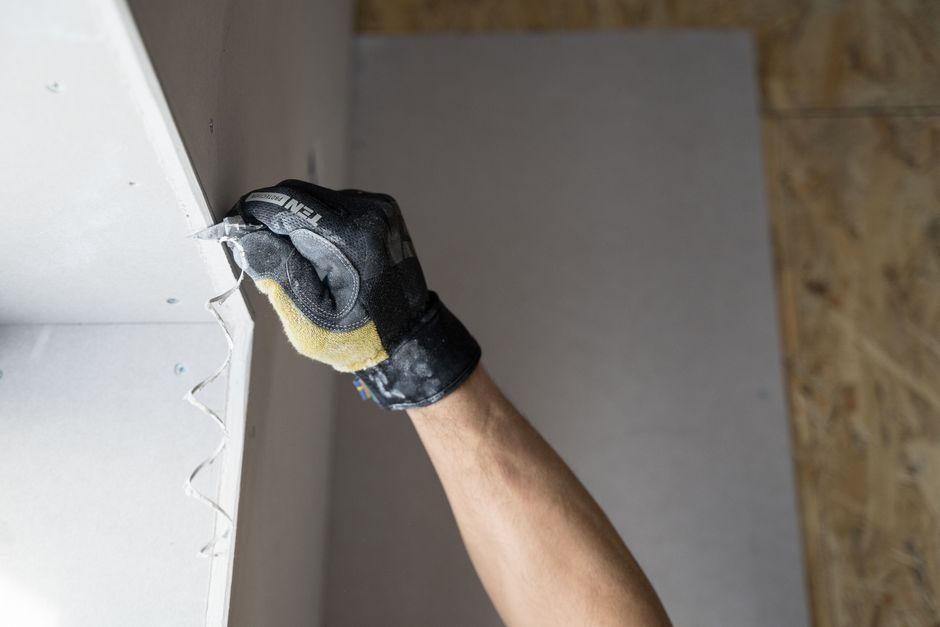
EPS board installation under a Dryvit-class EIFS follows a controlled sequence: ASTM C 578 Type I board in nominal 24 in × 48 in (PB) or 96 in (PM) sheets, ≥3/4 in thick, set in running-bond pattern with vertical adhesive ribbons and joints offset ≥6 in from sheathing seams [S3][S4].
Physical-property targets that drive spec match — and that an installer should confirm against the supplier data sheet — are thermal conductivity 0.032–0.038 W/mK, R-value 3.6–4.2 per inch, density 0.9–2.5 lb/ft³, and compressive strength 10–60 psi depending on ASTM class [S7]. EPS differs structurally from extruded polystyrene because its closed-cell content is pre-expanded bead rather than continuously extruded, which is why it is the lower-cost insulation-board choice for wall and roof assemblies rather than high-moisture assemblies where XPS foam board is preferred.
Definition and Scope: What "EPS Board Installation" Covers
An EPS insulation board, as defined in Dryvit specification DS131, is a Type I expanded polystyrene rigid cellular plastic thermal-insulation board used as the continuous-insulation layer of an Exterior Insulation and Finish System (EIFS) [S3]. The system as a whole consists of the board, an adhesive and/or mechanical fastener to the substrate, a glass-fiber-mesh-reinforced base coat, and a protective finish applied on the face of that base coat [S3].
Two Dryvit-defined EIFS classes govern board geometry: the PB (polymer-based) system uses 24 in × 48 in sheets with a base coat 1/16–1/4 in thick, while the PM (polymer-modified) system uses 24 in × 96 in sheets with mesh mechanically fastened to the substrate and a 3/16–1/4 in fiber-reinforced base coat [S3]. Both classes reference the same parent standard, ASTM C 578, which defines Type I EPS at a minimum density of 0.90 lb/ft³ (15 kg/m³) and a minimum compressive strength of 10 psi, well below the 100 psi ceiling of Type XV [S3][S7]. The full 5-page DS131 specification — including ordering information, permissible dimensional variations, and quality-control requirements under ICC-ES AC12 — applies to any board supplied into a Dryvit system [S3].
Selection Criteria: Density, Compressive, and Fire Classification
EPS insulation board supplied for construction carries a fire-retardant modifier but remains a combustible organic material, the same flammability class as other organic insulation, and must be stored and installed away from open flame and ignition sources per the manufacturer's flammability warning [S5]. Building-code classification entries for typical construction-grade EPS include ICC ESR-1349 and U.L. File R12290 Control 85TO Classification BRYX, which engineers should verify on the supplier's submittal package [S5].
Selection against the four decision criteria that drive cost versus performance — density, compressive strength, R-value, and code-listed fire classification — is straightforward: Type I (0.90 lb/ft³, 10 psi, R-3.6/in) is the EIFS default, Types II and IX cover most below-grade and roof applications, and Types XII–XV (1.35–2.50 lb/ft³, 25–100 psi) are used only where the assembly has a documented point load or plaza-deck duty [S7]. Alleguard's Envirosheet (EN) line, for example, is a standard closed-cell EPS offering graded densities and compressive strengths, with thicker, higher-density variants for higher-load assemblies [S8]. A related side-by-side framing of where EPS wins versus where XPS board advantages and disadvantages carry the specification is covered in our 2026 selection-boundary guide.
Substrate Prep, Adhesive Ribbons, and Running-Bond Layout
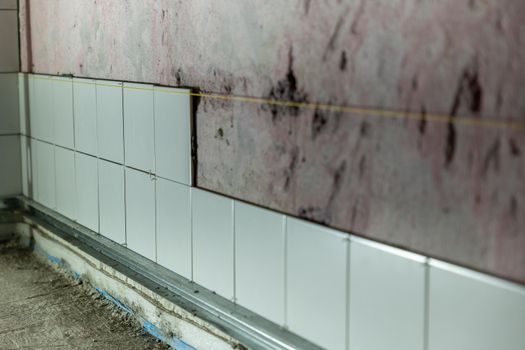
Substrate preparation for EIFS-grade EPS board requires a clean, dry, sound backing free of release agents; sheathing-joint locations must be mapped because insulation board joints are required to be staggered a minimum of 6 in (152 mm) off any sheathing joint, and inside/outside corners must be interlocked with L-shaped boards at openings [S4]. Adhesive is applied as vertical ribbons on the back of the board — not dabs — and the board is then pressed into place in a running-bond (staggered) pattern with joints butted tightly, not compression-fit [S4].
Cutting on site uses a sharp scoring knife for full sheets or partial fits, after which every EPS termination — window jambs, penetrations, grade breaks — is pre-wrapped or back-wrapped with the system manufacturer's reinforcing mesh embedded in the specified Sto base coat before field mesh is applied [S4]. Sto's product bulletin explicitly orders the sequence: terminations first, then field mesh, then base coat; reversing this order is the most common cause of hairline cracking at window heads in EIFS [S4]. The Alleguard installation manual for rigid EPS (EN) and higher-density Silverboard variants layers the same adhesive logic on top of additional mechanical-fastener requirements for thicker, higher-compressive grades [S8].
Acceptance Criteria, Test Methods, and Common Failure Modes
Acceptance against the DS131 specification requires verification against five ASTM standards: C 578 (rigid cellular polystyrene thermal insulation, governs Type classification), D 1623 (tensile and tensile-adhesion properties of rigid cellular plastics, governs adhesive bond), D 2863 (oxygen index, governs the fire-retardant additive's combustion behaviour), E 84 (surface burning characteristics), and E 2430 (the EIFS-specific board standard) [S3]. ICC-ES AC12 is the acceptance criteria for foam-plastic insulation and is the document a code official will typically request on submittal [S3].
The three failure modes that surface in service are predictable: (1) base-coat delamination at terminations where the back-wrap was omitted or installed in the wrong sequence, (2) thermal bridging at fasteners in PM systems where the mechanical-fastener heads were not seated below the base coat, and (3) R-value loss in interior applications where the board was not protected by a proper thermal barrier as flagged in the manufacturer's flammability warning [S4][S5]. The corrective action in all three is to cut out the affected board, re-prep the substrate, and re-install per the running-bond + 6-in-offset rule; replacement is required when the affected area exceeds one board width or when the fire-retardant additive has been compromised by sustained heat exposure [S4].
Product Comparison: EPS vs XPS vs Other Rigid Foam
The Dryvit published comparison frames EPS against DuPont Styrofoam Panel Core 20, an XPS foam board with extruded closed-cell structure: both deliver comparable R/inch at the comfort-insulation end of the range, but EPS is the lower-cost option for EIFS continuous insulation while XPS is the specified choice for high-moisture, high-compressive-load, or below-grade assemblies where water absorption and long-term R-value retention matter more than first-cost [S6].
Engineers should treat the three trade-offs explicitly: cost (EPS lower), moisture absorption (XPS lower, EPS can lose R-value if wetted long-term), and compressive strength ceiling (XPS typically 25–100 psi versus EPS Type I at 10 psi) [S6][S7]. A useful side-by-side on the fastening logic difference between EPS-EIFS and XPS-direct-to-sheathing assemblies is in our XPS board installation spec guide, which complements this article's running-bond + adhesive-ribbon rule for EIFS.
Who EPS Board Installation Is For — and Who It Is Not For
EPS board installation is the right specification for EIFS-clad commercial and multifamily wall assemblies where the project is on a competitive first-cost budget, the wall does not see persistent moisture, and the cladding system is a barrier- or drained- EIFS with a code-listed fire classification [S3][S5]. It is also the standard choice for cold-storage, HVAC duct, and floor-heating underlay where its 0.032–0.038 W/mK conductivity and low weight dominate the value calculation [S2][S7].
It is the wrong specification for below-grade foundation perimeter insulation where XPS's lower water absorption dominates, for plaza-deck or vehicular-traffic assemblies where the 10 psi Type I compressive ceiling is insufficient, and for any interior exposure where the assembly cannot be protected by a code-compliant thermal barrier [S5][S7]. In those assemblies, spec XPS, mineral wool, or polyiso instead and route the EIFS EPS to the wall-cladding layer where it belongs.
Three signals are worth tracking over the next 6–12 months: ICC-ES AC12 acceptance-criteria updates for foam-plastic insulation, any revision to ASTM C 578's Type I minimum-density floor (currently 0.90 lb/ft³), and U.L. Classification BRYX renewals for the supplier listed on the project's submittal package [S3][S5].
For component-level specifications, see eps board.