For planning, treat these figures as class ranges rather than approval limits: confirm the bucket against the exact excavator model, working weight, hydraulic circuit and lifting chart before fitting it.
20-Ton vs 30-Ton Bucket Capacity
The 20-ton class falls within the broader 10–25-ton category, for which standard bucket widths are commonly listed at 18–60 in, or approximately 455–1,525 mm [S2]. Capacity is a more useful starting point than width because a wider shell can hold more material, but rated capacity still depends on the specific bucket geometry and machine configuration.
The mid-size class of 10–40 tons carries a broad typical range of 0.5–2.5 m³ [S3]. A 30-ton machine therefore sits in the upper part of the mid-size group, not in the 40–90-ton large-excavator group, whose listed typical capacity is 2.5–5.0 m³ [S3].
The practical increase from the midpoint of the 20-ton range, about 1.0 m³, to the midpoint of the 30-ton range, about 1.5 m³, is approximately 0.5 m³ per bucket. That is a planning estimate, not a guaranteed production gain, because fill level, cycle time and material density also determine output.
How to Select the Right Capacity
Select capacity by working load first: bucket volume multiplied by material density determines payload, and that payload must remain within the machine’s operating and lifting limits [S6][S7]. A larger bucket is not automatically more productive because extra fill resistance increases hydraulic demand and can slow excavation in hard material [S3].
For trenches, foundations and utility work, choose a narrower bucket before increasing capacity. For utility excavation, the multi-purpose bucket type is designed to reduce snagging against pipes and cables, while the grading bucket is short, shallow and wide for finish work [S5]. Those designs protect productivity more effectively than simply moving up one capacity class.
Material, Reach and Ground Conditions
Material density changes the capacity decision because a cubic metre of saturated clay or broken concrete weighs substantially more than loose topsoil, so the same bucket can create a much higher load at the 30-ton class [S3]. Check the machine’s lifting-capacity chart, including the permissible load over the side at full reach, rather than relying only on the bucket catalogue [S7].
Ground bearing pressure controls another limit. A larger bucket increases payload and therefore the risk of overloading soft ground, while an oversized attachment can increase fuel consumption and create a tipping hazard [S3]. The 20-ton machine is normally the better choice for confined access and lighter ground; the 30-ton machine is normally the better choice when greater operating mass, breakout capability and payload justify additional mobilization [S4].
Rock and demolition work changes the priority from maximum volume to penetration and wear resistance. Rock buckets use reinforced construction and sharper teeth for asphalt, stone and dense material [S5]. A high-capacity 30-ton bucket is not automatically superior in rock because the additional volume can increase resistance while reducing control at the cutting edge.
Comparison by Work Criterion
On installation and logistics, the 20-ton machine is simpler to transport and typically has lower operating mass than the 30-ton machine, although exact trailer requirements and mobilization cost must be checked against the selected model [S4].
On application fit, the 20-ton class is better suited to utility trenches, residential foundations, landscaping and small demolition, where access and precision dominate. The 30-ton class is better suited to general construction, road work, foundations, sewer work and heavier excavation, consistent with the applications assigned to the 10–40-ton mid-size class [S3]. On hard material, bucket construction matters more than class alone: standard, rock, utility and grading buckets serve different duties [S5].
The cost decision is not simply bucket price. A 30-ton class can reduce the number of passes needed to move a given volume, but the machine itself carries the higher transport, fuel and operating burden. An oversized bucket on a 20-ton machine can erase that advantage through longer cycles, excessive hydraulic demand and added instability [S3][S4].
Compatibility and Safety Checks
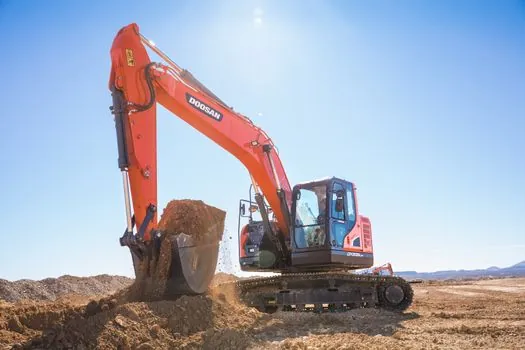
Do not fit a bucket because its nominal capacity falls inside a broad tonnage range. Verify the machine model, operating weight, bucket mounting geometry, hydraulic-flow requirement and manufacturer-approved attachment list; a class chart cannot account for every model variation [S4]. For excavator fleet planning, record the approved bucket part number and rated capacity alongside each machine rather than maintaining one generic size for the entire fleet.
Check the lifting chart before using either class at long radius. Bucket weight, payload, reach, undercarriage configuration and lifting height all affect the allowable load, and the safe load over the side at full reach is a separate limit from the machine’s normal digging rating [S7].
Bucket capacity may be quoted as heaped or struck capacity, so confirm which basis the supplier uses. One simplified geometric relationship is “Capacity = Width x Height x Depth x Fill Factor,” but the resulting estimate still needs to be reconciled with the manufacturer’s published rating [S6].
Recommended Configurations by Use Case
For general trenching and foundation excavation on a 20-ton model, specify an approved bucket near 0.8–1.0 m³ and optimize for the actual material. For bulk excavation on a 30-ton model, start near 1.3–1.5 m³; this range supports the class reference of 1.3–1.7 m³ without assuming that the upper limit is suitable for every radius or material [S5].
Use a rock bucket when penetration and wear resistance dominate, a utility bucket where snagging risk around buried services matters, and a grading bucket for final shaping. A 42–48-in bucket was identified as a large-volume option for 30-ton work, while 20-ton-class standard widths can extend from 18 to 60 in [S1][S2]. These dimensions are useful for attachment planning, but they do not override model-specific capacity approval.
For a mixed fleet, specify a mid-capacity 20-ton bucket around 0.9–1.0 m³ and a 30-ton bucket around 1.4–1.5 m³ as starting points, then verify the model, material density and lifting chart before release. Track bucket fill percentage, cycle time and fuel use over at least one operating shift; a lower-capacity bucket that maintains 90% fill can outperform an oversized bucket at 60% fill, while dense material or maximum-reach digging can require a smaller step down in capacity.