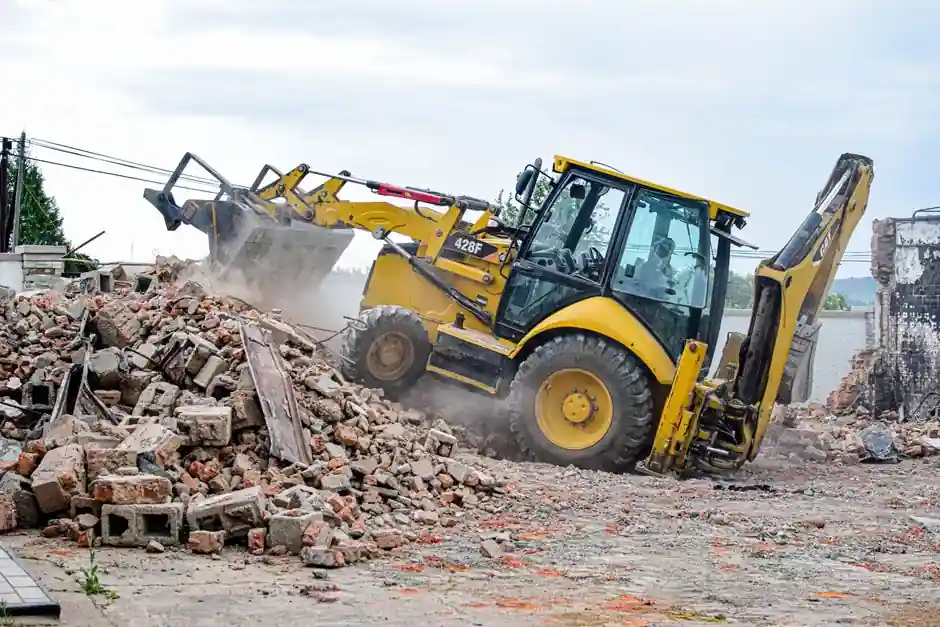
The comparison favors the tracked excavator on soft or saturated soil because its undercarriage distributes mass over a much larger contact area than the tires of a comparably sized wheel loader.
How Excavator and Loader Ground Pressures Compare
Ground pressure is machine weight divided by the contact area between the undercarriage and the soil. The comparison illustrates why the excavator normally causes less rutting and sinking when soil bearing capacity is low.
The same calculation applied to six 12.00R20 tires at 400 square inches of contact per tire produces substantially more pressure, illustrating the effect of contact area rather than machine mass alone.
Track configuration matters within the excavator class. A heavier excavator can therefore be gentler on soil if its pad geometry and total contact area offset the added mass.
Why Contact Area Controls Soft-Ground Performance
The governing quantity is pressure, not operating weight by itself. A 20,000 lb machine on narrow tracks concentrates its load over a small footprint, while the same machine on wide tracks spreads that load over a larger area and presses more gently into the soil [S5]. Wide tracks can therefore allow a heavier machine to remain on the surface where a lighter machine with narrow tracks would sink.
Soil moisture changes the result. Dry clay can carry substantial loads, while saturated clay loses bearing capacity and behaves like a weak plastic material. A field that supports a truck during a dry period may not support even light equipment during prolonged wet conditions [S5]. Ground-pressure calculations must therefore be treated as relative flotation data, not as a universal load-capacity rating.
Track contact area, track width, operating weight, inflation pressure and soil moisture must be considered together. Lower pressure improves flotation and reduces rutting on mud, sand, peat and sensitive surfaces, while higher tire pressure can improve rolling resistance and stability on firm ground [S4].
Excavator or Wheel Loader by Work Stage
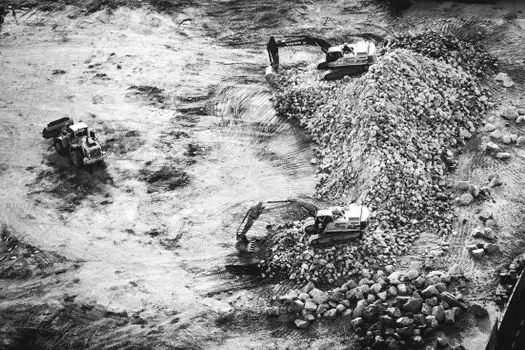
The excavator is the stronger choice for deep excavation, utility trenches, foundations, basements and pond work because it can dig below its tracks while remaining on stable ground [S2]. The wheel loader is more effective for loading dump trucks, managing stockpiles, handling gravel and sand, and consolidating loose material [S2].
On uneven terrain, the excavator can level a working pad and operate on slopes, whereas a wheel loader generally requires relatively flat ground for stable loading and travel [S2]. That operating requirement reinforces the ground-pressure distinction: a loader may have the better payload and cycle-time profile on a hard prepared surface, but the excavator usually offers more control over weak or uneven ground.
Who Should Choose Each Machine
Choose a tracked excavator when the work includes below-grade digging, trenches, foundations, slopes, wet clay, sand, peat or surfaces where rutting must be controlled. Its operating weight is normally distributed across the upper structure, undercarriage and working group, while the counterweight supports the machine against forward tipping during heavy breakout or lifting [S1].
Choose a wheel loader when the material is already loose, the haul distance is short, the loading area is firm and level, and truck-loading or stockpile handling dominates the schedule. It is not the better tool for soft ground solely because its bucket capacity is large; production depends on digging efficiency, loading cycle time, haul distance, site layout and material type [S2].
A wheeled excavator should not be treated as a general soft-ground substitute for a crawler. Its stated 25–40 psi pressure can be advantageous on hard surfaces, but that same configuration is less suitable when flotation, rut control and stability in mud are decisive [S3][S4].
Limits, Failure Modes and Site Controls
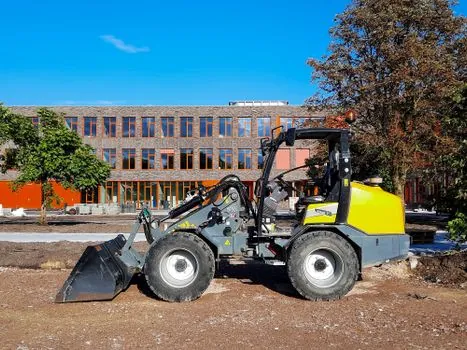
The principal failure mode is loss of bearing capacity, usually identified by standing water, a spongy surface, water-filled footprints, squelching vegetation or deep ruts under foot traffic [S5]. Once a wheel loader sinks into saturated clay, increasing engine power or bucket capacity does not restore flotation because the limiting factor is the soil, not traction power.
Ground mats or a temporary gravel pad can spread the load beyond the machine footprint. Another effective control is to position the excavator on firm ground and reach into the weak area instead of driving across it [S5]. The same operating principle applies to crawler-crane pad selection: Crawler Crane Track Pad Width Selection for Soft Ground provides a related comparison of load spreading on soft soil.
Operating weight still matters. A 20–25 metric ton excavator allocates about 40–45% of its weight to the upper structure, 25–30% to the undercarriage, 25–30% to the working group and 5–10% to attachments and optional equipment [S1]. Modifications, altered counterweight, different pads or heavier attachments can change the approved operating configuration, so published pressure for a nominal model class must not be transferred blindly to a modified machine.
Pressure, Soil Strength and Production Form One Decision
The correct soft-soil selection is normally the lower-pressure tracked machine, provided its track width and operating configuration match the required stability and digging duty. Track pressure of about 4–8 psi compares with 25–40 psi for a similarly sized wheeled excavator [S3], while an equivalent excavator comparison gives 40–50 kPa for a standard 20-ton machine and about 35 kPa for a wide-padded 30-ton machine [S1].
The wheel loader remains the faster material-handling choice once it has firm access, but the excavator has the lower-pressure undercarriage and the geometry to work from stable ground into weak areas [S2][S4]. Track the actual contact area, operating weight, soil moisture and rutting on entry before dispatch. If the surface is saturated and no firm route or protective pad exists, specify a lighter wide-track machine, work from mats, or postpone travel until the soil can carry the load [S5].