
An expansion joint, also called a movement joint, is a deliberate gap or flexible assembly that absorbs temperature-induced expansion, contraction, vibration, and settlement in buildings, bridges, piping, ducts, and ships, while keeping the surrounding structure sealed and serviceable [S4].
Classifications run along two independent axes: the mode of movement accommodated (axial compression, lateral shear, angular rotation) and the construction material (metallic bellows, fabric laminates, elastomer, PTFE). The same physical service, such as a steam header, can be served by several types, and the wrong pairing usually shows up as a failed bellows or a sheared anchor within the first year [S2][S3].
Movement Modes and Why They Drive Selection
Engineers specify expansion joints against four displacement vectors: axial (compressive), lateral (shear), angular (bending), and torsional, and every catalog type maps back to one or more of these [S4]. Single bellows units handle primarily axial compression on a straight run, while hinged, gimbal, and pressure-balanced configurations constrain unwanted degrees of freedom so the joint only moves where the designer wants it to [S3].
Elbow pressure-balanced and in-line pressure-balanced designs eliminate the reaction thrust that would otherwise load the main anchors, a critical point when anchoring is impractical or where anchor costs dominate the layout [S3]. Externally pressurized bellows solve the column-instability, or squirm, failure mode that hits long, thin-walled single convolutions under compression [S3]. For very large lateral travel, universal joints use two bellows joined by a center pipe to multiply deflection capacity per unit length [S3].
Material Family Comparison: Metal, Fabric, Rubber, PTFE
Metallic bellows are thin-walled cylinders, usually stainless steel, formed into convolutions that flex to absorb axial, lateral, and angular movement; they dominate high-pressure, high-temperature piping and are the default for refinery, power, and steam service [S3]. Fabric expansion joints, built up from layers of gas-seal film, PTFE, fiberglass, and insulation, are the workhorse for low-pressure hot-gas ducts where temperature, gas velocity, and particulate loading govern layer count and replacement interval [S3][S4].
Rubber and elastomeric joints, including single arch, multiple arch, lightweight, filled arch, spherical molded, and wide arch variants, carry the architectural and process-piping world because they damp vibration, tolerate misalignment, and accept a wide range of chemical linings including Teflon for aggressive media [S2]. The filled arch variant trades 50% of joint flexibility for abrasion resistance in slurry service, a deliberate one-way choice engineers make when media erosion would otherwise destroy an open arch in months [S2].
Bridge and Civil-Structure Joints: A Different Scale
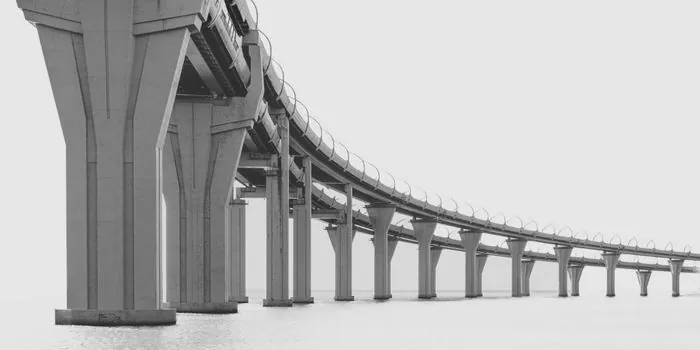
Bridge expansion joints occupy a parallel classification track, sized in millimetres of travel rather than pipe diameters, and rated against traffic load, skew, and seismic gap. Standard small-, medium-, and large-movement joints cover 30 to 1,000 mm, while modular multiple-gap joints engage when total deck travel exceeds a single gap's capacity, with documented use from 160 mm longitudinal up to over 3,000 mm [S4].
Modular designs divide the total deck movement into individual gaps separated by horizontal surface beams, sealed with watertight elastomeric profiles and regulated by an elastic control system; some versions use sinus plates on the running surface, reducing tire-impact noise by up to 80% [S4]. For comparison with the road and rail field, construction machinery and equipment that places or services these joints, such as asphalt pavers feeding approach slabs, follows its own spec envelope; the joint itself is a stationary engineered assembly, not a moving machine. Highway-class joints also include foam-type, compression seal, winged, inflated, and strip-seal variants, each tuned to a particular movement range and water-tightness target [S1].
Piping and Ducting: Geometry Decides the Geometry
For piping, the geometric families are single, universal, hinged, gimbal, pressure-balanced, and slip-type, and the choice is largely a function of what the upstream and downstream anchors can react [S3]. Slip-type joints use a sliding piston or sleeve to absorb large axial movements, often several hundred millimetres, on long hot lines such as district heating and turbine exhausts [S3].
Toroidal bellows, with smooth omega-shaped convolutions, are specified where high pressure and high durability matter and where crevice corrosion would attack a standard formed bellows; heat-exchanger tube sheets are the canonical use case [S3]. Thick-wall and refractory-lined versions extend metallic joints into high-temperature, abrasive flue-gas service, with the ceramic or cement liner protecting against both heat and particulate erosion [S3]. Rectangular metallic joints translate the same logic to square or rectangular ductwork, where a round bellows cannot be sealed against flat flange faces [S3].
Architectural and Building Joints: Cover, Not Just Gap

Building expansion joint systems pair a structural gap with an architectural cover plate system, and the cover, not the gap, is what facility owners and occupants actually see and trip on. Standard interior and exterior cover solutions start at 1 inch (25 mm) of design movement and run to highly engineered seismic joint systems for sky bridges and base-isolated structures [S5].
The four canonical movement types for an architectural joint, thermal expansion and contraction, seismic drift, wind sway, and live-load deflection, each drive a different cover profile and a different anchoring scheme, and the specifier is really buying a tested assembly, not a piece of rubber [S5]. For adjacent process equipment, the expansion joint and the expansion anchor serve related but distinct jobs: the joint absorbs pipe or structure movement, while the anchor holds the pipe or equipment fixed so the joint actually does the moving.
Selection Criteria: A Practical Engineer's Checklist
The decision tree starts with three numbers: design temperature, design pressure (including vacuum), and the calculated movement vector (axial, lateral, angular, or a combination). Media compatibility is the next gate, and it is where rubber, PTFE/FEP liners, and stainless alloys are picked, not the geometry [S2].
Life expectancy drives the fabric-versus-metal call in ductwork: a fabric belt that needs replacement every 2 to 5 years is acceptable in a power plant but unacceptable in a hospital riser, where a metal bellows with cyclic-life rated convolutions is the right spend [S3]. Size, weight, and alignment tolerance follow; lightweight and spherical-molded variants exist precisely to handle undersized or misaligned pipe runs where a full spool will not fit [S2]. For process lines that also need to transmit rotation between equipment, see universal joint design notes, which solve a related but separate torque-transmission problem.
Failure Modes, Limits, and Standards Anchors

The dominant failure modes are bellows fatigue cycling, column instability (squirm) in long single convolutions under compression, corrosion and stress-corrosion cracking of thin walls, liner permeation in fabric joints, and abrasion or chemical attack in elastomer and PTFE liners [S3][S4]. Each maps to a countermeasure: cycle-rated convolutions, externally pressurized geometry, alloy selection, multi-layer fabric build-up, and filled arches or chemical-resistant liners respectively [S2][S3].
Engineers should anchor specs to the governing piping or pressure-vessel code (ASME B31.1 / B31.3 for power and process piping) and to the Expansion Joint Manufacturers Association (EJMA) for calculation of bellows stress, life cycles, and anchor loads; for hazardous-area flue or solvent service, ignition-risk assessment follows the ATEX 2014/34/EU equipment directive and the IEC 60079 series for explosive atmospheres. A practical reference for adjacent equipment selection is the related coverage of lighting equipment and electric lamps and lamps and light fittings used in the same industrial spaces, which share the same hazardous-area classification logic.
Trackable signals to watch: EJMA revision cycles (the last major revision updated fatigue-life calculation methods), movement-range creep in modular bridge joints as climate-driven thermal swings widen, and the gradual shift in ducted service from single-layer fabric to multi-layer fluoropolymer-faced laminates where scrubbed flue-gas dew points demand tighter permeation control.
For related coverage, see Tunnel Asphalt Paver Specs: Feed Tunnel, Width, and Emissions Criteria.