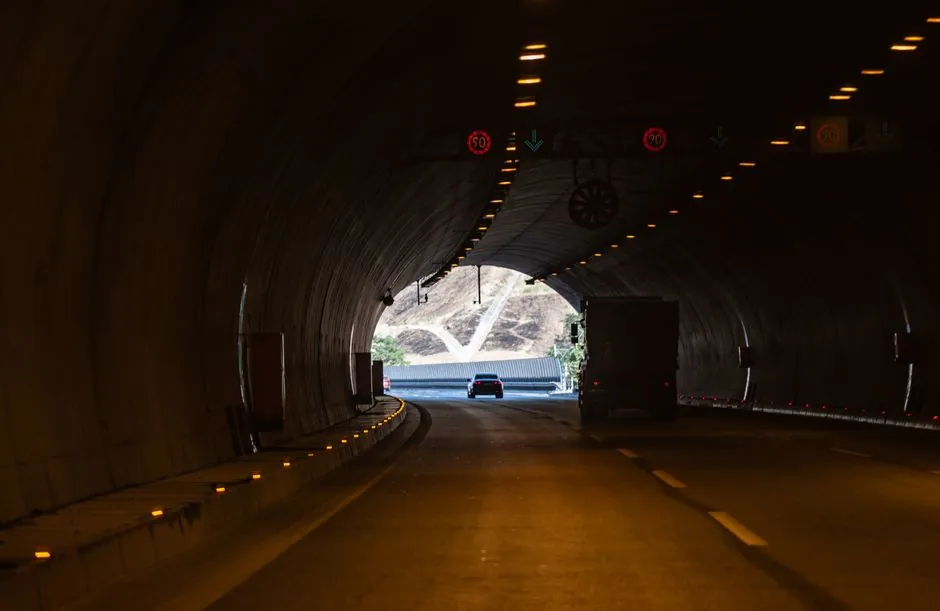
Wheeled pavers in the 8 ft to 10.4 ft standard paving-width class dominate European tunnel resurfacing jobs, with feed-tunnel widths around 30 in (762 mm) and auger diameters near 16 in setting the geometric floor for tunnel-grade asphalt pavers [S5][S1].
Two wheeled Vögele pavers, a SUPER 1803-5 X and a SUPER 1303-3i, are currently on the Mont Blanc Tunnel modernization, where the full 11.6 km bore is being renovated through 2042 under night-shift logistics, a deployment that sets the practical reference case for tunnel paver selection in 2026 [S2].
Why feed-tunnel geometry is the first spec to lock
The feed tunnel is the rectangular steel chute that bridges the paver hopper floor to the auger chamber, and its width is the single dimension that disqualifies a machine before any other spec is reviewed. A 30 in (762 mm) feed tunnel, paired with twin 16 in (406 mm) augers and a 0.7 in auger flight thickness, is a typical highway-class configuration that handles standard dense-graded mixes without bridging [S5]. For a tunnel bore, the more critical question is the auger chamber ceiling height and whether the machine can maintain head of material against a high-friction stone-matrix asphalt (SMA) or a polymer-modified wearing course, both common in long-tunnel wearing courses. Screed pre-strike-off pressure is delivered by a screed plate typically 0.5 in thick sitting on a vibratory mount that can run up to 3000 vibrations per minute in Tier 4F highway-class pavers [S5].
Standard vs maximum paving width in a tunnel
Highway-class wheeled pavers normally publish a standard paving width near 10.4 ft (3.17 m) and a maximum paving width near 28 ft (8.53 m) with bolt-on extensions, but tunnel work almost never uses the maximum figure because the carriageway width is fixed by the bore [S5]. The 8 ft (2.5 m) working width of compact wheeled units such as the Roadtec RP-170 suits tight-radius tunnel curves where a longer-wheelbase tracked machine cannot track the centerline without corrective steering [S1]. For two-lane tunnel tubes near 7 m to 8 m clear carriageway, contractors typically pave in two passes, which is why the screed crown adjustment range matters: the Bomag Stretch 16 in the CR462 supports positive crown up to 3 in and negative crown up to 1 in, sufficient for the 1.5% to 2.5% cross-fall typically specified in road tunnels [S5].
Emissions and driveline for confined-space work

Ventilation-limited tunnel environments push selection toward Stage V / Tier 4F diesels with diesel particulate filters, or fully electric drive packages. The Vögele SUPER 1300-5e is a fully electric compact paver with zero operating emissions, shown at bauma 2025, and the MINI 500e and MINI 502e machines extend the battery-electric line down to mini-class paving widths below 1.5 m [S2]. For diesel power in a tunnel, the Cummins QSB6.7 platform at 225 hp gross (measured at 2200 rpm) is one of the engines documented in the CR462 spec sheet, and its aftertreatment sizing is the variable that determines whether a machine can run a 12-hour tunnel shift on the available duct ventilation without tripping a diesel-emission sensor [S5].
Comparison: tunnel paver class options on four decision criteria
Four paver classes are practical candidates for tunnel work, and the differences fall along four axes: working width, drive type, hopper volume, and feed-tunnel cross-section. The CR462 sits at 10.4 ft standard width, Tier 4F diesel, 8.2 yd³ (6.27 m³) hopper, and 30 in (762 mm) feed tunnel with 16 in augers [S5]. The Roadtec RP-170 is an 8 ft (2.5 m) rubber-tire compact paver aimed at maneuverability in tight curves [S1]. The Vögele SUPER 1803-5 X and 1303-3i are wheeled units running the Mont Blanc tunnel, with documented zero-emission sister machines (SUPER 1300-5e, MINI 500e, MINI 502e) on the same platform [S2]. Mini pavers like the Vögele Super 800-5 P-Tier cover trench and narrow-strip work below 1.5 m but cannot match a highway-class paver for mat density in a single lift [S2]. For typical 3 m to 8 m tunnel carriageways, the wheeled 8 ft to 10.4 ft class is the sweet spot; tracked units are reserved for jobs where ground bearing pressure is the binding constraint rather than geometry.
Material handling and laydown rates in a tunnel
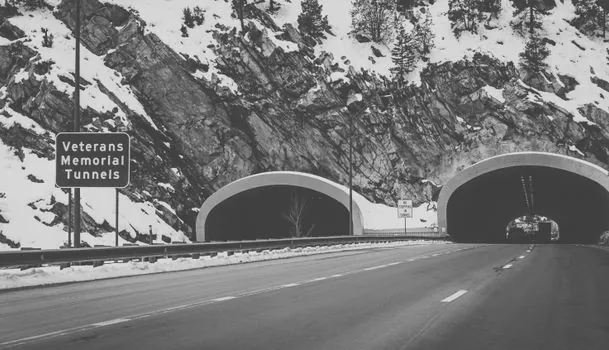
Hopper capacity sets the truck-to-paver hand-off window, and a 28,000 lb (≈12,700 kg) hopper with 8.2 yd³ volumetric capacity gives roughly 4 to 5 minutes of paving buffer at a 200 ft/min laydown rate before a fresh haul truck must dock [S5]. The paving train sequence (haul truck → MTV/shuttle buggy → paver hopper → feed tunnel → augers → screed → rollers) is standard, and the MTV is a near-mandatory insert for long tunnel drives where reversing a truck inside the bore is unsafe [S4]. Maximum paving speed around 242.8 ft/min (74 m/min) and travel speed up to 10 mph (16 km/h) on a wheeled chassis give enough repositioning speed between shifts without burning fuel on non-paving movement [S5].
Operating-mass and ground-bearing limits
Tunnel invert slabs are usually designed for highway loading, not for a fully loaded paver sitting in one spot for an extended stop-and-go cycle, and the tractor weight is the number to track. The CR462 tractor weight with Stretch 16 screed and hydroflated tires is 42,600 lb (19,323 kg); with the lighter Fastach 8 screed the same tractor is 38,700 lb (17,554 kg); bare tractor is 34,700 lb (15,740 kg) [S5]. Hydroflated tires reduce ground-bearing pressure at the cost of higher rolling resistance, which is the trade-off that matters on a wet or freshly tack-coated tunnel invert. Hydraulic system capacity of 75 gal (284 L) and fuel capacity of 72 gal (272 L) define the shift-length envelope before the machine has to be pulled out for service [S5].
Rejection criteria, subgrade prep, and quality gates
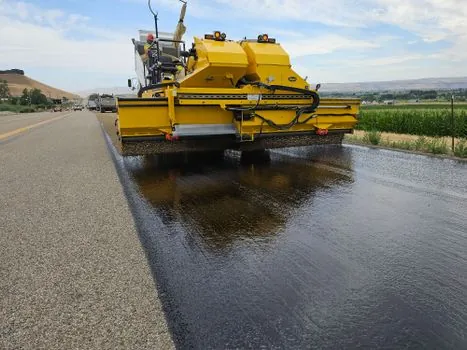
Tunnel paving inherits the same mix-rejection rules as open-road work: any non-spec mix arriving at the paver is to be rejected and the rejection logged, per standard DOT paving-operations guidance [S3]. Subgrade in a tunnel is typically the previously placed lift or the existing invert surface, and the surface must be cleaned and tacked before the next lift; the subgrade must support haul trucks without rutting or it must be reworked and stabilized [S3]. A practical spec-led asphalt paver inspection walkthrough before a tunnel shift should confirm screed plate flatness, auger flight clearance against the feed tunnel walls, hopper insert wear, and aftertreatment differential-pressure baseline, all items that drive in-tunnel downtime if missed. Adjacent systems worth cross-checking on the same tunnel job are the screed hydraulic pressure transmitter lines that read extension-cylinder load, the auger chamber flow-meter signal that flags conveyor starvation, and the screed-extension industrial valve block that locks crown in negative position.
Trackable signals to watch over the next two reporting cycles: (a) further deployment data from the Mont Blanc wheeled-paver program, where two Vögele machines are committed through 2042 and any shift to the SUPER 1300-5e electric variant would materially shift the tunnel-paver emissions baseline [S2]; (b) Tier 4F aftertreatment service intervals on Cummins QSB6.7 power in confined-space duty, which are not separately published but emerge in field reports [S5].