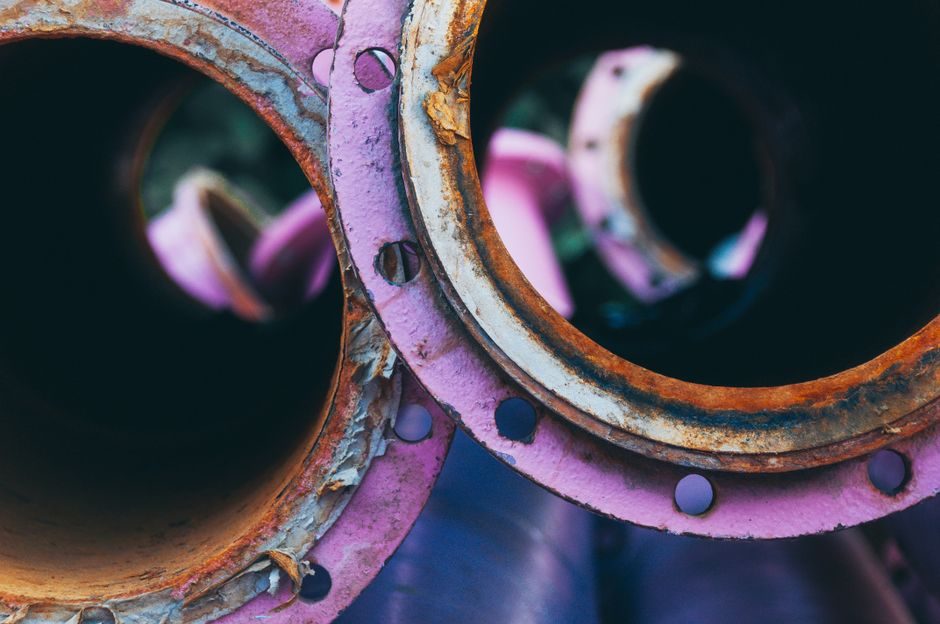
An expansion joint is a deliberate flexible element built to absorb pipe movement — typically thermal expansion, contraction, vibration, or anchor movement — without transmitting destructive load to adjacent equipment [S1][S5].
A pipe fitting does the opposite: it is a rigid or semi-rigid connector that changes direction (elbow), branches flow (tee), reduces size (reducer), or terminates (cap), and it is dimensionally controlled by ASME B16.9, B16.11, MSS-SP etc. The two product families overlap on flanges and connectors, which is where most project-spec errors begin.
What an Expansion Joint Actually Does
A metallic expansion joint is "a compensating element for thermal expansion and relative movement in pipelines, containers and machines," per the OEM definition published on Hebei Zhongran's product page [S1]. A stainless-steel metallic unit lists standard size coverage from DN15 to DN200 mm, with bellows wall thickness 1.5–3.0 mm and overall length 0.2–20 m on a flange-end, axial-type, CE/ISO 9001/ISO 14001/JIS-certified build [S2].
Rubber/elastomer expansion joints trade the temperature and pressure ceiling of metal for far greater axial, lateral and angular travel per cycle, and they isolate vibration — EPDM, NBR, PTFE-lined and double-sphere rubber units dominate HVAC, chilled water and chemical dosing lines [S2][S4]. Finger-type expansion joints are a separate bridge-and-roadwork product, sold in 10 m MOQ units for structural concrete joint sealing, not pipe service.
What a Pipe Fitting Is For
Pipe fittings are geometric and dimensional components: elbows, tees, reducers, couplings, unions, caps and plugs sized to ASME/EN/JIS standards. They carry no design travel budget; their job is to redirect or terminate flow within a tight dimensional envelope. On made-in-china sourcing pages, metal joint fittings — typically brass or stainless — turn up at very different price points, for example brass flare fittings at US$0.88–2.98 per piece (MOQ 100) and brass pneumatic push-in elbows at US$0.90–1.50 (MOQ 50) [S3].
Flanges straddle both worlds: a pipe fitting in the B16.5/B16.47 sense (a flat or raised-face connector), but also the end connection of most metallic and rubber expansion joints [S2]. A single-sided weld, flanged expansion joint with tie-rod control unit is a hybrid: the bellows absorb movement, the tie rods transfer pressure thrust to the flanges, the flanges bolt to the adjoining pipe like any standard pipe fitting.
Selection Criteria: Movement, Pressure, Temperature, Media
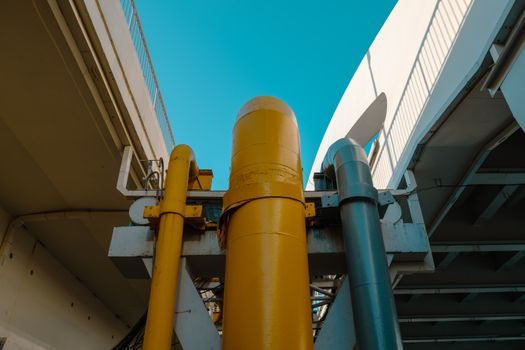
Four numbers drive the call. (1) Required axial/lateral/angular travel in mm or degrees — anything above ~5 mm thermal growth per 10 m of carbon steel pipe means a dedicated expansion joint is mandatory. (2) Design pressure and temperature — metallic bellows cover the high end (steam, hot oil, refinery hydrogen), rubber/elastomer the low end (chilled water, seawater, dilute acids). (3) Media compatibility — PTFE-lined and 316L bellows are standard for chemical and pharmaceutical service [S2]. (4) Pressure-thrust load — fixed-end anchors must be designed for the bellows cross-sectional area × design pressure, which is the leading cause of misalignment failure when engineers treat a joint as a fitting [S1].
For purely directional or branching work with no movement budget, specify a pipe fitting and be done. For systems with thermal cycling, pump vibration, or seismic displacement, an expansion joint is non-negotiable. The wrong pick shows up as cracked pipe supports, leaking flange gaskets within weeks of start-up, or, in the worst documented case, anchor failure under full pressure thrust.
Comparison: Expansion Joint vs Pipe Fitting on Four Decision Criteria
On primary function, an expansion joint absorbs movement while a pipe fitting redirects or terminates flow. On design basis, expansion joints are engineered per EJMA (Expansion Joint Manufacturers Association) for cycle life and travel, whereas pipe fittings follow ASME B16.9 / B16.11 / MSS-SP dimensional rules. On pressure-temperature ceiling, metallic bellows units handle the highest service (stainless steel grades SUS304, 321, 310S, 316L are standard offerings [S2]), while standard carbon-steel fittings cap out where the line class dictates. On price/lifecycle, fittings are commodity items at sub-dollar brass up to multi-thousand-dollar alloy weldolets; expansion joints are engineered, often special-built, and priced per piece with non-trivial engineering content [S3][S6].
Where Pipe Fittings and Expansion Joints Overlap (and Where They Don't)
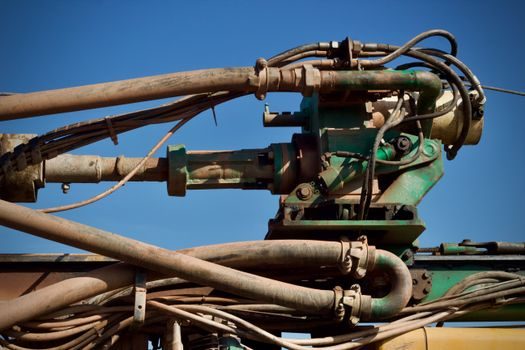
Flanged joints, coupling/union joints, and connector categories are sold by the same factories — Henan Liwei Industry, for instance, lists "Flexible Joint, Expansion Joint, Steel Bellows, Dismantling Joint, Pipe Fitting, Pipe Connector, Flange Rubber Joint, Pipe Compensator" as a single product family with 1-piece MOQ and 100-piece-per-week supply [S6]. API International similarly bundles "Industrial Flanges | Expansion Joints | Pipe Fittings | Custom Machined Parts" as one engineering solution. That bundling is fine at the catalog level, but it is dangerous on the datasheet: a pipe fitting carries no movement rating, and an expansion joint carries no dimensional standard for line layout.
They don't overlap on three points: cycle life (joints are specified for thousands of cycles; fittings are not rated), anchor-load design (joints impose thrust; fittings do not), and inspection regime (joints are inspected for bellows convolution integrity; fittings are inspected for dimension and material cert).
Common Specification Errors and Failure Modes
Three errors recur in the field. First, using a pipe fitting where a flexible joint is required — typically a long straight hot run with no expansion loop, which then cracks an elbow or pushes an anchor off its foundation. Second, using an expansion joint where a rigid fitting is correct — installing a flexible joint on a cold, non-cycling line, paying for cycle life the system will never consume. Third, mis-sizing the joint: ordering DN50 bellows on a DN80 line, or omitting tie rods on a pressurised axial joint so the line walks off its supports. Each error is recoverable at the drawing stage with a movement calculation and an EJMA-based selection. [S1]
For buyers sourcing from Asian OEM catalogs, the practical signal is certification: CE, ISO 9001, ISO 14001, JIS, and SGS test reports on the metal joint datasheet are the minimum baseline; for chemical and steam service, insist on material traceability for 304/316L and on cycle-life test data per EJMA [S2][S6].
Standards, Sourcing Reality and What to Verify

No single ISO or ASME standard unifies both product families: expansion joints are governed by EJMA (latest edition), with flange ends following ASME B16.5/B16.47, while pipe fittings follow ASME B16.9 (butt-weld), B16.11 (socket-weld and threaded), MSS-SP (unions, couplings), and equivalent EN 10253 / JIS B2311 series. PTFE-lined and rubber expansion joints add ISO 9001 quality-system and CE pressure-equipment compliance to the mix [S2][S4]. API International positions itself across all three — flanges, expansion joints, and pipe fittings — as a one-stop custom fabricator for industrial and imported line classes.
For a 2026 specification, the cost gap between rubber expansion joints and metallic bellows remains 3–10× depending on size and alloy, while the cost of a single misapplied pipe fitting versus a correctly specified expansion joint is a failed start-up. The trackable next node to watch: EJMA cycle-life data on 316L bellows above DN400, and the uptake of PTFE- and EPDM-lined rubber joints in district-cooling and seawater service. For a related reference on movement-absorbing hardware, the expansion anchor encyclopedia page covers the fixed-point design that pairs with every bellows on this list.
For related coverage, see NAND flash smart manufacturing: 2026 fab automation, 3D stack specs and line reality.