Explosion-proof control stations sold by North American and European suppliers span $200 enclosure-only assemblies to over $3,000 for multi-switch operator stations, with Class I Division 1 Groups C,D and Class II Groups E,F,G as the most commonly quoted ratings [S2][S3].
The category covers factory-sealed pushbutton, pilot light, and selector switch stations used in petroleum refineries, chemical plants, paint spray booths, grain handling, and pharmaceutical facilities, with Crouse-Hinds, Appleton, Killark, Allen-Bradley, Larson Electronics, and CEAG (Cooper) as the most cited manufacturer brands in distributor catalogs [S3][S4][S5].
What an Explosion-Proof Control Station Actually Does
An explosion-proof control station is a certified enclosure engineered to contain any internal arc or spark so that the resulting ignition cannot propagate to the surrounding hazardous atmosphere, with the flame path through threaded joints, flanges, covers, and conduit entries acting as the primary quenching mechanism [S1].
Operators interact with the same controls found in ordinary industrial enclosures, including pushbuttons, selector switches, emergency-stop mushroom heads, and pilot lights, but the housing itself is rated to a defined hazardous location classification such as Class I Division 1, Class I Division 2, Class II, Class III, or the IEC equivalents Zone 1 and Zone 2 [S1][S2]. The principle differs from intrinsic safety: instead of limiting circuit energy below ignition thresholds, flame-path containment lets the station house conventional 600V AC switching hardware [S1][S3].
Two Material Families Define the Enclosure Decision
Cast Feraloy iron alloy and copper-free aluminum are the two dominant enclosure materials across the major North American lines, with stainless steel components typically used for shafts and fasteners regardless of body material [S2][S3].
Crouse-Hinds EDS-series stations in the Eaton catalog are offered in both Feraloy iron alloy and copper-free aluminum variants, with single-gang and two-gang housings, 1/2" to 1" NPT hub sizes, and 600V AC ratings across the pushbutton, selector, and emergency-stop SKUs [S3]. The Larson Electronics EPCS-HOM-2XFOR-ESTP station uses an aluminum body with stainless steel parts, surface mount, four drilled and tapped operator holes, and a 3/4" NPT wiring hub, listed at $3,062.35 for a (3) 3-position switch plus E-stop configuration [S2]. Material choice typically tracks corrosion exposure: aluminum for offshore and chemical, Feraloy for heavy industrial and mining, and stainless where washdown or hygienic service applies [S1][S3].
Certifications, Ratings, and the C1D1 vs C1D2 Distinction
North American NEC Class I Division 1 ratings cover locations where ignitable concentrations of flammable gases or vapors exist under normal operation, while Division 2 covers abnormal-condition-only exposure, and explosion-proof control stations are specifically required to prevent an internal spark from igniting the surrounding atmosphere in both cases [S1].
Common UL/NEMA ratings on these stations include NEMA 7 for Class I Groups C,D and NEMA 9 for Class II Groups E,F,G, with NEMA 4 added where wet or corrosive outdoor exposure applies [S2]. The Larson unit carries Class I Division 1&2 Groups C,D, Class I Zones 1&2 Groups IIB, IIA, Class II Division 1&2 Groups E,F,G, Class III, and a NEMA 7(C,D) 9(E,F,G) enclosure type [S2]. For European and global projects, the equivalent path is ATEX (2014/34/EU) and IECEx certification, and CEAG-branded stations distributed through Reynolds online (page refreshed 2026-10-22) sit in that track [S5]. When an explosion-proof button must be integrated with a broader assembly, the control station enclosure is often the more efficient single certification target than certifying the operator alone.
Configurations That Drive Price and Lead Time
Control station price and lead time are governed by gang count, switch count, contact configuration, and hub size, with 1NO-1NC and 2NO-2NC the most common contact patterns and 10A or 20A the most common amperage ratings in distributor stock [S4].
Looking at the Kendall Electric catalog slice of explosion-proof control stations, 181 of 186 SKUs are listed as NONSTOCK with only 5 STOCK items, indicating a build-to-order norm rather than shelf inventory [S4]. Brand share within that catalog runs Crouse-Hinds at 110 SKUs, Allen-Bradley at 40, Appleton at 17, and Killark at 15, which lines up with the field reality that Crouse-Hinds (Eaton) is the volume leader in North American hazardous-location control hardware [S4]. A practical decision is whether the design needs a single-gang, one-operator station (smallest, cheapest, fastest lead) versus a two-gang assembly combining start/stop, E-stop, and pilot light on a single dead-end or through-feed body [S3].
Operator Components: Pushbuttons, Selector Switches, E-Stops

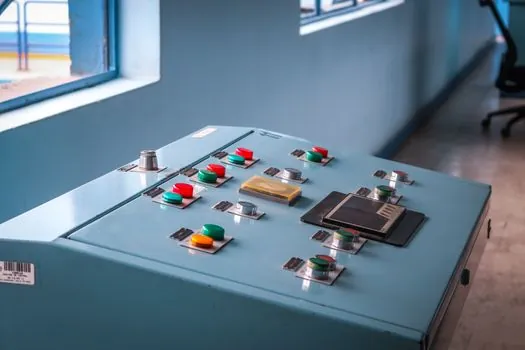
Factory-sealed EDSX, EDS, and EFS control stations from Eaton are designed so that arcing inside the enclosed device cannot ignite the surrounding atmosphere, with operator options covering momentary pushbuttons, maintained-contact mushroom heads, and 2-position or 3-position selector switches [S3].
Selector switches in this class commonly ship as Hand-Off-Auto, Forward-Off-Reverse, or Raise/Lower patterns, with the forward-off-reverse units frequently spring-loaded between off and reverse to act as momentary returns [S2]. The trade-off between push button and selector switch on the same station usually comes down to whether the operator needs a continuous mode selection or only discrete start/stop commands, since each selector position consumes a circuit and a face hole. Emergency-stop stations universally use a red maintained-contact mushroom head with push-pull or twist-to-release operation, and lockout provisions are common on the larger industrial SKUs [S3].
Use Cases, Sourcing Channels, and Failure Modes to Avoid
Petroleum refineries, chemical and petrochemical plants, paint spray booths, food manufacturing, agricultural processing, and waste water treatment are the application areas most often cited by both manufacturers and distributors for explosion-proof control stations [S1][S2][S6].
Three sourcing channels dominate: direct from the OEM (Larson Electronics, Eaton Crouse-Hinds, CEAG), through electrical distributors (Kendall Electric, Reynolds, Kirby Risk), and through integrated hazardous-location packagers who assemble the station into a broader explosion-proof distribution or motor-control package [S4][S5][S8]. The most common field failure modes are damaged flame paths from improperly torqued cover bolts, missing or wrong thread engagement on conduit entries, and painted or coated threaded joints that close the gap needed for the flame-path quench, so installation and inspection crews should treat the threaded interfaces as functional safety components, not cosmetic hardware [S1]. Stations installed in corrosive washdown or outdoor service should also be specced with NEMA 4 protection on top of the NEMA 7/9 hazardous-location rating, since NEMA 7/9 alone does not imply water resistance [S1][S2].
Trackable signals over the next two quarters: whether more Crouse-Hinds EDS-series SKUs move from NONSTOCK to STOCK in the major distributor catalogs (a leading indicator of supply normalization), and whether the ATEX/IECEx dual-certified SKU count from CEAG expands as European EPC contractors standardize on global specs.