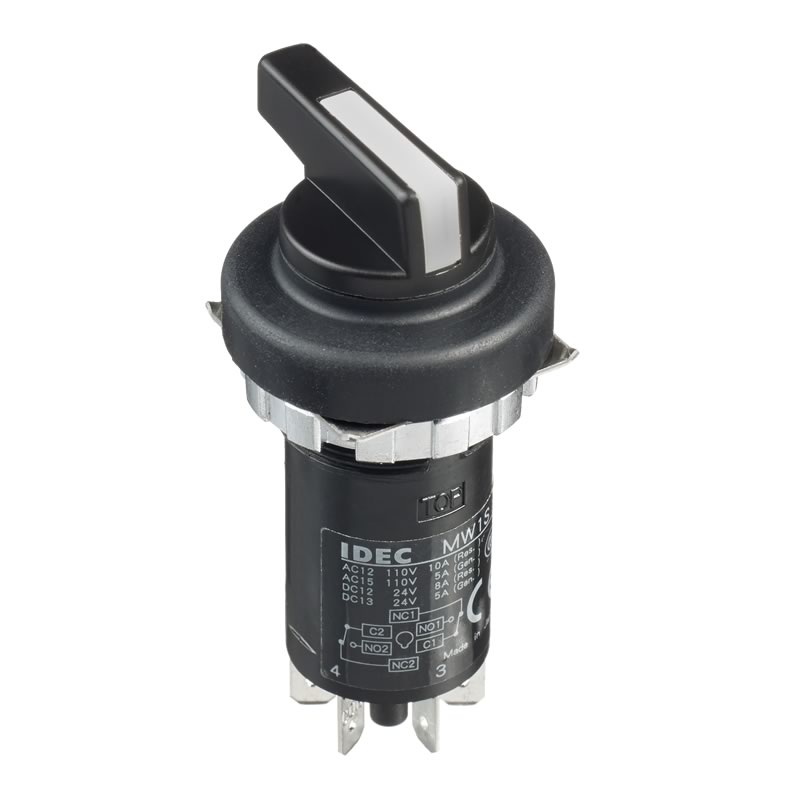
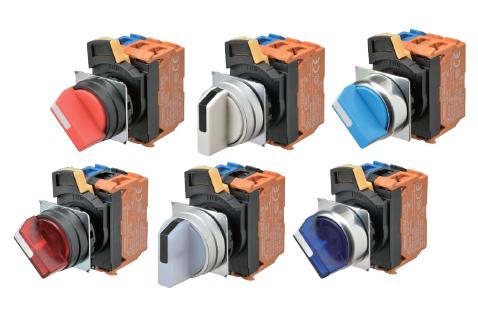
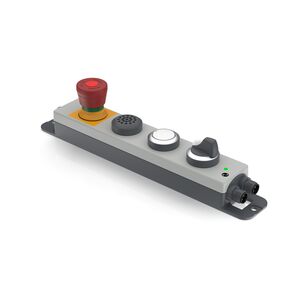
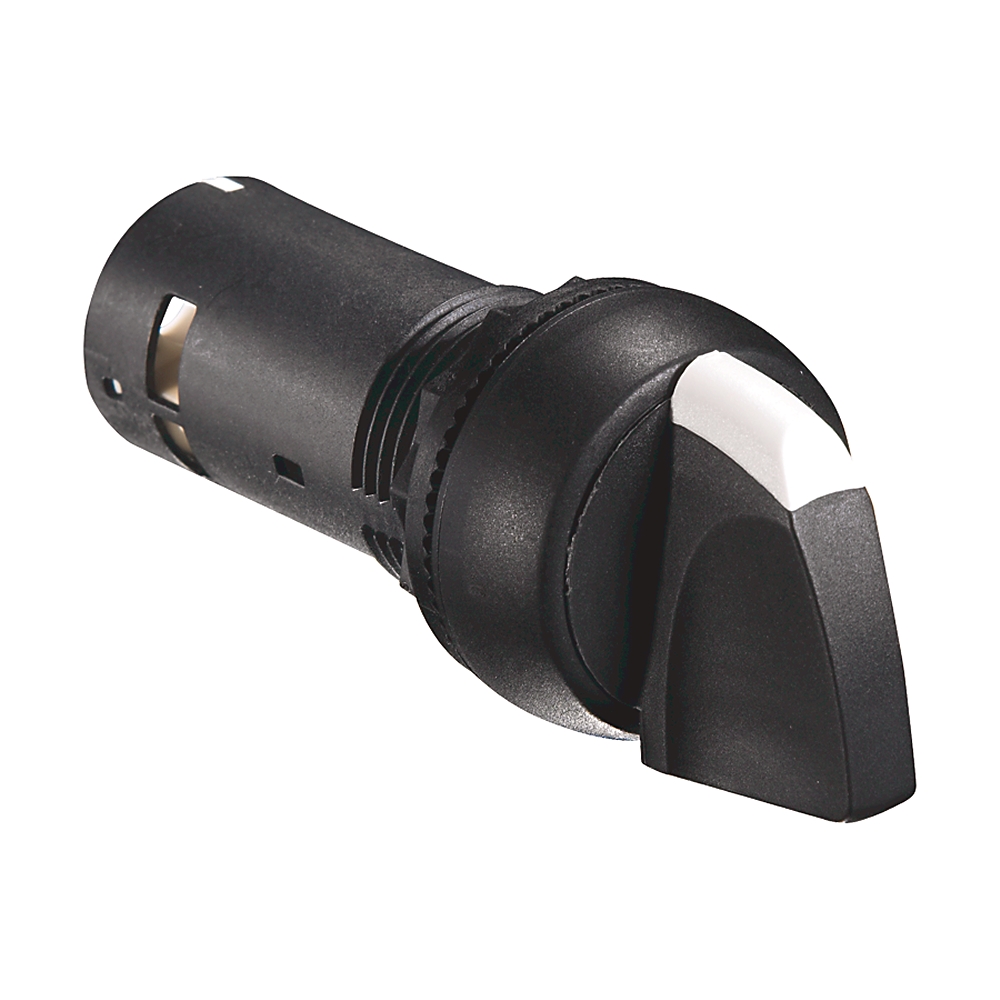
A selector switch is a panel-mounted control device that lets an operator choose between two, three, or four discrete circuit states by turning a handle, knob, or key. It is the most common way to express a machine mode on a control panel: Hand-Off-Auto on a pump starter, Local-Remote on a conveyor, or Manual-Jog on a press. Mechanically it is a short-throw rotary device whose cam opens and closes a stack of contact blocks behind the operator.
Although it shares the rotary form factor with rotary and cam switches, the selector switch is purpose-built for control-circuit duty under IEC 60947-5-1: low position count, defined make-break sequence, and contact blocks rated to switch contactor and relay coils rather than to carry main load current. This guide decodes the actuator options, the contact-block ratings, the protection classes, and the selection logic that separate a correct order from a panel rework.
Photo: Balurbala, CC BY-SA 3.0, via Wikimedia Commons
This guide is written for industrial purchasing engineers and panel designers. It covers 6 chapters, from what a selector switch is, through actuator types, contact-block technology, mounting and protection standards, and key spec parameters, to a selection decision sequence, with 7 selection FAQs and manufacturer comparisons. All ratings reference the public standards IEC 60947-5-1 (control circuit devices), IEC 60947-3 (switch-disconnectors, used for cam-switch comparison), UL 508 and UL 60947, CSA C22.2 No. 14, the IEC 60529 IP scheme, the NEMA 250 enclosure scheme, and ISO 20653 for IP69K.
Chapter 1 / 06
What is a Selector Switch
A selector switch is an electromechanical control-circuit device that converts an operator's rotary motion into the opening and closing of one or more contact pairs, allowing a person to select among a small number of fixed circuit states. It belongs to the same family as the pushbutton and the pilot light: a command and signalling device that talks to a control circuit, not a power device that carries motor or feeder current. Its job is to tell a PLC, relay, or contactor which mode the machine should run in, after which those downstream devices do the heavy switching of the actual load.
Structurally a selector switch has three layers. The first is the operator, also called the actuator: the handle, knob, or key barrel that protrudes through the panel face, plus its bezel and sealing collar. The second is the cam, a profiled drum that rotates with the operator and mechanically pushes contact plungers in a defined sequence. The third is the contact-block stack, one to three snap-on or screw-on modules behind the panel, each holding a normally-open (NO) or normally-closed (NC) contact element. The truth table that maps each handle position to a set of open and closed contacts is fixed by the cam profile and printed in the catalog as a position diagram.
The distinction from neighboring devices is sharp once the standard is named. A selector switch and a pushbutton are both governed by IEC 60947-5-1, the standard for low-voltage control circuit devices and switching elements; they differ only in actuator motion, rotary versus linear. A rotary switch or a cam switch can carry far more positions and is often rated to carry or break heavier loads under IEC 60947-3, the switch-disconnector standard. So the practical rule is: if the device only selects a mode for a control circuit, specify it as a selector switch to 60947-5-1; if it must carry or interrupt main current or needs many positions, specify a cam switch to 60947-3.
Selector switches appear on virtually every industrial control panel built since the era of relay logic. Typical roles include Hand-Off-Auto on motor starters, Local-Remote transfer on conveyors and pumps, Manual-Automatic on packaging lines, On-Off lighting and heater control, forward-reverse jog on small drives, and lamp-test or alarm-acknowledge functions. The modern 22 mm form factor traces back to the consolidation of European control-gear dimensions, while the larger 30 mm heavy-duty operators grew out of the North American NEMA oil-tight tradition, and the major suppliers carry parallel lines in each diameter. Because they directly encode the operator's intent, they sit at the interface between human and machine and are subject to ergonomic and safety expectations: legible legends, distinct detents, and, where a mode change can create a hazard, key access or interlocking.
The device matters because it is deceptively simple to order wrong. Two switches with identical panel faces can differ in switching action (maintained versus spring-return), in cam truth table, in contact count, in contact rating category, and in sealing class. A mismatch is invisible until the panel is wired and powered, at which point the wrong mode logic or a coil that will not pull in forces a hardware swap. The remainder of this guide is organized to make each of those hidden parameters explicit before the order is placed.
Chapter 2 / 06
Actuator Types and Switching Action
The actuator defines how the operator interacts with the switch and how the position behaves when released. Two independent dimensions describe it: the physical operator (what your hand or key turns) and the switching action (whether the position holds or springs back). Confusing these two is a leading cause of returns, so this chapter separates them deliberately. The table below summarizes the common operator styles.
Operator type
Typical positions
Access
Typical use
Short / standard handle
2, 3
Open (anyone)
Hand-Off-Auto, On-Off, Local-Remote
Long handle (lever)
2, 3
Open, gloved hand
Heavy industry, high-visibility setting
Knob (coin slot / wing)
2, 3, 4
Open or tool
Compact panels, hygienic washdown
Key-operated
2, 3
Key holder only
Maintenance mode, guard defeat, LOTO
Illuminated handle
2, 3
Open
Status feedback in low light
Short and long handles are the default. A short handle suits clean indoor panels and tight legend spacing; a long lever handle is easier to read at a distance and easier to operate with a gloved hand, which is common in heavy industry. The handle angle indicates the selected position, so legend plates around the bezel mark each detent, for example the classic three-position legend reading Hand, Off, Auto.
Knob operators, including coin-slot and wing styles, are used where a low profile or a smooth wipe-down surface matters. Schmersal's N-series IP69K knobbed selector switches, for instance, are built for food and pharmaceutical washdown, with rounded, food-compatible surfaces that tolerate caustic cleaning. Illuminated operators add an LED in the handle or bezel for status feedback, drawing a small auxiliary supply (commonly 24 V AC/DC, 110 to 120 V, or universal LED versions that accept a wide input range).
Key-operated selectors replace the handle with a lock barrel so only a key holder can change the mode. Crucially, many key versions allow the key to be removed only in one or more defined positions, which is what makes them useful for access control and lock-out / tag-out: park the switch in the safe position, remove the key, and the mode cannot be changed without it. Key switches enforce procedure but are not by themselves a rated safety function; a safety-related mode change requires a direct-opening contact and an appropriately designed circuit, covered in Chapter 4.
The second dimension is switching action, the behavior on release, summarized below.
Action
Behavior on release
Catalog term
Typical use
Maintained
Holds the selected position
Stay-put
Hand-Off-Auto, Local-Remote mode states
Spring-return (full)
Returns to rest from every position
Momentary
Jog, test, pulse commands
Spring-return (one side)
One position holds, one springs back
Maintained + momentary
Off (held) plus jog (released)
Maintained (stay-put) switches latch at each detent and are the right choice for persistent mode selection, where the machine must keep running in the chosen state after the operator walks away. Spring-return (momentary) switches are held against a spring and snap back to a rest position when released, producing a pulse, used for jog, inch, lamp-test, or alarm-acknowledge. Three-position units frequently mix the two, for example a held Off in the center with a spring-return jog to the right, written in catalogs as a cam diagram such as "spring return right to left" or "spring return to center." Schneider's Harmony XB5 catalog, for example, lists distinct part numbers like the stay-put XB5AD25 and the spring-return-to-center XB5AD53 that share the same handle but carry different cam actions. Because the panel face cannot reveal the action, the cam diagram in the datasheet is the authoritative reference when ordering.
Chapter 3 / 06
Contact Blocks and Ratings
Behind the operator sits the contact-block stack, the part that actually carries and breaks current. This is where the electrical ratings live, and where most under-specification happens, because the panel-facing operator looks the same regardless of what is wired behind it. A typical 22 mm body accepts up to three contact blocks; each block holds one NO or NC element, snapped or screwed onto the operator base. The table below compares the engineering parameters that distinguish contact-block choices, with representative values from mainstream 22 mm lines such as Schneider Harmony XB5 and ABB Modular.
Parameter
Standard contact block
Gold-plated / low-level block
Why it matters
Contact material
Silver alloy (AgNi)
Gold-flashed silver
Gold resists oxide film at low current
Rated insulation voltage Ui
600-690 V
600-690 V
Sets clearance / creepage class
Conv. thermal current Ith
10 A
~1 A or less
Resistive heating limit only
AC-15 rating (typical)
6 A @ 120 V; 3 A @ 240 V
Not for coil loads
Real make-break of contactor coils
Minimum switching load
17 V / 5 mA
~5 V / 1 mA
Reliable PLC / electronic input
The single most important idea in this chapter is that a contact block carries two different current numbers, and confusing them causes premature failure. The conventional thermal current (Ith) is the current a closed contact can carry continuously without overheating, often 10 A on a 22 mm element such as the Harmony XB5 ZB5 block, and as high as 24 A on heavy-duty NEMA contacts like the Allen-Bradley 800T family. It says nothing about switching life. The utilization category rating (AC-15, DC-13) is the current the contact can repeatedly make and break against an inductive coil load, which is far lower. A representative 22 mm block is rated around AC-15 6 A at 120 V, 3 A at 240 V, and 1.2 A at 600 V. The ABB Modular contact element, for example, is published at Ui 690 V with Ith 10 A while its AC-15 and DC-13 figures sit well below that. Always size the switch against the AC-15 or DC-13 number for the coil you intend to switch, never against Ith.
AC-15 is the IEC 60947-5-1 utilization category for switching AC electromagnetic loads that draw more than 72 VA, such as a contactor operating coil. The inrush of an energizing coil and the arc of a collapsing magnetic field make AC-15 the governing case for almost all control panels. DC-13 covers DC electromagnet coils switched without an economy resistor; the long inductive time constant means DC contacts must break a sustained arc, which is why DC-13 currents are an order of magnitude below the AC-15 figures and why DC coil circuits sometimes add a suppression diode or RC snubber to protect the contacts.
Contact material matters at the two extremes of current. Standard silver-alloy (silver-nickel, AgNi) contacts self-clean their surface oxide through the small arc of normal switching, which is ideal for coil and lamp loads but can leave an insulating film when switching only a few milliamps. For low-level signals into PLC or electronic inputs, specify a gold-plated (gold-flashed) contact block, which holds contact resistance low down to roughly 5 V and 1 mA. Mixing this up, by using a gold block on a contactor coil, burns the thin gold off immediately; using a silver block on a 5 mA PLC input risks intermittent reads as oxide builds. Several manufacturers, including Rockwell Automation with its 800T low-level "logic reed" and gold contacts, publish dedicated low-level blocks for exactly this reason.
Two further block attributes deserve attention. Contact reliability, sometimes quoted as a probability such as a failure rate below a few parts per ten million operations at a stated minimum load, is the metric for safety and signal circuits. Direct opening (positive opening), marked with the standardized arrow-in-circle symbol and defined in IEC 60947-5-1 Annex K, guarantees that the NC contact is forced open by a non-resilient mechanical link rather than by a spring, so a welded contact cannot mask an open command. The term "direct opening" is used in IEC and "positive opening" historically in NEMA practice, but both describe the same rigid, spring-free link between the actuator and the moving contact. Any selector switch contact used in a safety function, such as a guard-mode key switch, should carry a direct-opening NC element.
Chapter 4 / 06
Mounting, Sealing, and Standards
A selector switch must fit the panel cut-out, seal against the panel environment, and carry the certifications the project requires. These three constraints are governed by the mounting diameter, the IP and NEMA protection scheme, and the device standards. Each is a hard gate: a switch that fits but does not seal, or seals but is not certified for the market, cannot ship.
Mounting diameter follows two traditions. The 22 mm cut-out is the IEC standard, dominant in Europe and Asia, used by compact modular operators with snap-in contact blocks rated to IEC 60947-5-1. The 30 mm (more precisely 30.5 mm) cut-out is the legacy NEMA heavy-duty standard common in North American industry, with larger oil-tight operators rated to UL 508 and CSA C22.2 No. 14. A smaller 16 mm and even 12 mm form factor exists for instrument and OEM panels. The diameters are not interchangeable: the legend plate, the sealing collar, and the contact-block family all change with the body size, so the panel design must commit to one cut-out standard before ordering operators.
The IP and NEMA protection classes describe how well the front of the operator resists dust and water; the table below maps the common front-of-panel ratings to environments.
Front-of-panel rating
Roughly equals
Resists
Typical environment
IP65
NEMA 1 / 12
Dust, low-pressure water jets
Indoor control room, dry plant
IP66
NEMA 4
Dust, powerful water jets
Outdoor, wet, hose-down areas
IP66 (4X body)
NEMA 4X
Above plus corrosion
Marine, chemical, coastal
IP69K
NEMA 4X (washdown)
Close high-pressure hot steam
Food, beverage, pharma washdown
IP ratings come from IEC 60529; the first digit (here 6) is dust ingress and the second (5 or 6) is water. IP69K extends the scale to close-range high-pressure, high-temperature spray and is defined in ISO 20653, originally the German DIN 40050-9. The test uses water at roughly 80 degrees C delivered at 80 to 100 bar (1,160 to 1,450 psi) and 14 to 16 litres per minute, from a nozzle held 10 to 15 cm from the device at four angles for thirty seconds each while the part rotates on a turntable. That is the standard for hygienic washdown lines. Schmersal, for example, builds a dedicated IP69K hygienic selector-switch family for this duty with food-compatible, UV- and ozone-tolerant seals. One caution: the front rating protects only the operator face. The contact blocks behind the panel rely on the enclosure for their protection, so the cabinet must be rated at least as high as the operator, and the panel cut-out must be deburred and gasketed correctly for the rating to hold.
Device standards establish what the ratings mean and where the switch can be sold. IEC 60947-5-1 (and its EN equivalent) is the global control-device standard defining utilization categories, contact reliability, and direct opening; the current edition is IEC 60947-5-1:2024. UL 508 historically governed industrial control equipment in North America and is transitioning to the harmonized UL 60947 series, which is technically aligned with IEC 60947 apart from national differences. CSA C22.2 No. 14 covers Canada. A device intended for both IEC and North American markets typically lists IEC 60947-5-1 plus UL 508 or UL 60947 plus CSA on its datasheet, as the dual-certified Schneider Harmony and Siemens SIRIUS ACT families do. For safety-related selector functions, IEC 60947-5-1 Annex K (direct opening), plus the machine-safety standards ISO 13849-1 and IEC 62061, define the required performance level of the overall circuit.
Chapter 5 / 06
Key Specification Parameters
A selector-switch datasheet lists a dozen or more fields, but only a handful change the order. Reading them correctly separates a clean specification from a panel rework. The parameters below are the ones that drive selection, grouped by what they control.
Number of positions. 2, 3, or 4. Two positions handle On-Off and Local-Remote; three handle Hand-Off-Auto and Forward-Off-Reverse; four are used for multi-speed or multi-mode selection. Beyond four positions, or where multiple parallel circuits must switch together, the design usually moves to a rotary cam switch rated to IEC 60947-3.
Switching action and cam diagram. Maintained, spring-return, or a mix. The cam diagram in the datasheet is authoritative: it shows which contacts are closed in each position and whether each position holds or returns. Two switches with the same handle and the same position count can carry entirely different cam tables, so quote the cam reference, not just "3-position."
Contact configuration. The NO and NC count, for example 1NO, 1NO+1NC, 2NO, or 2NO+2NC, limited by how many contact blocks the body accepts, commonly up to three on a 22 mm body. Count not only the circuits you switch today but spares for future logic, since adding a block later is far cheaper than swapping the whole operator.
Electrical rating by utilization category. AC-15 and DC-13 currents at the relevant voltages, as covered in Chapter 3. This is the number that matters for switching coils. The conventional thermal current Ith is a separate, higher figure for continuous carrying and must not be substituted for the AC-15 or DC-13 value.
Rated insulation voltage Ui and rated impulse withstand Uimp. Ui (often 500, 600, or 690 V on 22 mm blocks) sets the clearance and creepage distances and therefore the circuit's working-voltage ceiling; Uimp (commonly 4 or 6 kV) sets surge withstand. These govern whether the device is legal in a given control-voltage system.
Mechanical and electrical durability. Mechanical life is the number of operations the mechanism survives unloaded, typically around 1,000,000 operations for quality 22 mm operators such as the Harmony XB5 and the Siemens SIRIUS ACT 3SU1, with some variants of these ranges rated up to 10,000,000 cycles. Electrical life is far lower and load-dependent, because each make-break erodes the contacts; it is quoted at a stated AC-15 or DC-13 current. For a switch operated many times a shift, electrical life, not mechanical life, sets the replacement interval.
Minimum switching capacity. The lowest voltage and current at which the contact reliably conducts, for instance around 17 V and 5 mA for a standard silver block, or about 5 V and 1 mA for a gold-plated block. Driving a low-current PLC input below the standard block's minimum is a classic cause of intermittent faults.
Protection class and ambient temperature. The front IP and NEMA rating per Chapter 4, plus the operating temperature window, commonly around minus 25 to plus 70 degrees C for general-purpose operators, narrower for illuminated versions because of the LED. Outdoor and cold-store panels must verify both ends of the range.
Terminal and connection type. Screw-clamp, spring-cage (push-in), or faston and PCB terminals. Push-in terminals speed panel build and resist vibration loosening; screw terminals remain common for field-serviceable panels. Match the terminal style to the shop's wiring practice and the wire gauge in use.
Chapter 6 / 06
Selection Decision Factors
To turn the preceding chapters into a single part number, follow the ordered sequence below. Most selector-switch errors come not from one wrong field but from deciding a later step before an earlier one is fixed. These steps double as a fixed RFQ template.
Function and positions: Define the mode logic first (Hand-Off-Auto, Local-Remote, Forward-Off-Reverse, jog) and from it derive the number of positions: 2, 3, or 4. The mode logic also tells you the cam truth table you will need.
Switching action: Decide which positions must hold (maintained) and which must spring back (momentary). Capture this as a cam diagram, not a word, because catalogs index by cam reference. This is the single most error-prone choice.
Operator type and access: Short handle, long handle, knob, illuminated, or key. Choose key access where a mode change must be restricted or must support lock-out / tag-out; choose illuminated where status feedback in low light is needed.
Contact configuration and rating: Count the NO and NC contacts the logic needs, plus spares, then verify the AC-15 or DC-13 current against every coil the contacts switch. Select gold-plated contacts only for low-level PLC or electronic signals, and silver for coil and lamp loads.
Mounting diameter: Commit to 22 mm (IEC) or 30 mm (NEMA) to match the panel and the contact-block ecosystem. Do not mix cut-out standards within one panel design.
Protection and environment: Set the front IP and NEMA rating from the location (IP65 indoor, IP66 / 4X outdoor or corrosive, IP69K washdown) and confirm the enclosure rating is at least as high. Verify the operating temperature range at both extremes.
Certifications: List the device standards the market and application require: IEC 60947-5-1 always, UL 508 or UL 60947 and CSA for North America, plus direct-opening (Annex K) contacts and ISO 13849-1 / IEC 62061 circuit design for any safety-related mode function.
Terminal, durability, and total cost: Pick the terminal style (screw or push-in), check electrical life against the duty cycle, and weigh purchase price against contact endurance and brand support. A cheap operator that fails contacts in a year of frequent switching costs more in downtime than the price gap.
One last dimension that is easy to overlook is serviceability and ecosystem: whether the chosen line offers interchangeable contact blocks and spare operators, whether legend plates and accessories are stocked locally, and whether the brand is supported in the regions where the machine will run. Selector switches are high-touch devices that wear out and get replaced over a machine's life, so a line with a deep local accessory range, such as Schneider Harmony XB5, Siemens SIRIUS ACT 3SU1, ABB Modular, Allen-Bradley 800F, Eaton M22, or IDEC HW, lowers the long-run maintenance burden even when a cheaper one-off device exists. For non-critical, low-cycle loops, lower-cost 22 mm lines such as Chint NP2 are serviceable substitutes, provided the contact rating and certification are verified for the specific duty rather than assumed from the catalog headline.
FAQ
What is the difference between a maintained and a spring-return selector switch?
A maintained (stay-put) selector switch holds whatever position the operator turns it to until it is deliberately turned again, so it is used for mode states that must persist: Hand-Off-Auto, Local-Remote, or Manual-Automatic. A spring-return (momentary) selector switch is held against a spring while turned, then snaps back to a defined rest position when released, so it is used for jog or pulse commands such as inch-forward or lamp-test. Many three-position units mix the two: a stay-put left and a spring-return right, written in the catalog as the cam diagram. Choosing the wrong action is the most common selector-switch ordering error, because both versions look identical from the panel face.
What do the AC-15 and DC-13 ratings on a selector switch mean?
AC-15 and DC-13 are utilization categories from IEC 60947-5-1 that describe the most demanding load a control-circuit contact is rated to make and break: an electromagnet, typically a contactor or relay coil. AC-15 covers AC electromagnetic loads drawing more than 72 VA; DC-13 covers DC electromagnet coils without an economy resistor, whose inductive collapse is hard on the contacts. A typical 22 mm contact block such as the Schneider Harmony XB5 ZB5 element is rated around AC-15 6 A at 120 V, 3 A at 240 V, and 1.2 A at 600 V. Always size against the AC-15 or DC-13 figure, never against the higher conventional thermal current Ith, because Ith only describes resistive heating, not coil switching life.
How many positions and contacts can a selector switch have?
Standard panel selector switches offer 2, 3, or 4 positions, indexed roughly 45 to 90 degrees apart. Each position drives an internal cam that opens or closes a stack of contact blocks mounted behind the operator. A common 22 mm body accepts up to three contact blocks, giving combinations such as 1NO, 2NO, 1NO+1NC, or 2NO+2NC. The cam truth table, not the handle, defines which contacts are closed in each position, so a 3-position switch can energize different circuits at left, center, and right. For more than 4 positions or many parallel circuits, engineers move to a rotary cam switch, which stacks many wafers and is rated under IEC 60947-3 rather than 60947-5-1.
What is the difference between a 22 mm IEC and a 30 mm NEMA selector switch?
The two numbers are panel cut-out diameters tied to different design traditions. 22 mm is the IEC standard mounting hole, dominant in Europe and Asia, with compact modular operators and snap-in contact blocks rated to IEC 60947-5-1. 30 mm (30.5 mm) is the legacy NEMA heavy-duty standard common in North American industry, with larger oil-tight operators rated to UL 508 and CSA C22.2 No. 14. Functionally both deliver the same selector action, but they are not interchangeable in the panel: the cut-out, the legend plate, and the contact-block ecosystem differ. Modern series such as Schneider Harmony XB5 and Siemens SIRIUS ACT 3SU1 carry dual IEC plus UL certification, so a 22 mm device can be specified for a North American panel when the documentation lists UL 508 or UL 60947.
When should I use a key-operated selector switch?
A key selector switch replaces the turn handle with a barrel lock so that only a key holder can change the position, and in many models the key can be withdrawn only in one or more defined positions. This is used for access control of operating modes: enabling a maintenance or setup mode, defeating a guard interlock for trained personnel, or enforcing a locked condition during service. Because the key can be trapped in a chosen position, it supports lock-out / tag-out procedures, though a dedicated trapped-key interlock system is required where a formal safety function is needed. Key switches are not a substitute for a rated safety device: if the function is safety-related, verify the contact is a direct-opening (positive-opening) NC element per IEC 60947-5-1 Annex K and that the overall circuit meets the required performance level.
What IP and NEMA protection does a selector switch need?
Match the front-of-panel sealing to the environment. A dry indoor control room is fine at IP65 / NEMA 1 or 12. Outdoor, dusty, or occasional-spray locations need IP66 / NEMA 4 or 4X, with 4X adding corrosion resistance for stainless or coated bodies. Food, beverage, and pharmaceutical washdown lines need IP69K, which adds resistance to close-range high-pressure, high-temperature steam jets tested with water at roughly 80 degrees C and 80 to 100 bar (1,160 to 1,450 psi) per ISO 20653; manufacturers such as Schmersal build dedicated IP69K hygienic-design selector switches for this duty. Remember the rating applies only to the operator face; the contact blocks inside the enclosure are protected by the cabinet itself, so the enclosure rating must be at least as high as the operator.
Which manufacturers and series are common for industrial selector switches?
For 22 mm IEC panel selector switches the mainstream series are Schneider Electric Harmony XB5 / ZB5 and the metal XB4, Siemens SIRIUS ACT 3SU1, ABB Modular (CP and C2SS families), Allen-Bradley (Rockwell) 800F and 800FP, Eaton Moeller M22, and IDEC HW, plus Schmersal N series for IP69K washdown. For 30 mm (30.5 mm) NEMA heavy-duty the references are Schneider 9001K / Type SK (Square D), Allen-Bradley 800T / 800H, and Eaton 10250T. All of these carry IEC 60947-5-1 plus UL 508 or UL 60947 certification, share standard 22 mm or 30 mm cut-outs, and offer interchangeable contact blocks within their own line. Chinese suppliers such as Chint NP2 and Delixi offer the same 22 mm form factor at lower cost for non-critical loops, though contact endurance and certification depth vary by batch.
Selector Switch Manufacturers
Source-backed product routes. Open a company dossier for procurement scope and cited evidence.