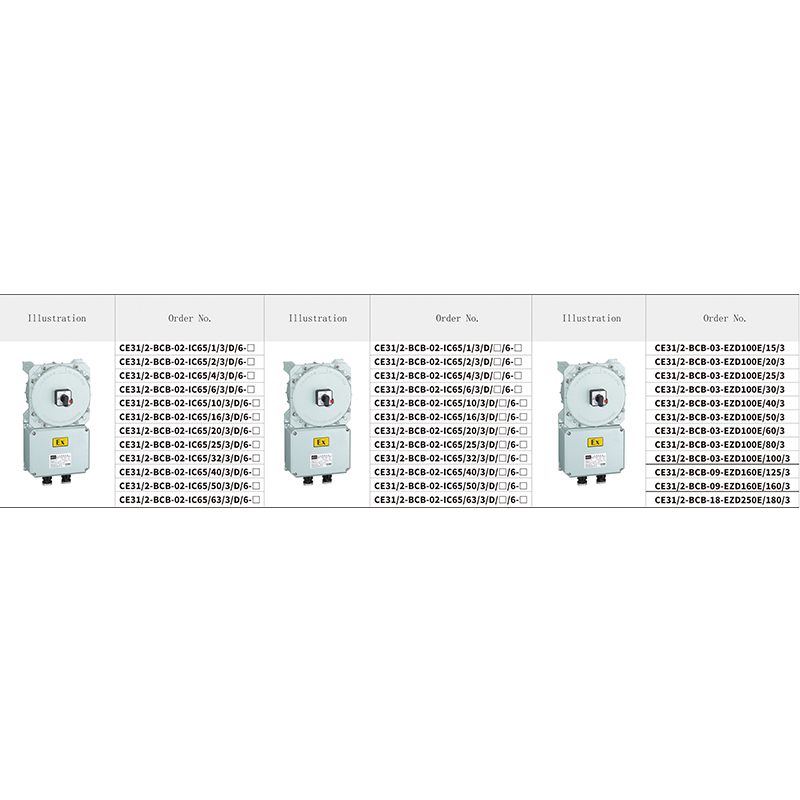
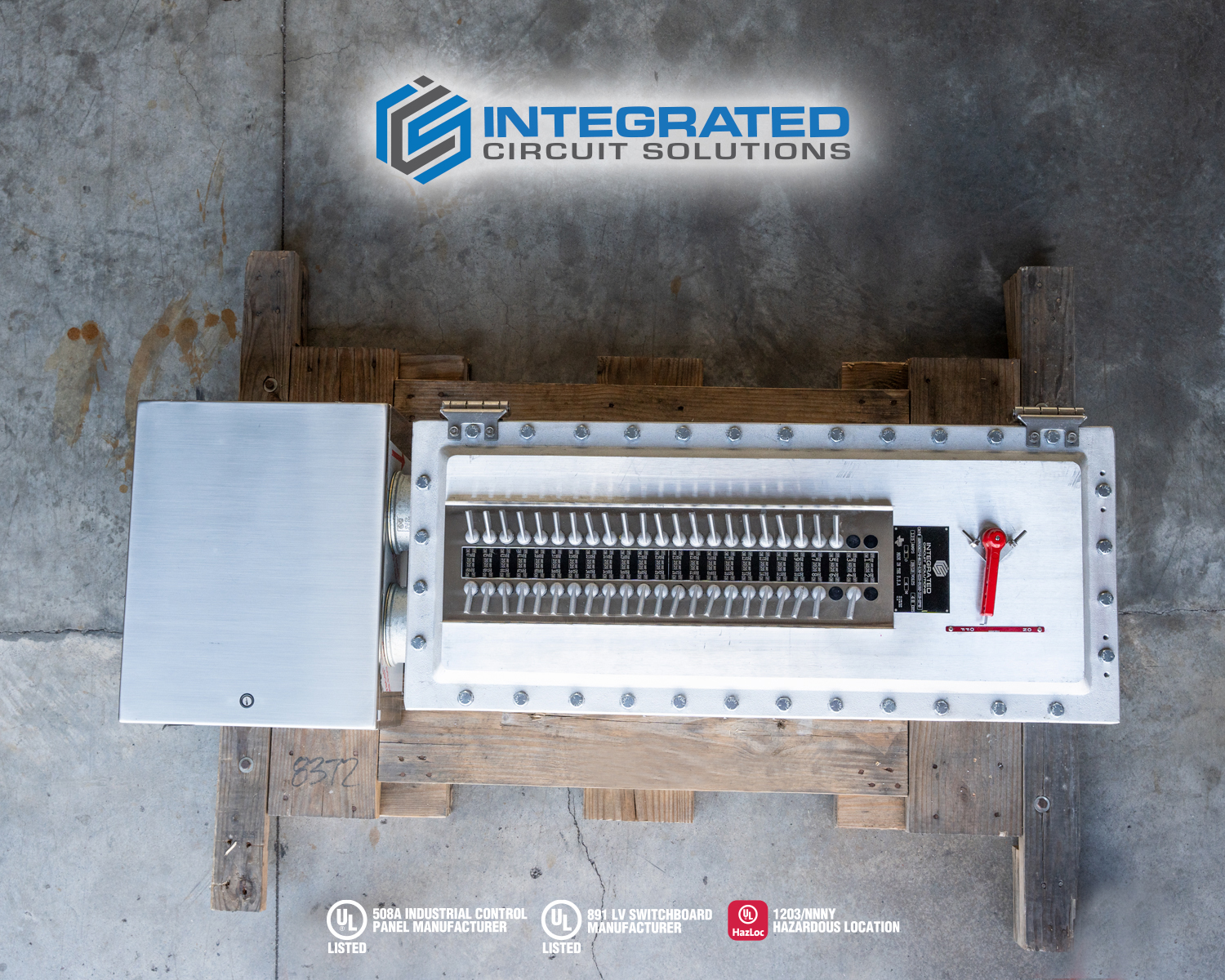
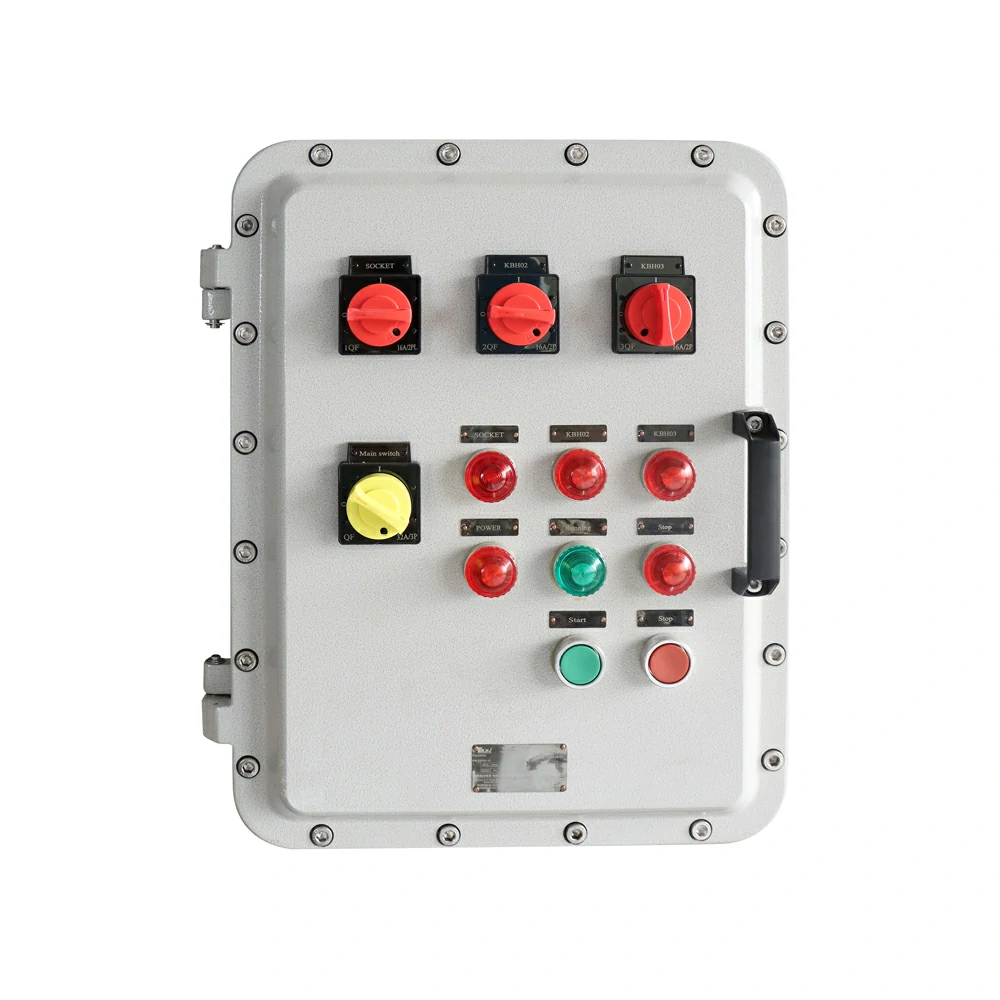
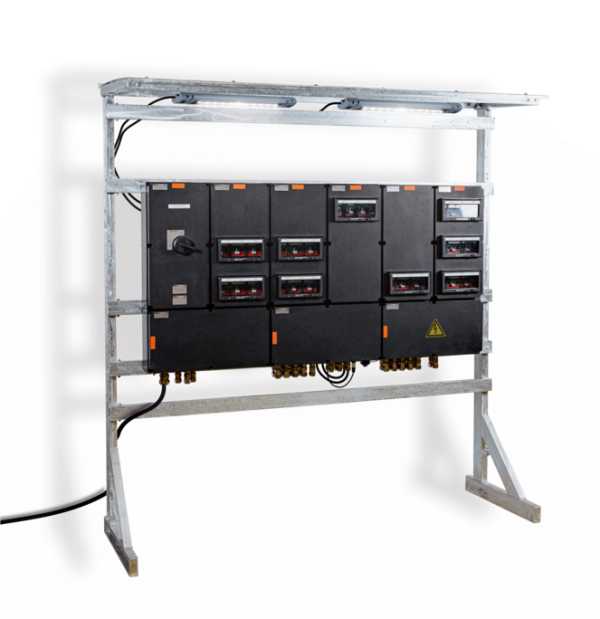
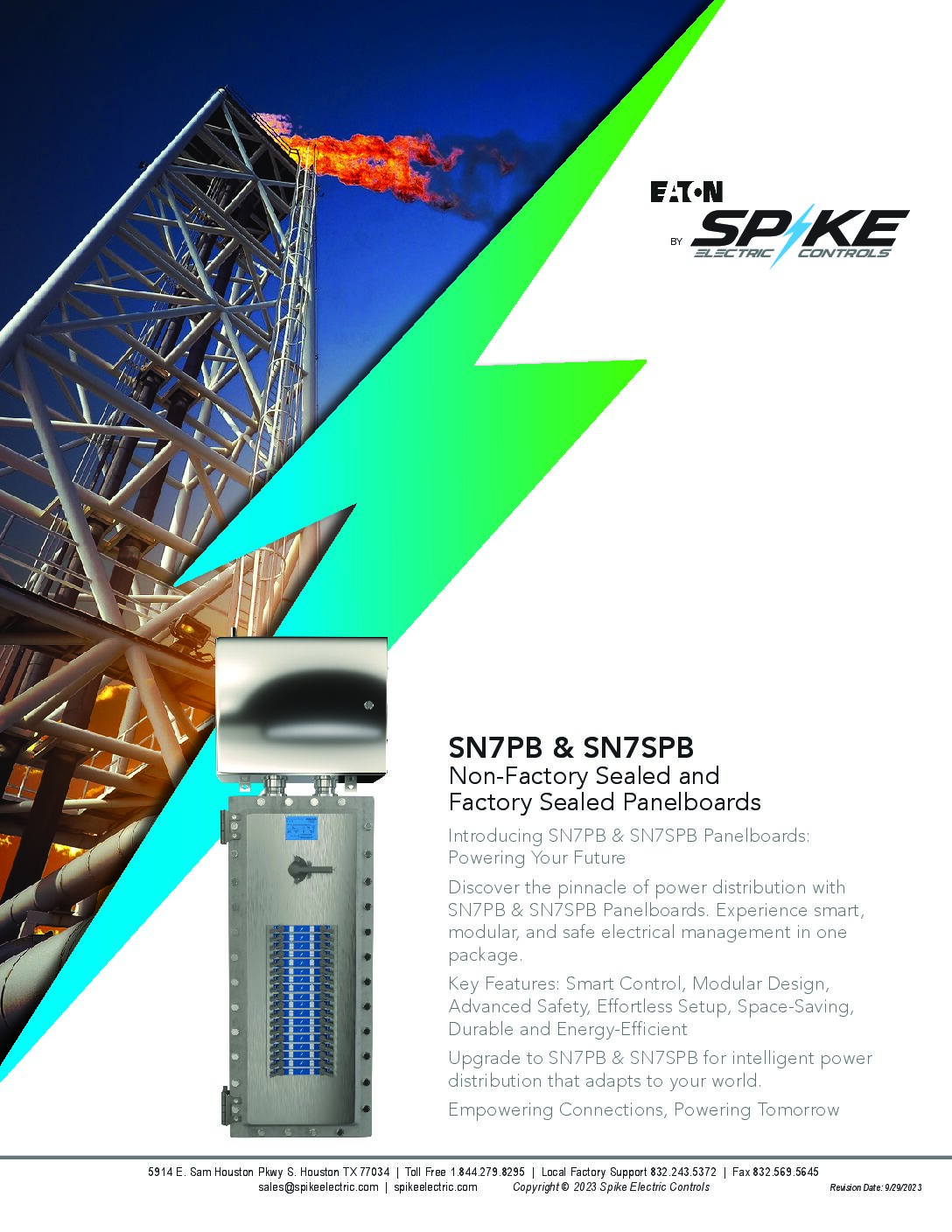
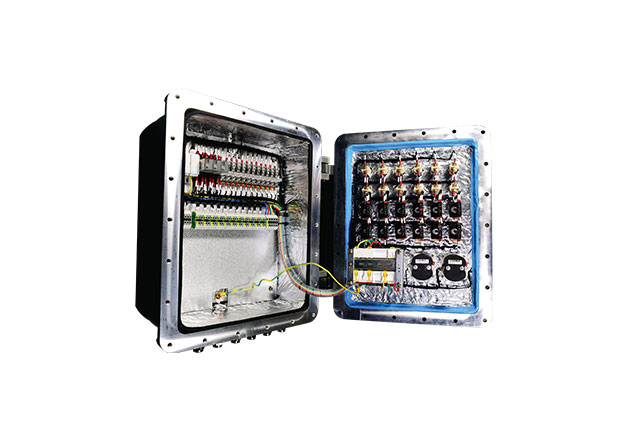
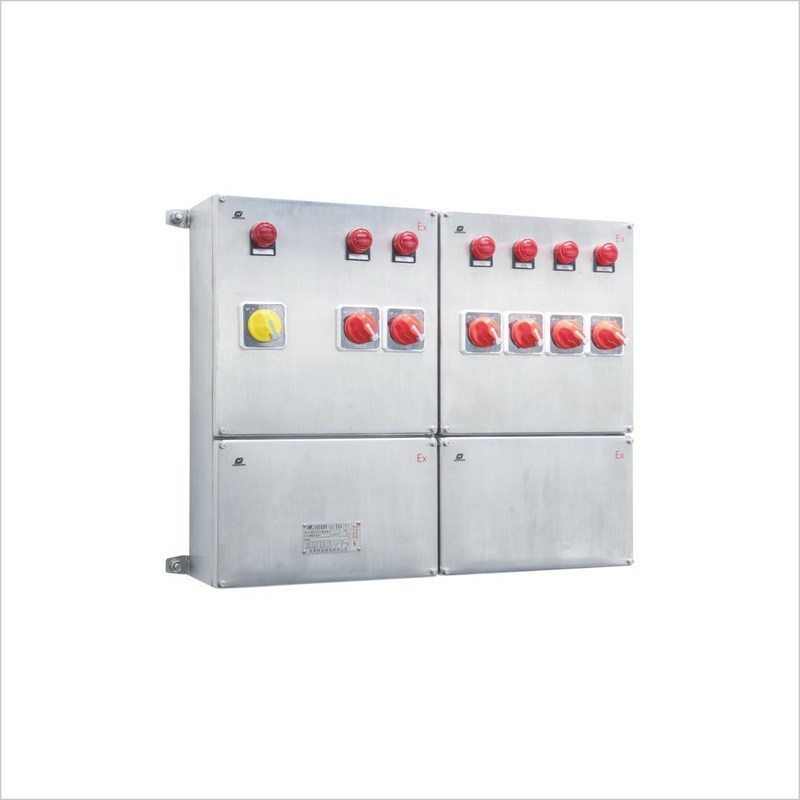
An explosion-proof distribution box, often called a flameproof distribution board or hazardous-area panelboard, distributes electrical power and houses protection and switching devices inside an enclosure certified to operate safely in atmospheres that may contain flammable gas, vapor, or combustible dust. Unlike an ordinary panel, it is engineered either to contain an internal explosion (Ex d flameproof) or to eliminate the ignition source entirely (Ex e increased safety), so that an internal arc can never propagate to the surrounding hydrocarbon or dust cloud.
These boxes are the electrical backbone of refineries, offshore platforms, chemical plants, paint shops, grain handling, and mining. Selection is governed by international standards rather than catalog convenience: the IEC 60079 series and, in North America, the National Electrical Code Article 500 Class and Division system. This guide explains the protection concepts, the marking syntax, the spec parameters, and the decision sequence an engineer uses to specify the right unit.
Photo: HAZLOC ELECTRICAL EQUIPMENTS, CC BY-SA 4.0, via Wikimedia Commons
This guide is written for industrial purchasing engineers and design engineers specifying power distribution for hazardous areas. It covers 6 chapters from protection concepts, area classification, enclosure materials, spec-sheet decoding, to the selection decision sequence, with 7 selection FAQs and certified-manufacturer references. All parameters reference the IEC 60079 series (60079-0 general, 60079-1 flameproof, 60079-7 increased safety, 60079-14 installation, 60079-17 inspection), the IEC 60529 ingress-protection code, IEC 62262 impact code, ATEX directive 2014/34/EU, the IECEx scheme, and the North American NEC Article 500 framework.
Chapter 1 / 06
What is an Explosion-Proof Distribution Box
An explosion-proof distribution box is a certified electrical assembly that splits an incoming feeder into multiple protected outgoing circuits while remaining safe to operate inside a potentially explosive atmosphere. It combines three functions in one housing: power distribution through a main busbar and outgoing terminals, circuit protection through enclosed circuit breakers or fuses, and explosion containment or prevention through the certified enclosure itself. The everyday names flameproof distribution board, Ex panelboard, and hazardous-area distribution box all describe the same class of equipment.
The defining feature is not the breakers it carries but the enclosure concept around them. A standard industrial panel relies on the surrounding air being non-flammable. In a hazardous area that assumption fails, because an arc from a switch, a loose terminal, or a tripping breaker can ignite the gas or dust cloud outside the box. An explosion-proof distribution box solves this in one of two opposite ways: the flameproof approach (Ex d) lets the internal arc happen but traps it inside a pressure-resistant housing whose machined joints cool any escaping gas below its ignition temperature, while the increased-safety approach (Ex e) removes every normal ignition source through enhanced electrical design so that no arc occurs in the first place.
The standards backbone is the IEC 60079 series. IEC 60079-0 sets the general construction, testing, and marking requirements that all Ex equipment must meet. IEC 60079-1 governs flameproof enclosures, and IEC 60079-7 governs increased safety. Installation and inspection are covered by IEC 60079-14 and IEC 60079-17. In Europe these standards are enforced through the ATEX directive 2014/34/EU, which requires an EU type-examination certificate and CE marking. Internationally the IECEx scheme issues a Certificate of Conformity recognized across more than thirty member countries. In North America a parallel framework exists under NEC Article 500, which classifies hazardous locations by Class, Division, and Group rather than by Zone.
The two regulatory systems describe the same physics with different vocabulary. The IEC and ATEX world uses Zones: Zone 0, 1, and 2 for gas and Zone 20, 21, and 22 for dust, ranked by how often an explosive mixture is present. The North American system historically used Class I (gas), Class II (dust), and Class III (fibers), each split into Division 1 (hazard present in normal operation) and Division 2 (hazard present only under fault). A distribution box certified to the wrong system, or to a lower zone or division than the installation requires, is not legally usable no matter how robust it appears.
Scale and stakes are high. A single offshore platform or large refinery may carry hundreds of hazardous-area distribution and control boards, and a single defeated flame path can ignite an entire process unit. This is why explosion-proof distribution boxes are among the most heavily certified and most rigorously inspected pieces of electrical equipment in industry, and why selection is an engineering decision traceable to a certificate, not a purchasing decision based on price alone.
Chapter 2 / 06
Protection Concepts and Box Types
The first selection decision is the protection concept, because it determines the enclosure construction, the maintenance procedure, and the cost. Five concepts are relevant to distribution and control boxes: flameproof (Ex d), increased safety (Ex e), the flameproof-plus-increased-safety hybrid (Ex de), pressurization (Ex p), and dust protection by enclosure (Ex t). The table below summarizes the engineering trade-offs.
Flameproof (Ex d) is the most widely deployed concept for boxes that contain sparking devices in Zone 1. It accepts that an internal ignition may occur and engineers the enclosure to survive it. The walls and joints withstand the internal explosion pressure, and the precisely machined flame paths along covers, glands, and shafts cool any escaping gas below the auto-ignition temperature before it reaches the outside atmosphere. The penalty is mechanical: Ex d boxes are heavy cast or fabricated housings with tight tolerances, and any field opening must respect the flame path, so maintenance is slower and bolt torque matters.
Increased safety (Ex e) takes the opposite stance: eliminate the ignition source so containment is unnecessary. It applies enhanced creepage and clearance distances, certified non-loosening terminals, controlled temperature rise, and high-integrity insulation to passive components that do not arc in normal service. Ex e is the standard concept for terminal boxes and the terminal sections of distribution boards. It is lighter and cheaper than Ex d, but it cannot house any device that arcs in normal operation, which is precisely why pure switching is never placed in an Ex e chamber.
The Ex de hybrid is how most practical distribution boards are actually built. A compact flameproof (Ex d) chamber houses the circuit breakers, contactors, or switches, and the supply and outgoing conductors pass through certified bushings into a separate increased-safety (Ex e) terminal chamber where field cables land. This combination, marked for example Ex db eb, gives the switching the robustness of flameproof containment while letting electricians terminate cables in the safer, easier-to-access increased-safety compartment. Pressurization (Ex p) keeps a clean protective gas at slight overpressure inside a larger enclosure so flammable atmosphere cannot enter, and is favored for large panels, variable-speed drives, and motor control centers where cast flameproof construction would be impractically heavy. Dust protection (Ex t) relies on a dust-tight enclosure and limited surface temperature to keep combustible dust from igniting, and is the concept for grain, sugar, flour, coal, and mineral processing distribution boards in Zones 21 and 22.
Chapter 3 / 06
Area Classification and Ex Marking
Before any box can be specified, the installation must be classified. Classification fixes three independent variables that the box marking must then satisfy: the zone or division (how often an explosive atmosphere is present), the gas or dust group (how easily it ignites), and the temperature class (how hot the enclosure surface may become). Misreading any one of the three is the most common and most dangerous selection error.
Variable
Gas (Group II)
Dust (Group III)
What it constrains
Zone present
Zone 0 / 1 / 2
Zone 20 / 21 / 22
Required EPL of the box
Equipment protection level
Ga / Gb / Gc
Da / Db / Dc
Likelihood box becomes ignition source
Group
IIA / IIB / IIC
IIIA / IIIB / IIIC
Flame-path gap, ignition energy
Temperature class
T1 to T6
surface temp in °C
Max surface temperature
Zones and EPL. Zone 0 (gas continuously present) demands the very high protection level Ga and is rarely a place for a distribution box. Zone 1 (gas present in normal operation) requires equipment protection level Gb, which is what most flameproof and increased-safety distribution boards carry. Zone 2 (gas present only under fault) accepts the enhanced level Gc. The dust equivalents are Zone 20 / 21 / 22 mapping to Da / Db / Dc. The rule is simple and non-negotiable: the equipment protection level of the box must be at least as high as the zone demands, and a Gb box may serve Zone 1 and Zone 2 but never Zone 0.
Gas groups. Group II gas is subdivided by ignitability. IIA covers the least readily ignited gases such as propane, IIB covers ethylene, and IIC covers the most easily ignited gases, hydrogen and acetylene. Under IEC 60079-1 the permitted flame-path gap and minimum flame-path length in a flameproof enclosure tighten as the group rises and as internal volume grows, so a IIC enclosure uses the smallest joint gaps, often below 0.1 mm for flat joints. The substitution rule runs upward only: equipment certified for IIC may be used where IIB or IIA gases are present, but a IIA box may never be installed in a IIB or IIC area. Dust uses the parallel IIIA, IIIB, IIIC subdivision for combustible flyings, non-conductive dust, and conductive dust.
Temperature class. The temperature class caps the maximum external surface temperature so it never reaches the auto-ignition temperature of the surrounding gas. T1 permits up to 450 degrees Celsius, T2 up to 300, T3 up to 200, T4 up to 135, T5 up to 100, and T6 up to 85 degrees Celsius. A higher T number is the more demanding rating because it allows a lower surface temperature. For dust the figure is given directly, for example T80 degrees C or T120 degrees C, because dust layers insulate and self-heat.
Putting it together, a complete marking such as Ex db eb IIC T6 Gb decodes as: explosion-protected equipment, flameproof to protection level b combined with increased safety to protection level b, suitable for hydrogen and acetylene group IIC, surface temperature limited to 85 degrees Celsius, equipment protection level Gb for Zone 1. A dust-rated board adds a parallel string such as Ex tb IIIC T80 degrees C Db for Zone 21. The accompanying ATEX, IECEx, or NEPSI certificate ties this marking to a specific enclosure family, ambient range, and gas group. China enforces the same physics through GB 3836, which is technically aligned to the IEC 60079 series and is certified domestically through NEPSI.
Chapter 4 / 06
Enclosure Materials and Construction
Once the protection concept and marking are fixed, the enclosure material is the next decision, because it governs corrosion life, weight, temperature ceiling, and cost. Three families dominate: cast metal (copper-free aluminum or, less often, cast iron), glass-reinforced polyester (GRP), and stainless steel in grades 304 and 316L. The table below compares them on the dimensions that matter for a hazardous-area distribution box.
Material
Corrosion resistance
Relative weight
Typical concept
Best fit
Cast aluminum (Cu-free)
Moderate (coated)
High
Ex d
Onshore, North American Div 1
GRP polyester
Excellent
Low
Ex e / Ex de
Offshore, chemical, washdown
Stainless 304
Very good
High
Ex e / Ex de
Hygienic, food, pharma
Stainless 316L
Excellent (chloride)
High
Ex e / Ex de
Marine, offshore, coastal
Cast copper-free aluminum is the traditional flameproof material. Explosion-proof flameproof enclosures are typically cast from a low-copper aluminum-silicon alloy, with copper held to a fraction of a percent so the metal resists salt and humidity, then machined to produce the precise flame-path joints that an Ex d certificate demands. Note that the friction-spark limit in IEC 60079-0 applies to magnesium, titanium, and zirconium content (capped at 7.5 percent total for Group II level Gb), not to copper, which is restricted for corrosion reasons. It is strong, dimensionally stable, and dissipates heat well, which suits boxes full of breakers. Its weakness is corrosion: uncoated aluminum pits in salt fog, so offshore and coastal cast-metal boxes carry epoxy or polyester powder coatings, and surface damage must be repaired to preserve both corrosion and flame-path integrity.
Glass-reinforced polyester (GRP) has become the default for Ex e and Ex de distribution and control boards on offshore platforms, chemical plants, and washdown areas. It is light, which matters when hundreds of boards hang on a structure, and it is intrinsically corrosion resistant against salt, many chemicals, and UV when properly stabilized. Manufacturers such as Eaton offer the Crouse-Hinds AGP17 distribution board in GRP, and Bartec builds increased-safety GRP terminal and distribution boxes for Zones 1, 2, 21, and 22. The trade-off is a lower mechanical and continuous-temperature ceiling than metal, so GRP is rarely used for large flameproof switching chambers.
Stainless steel 304 and 316L sit at the top for corrosion resistance and hygiene. Grade 304 suits clean and food or pharmaceutical environments, while 316L, with added molybdenum, resists chloride pitting and is the marine and offshore choice. The AGP17 family, for instance, is offered in 304 and 316L as well as GRP, letting a single product platform cover both washdown hygiene and salt-fog corrosion. The penalties are weight and cost, both higher than GRP, which is why stainless is specified where corrosion or cleanability genuinely demands it rather than by default.
Whatever the material, the construction details decide whether the certificate holds in the field. Flameproof joints must keep their gap and length, fasteners must be the certified grade at the certified torque, gaskets and seals must match the IP claim, and viewing windows, breathers, and shaft seals must themselves be certified to the same concept. A correctly chosen material on a poorly maintained joint is still an uncertified box.
Chapter 5 / 06
Key Specification Parameters
A datasheet for an explosion-proof distribution box mixes explosion-protection parameters with conventional electrical and environmental ratings. Eight parameters drive most selection decisions: the Ex marking and certificate, the ingress protection (IP) rating, the impact (IK) rating, the rated voltage and current, the busbar and short-circuit withstand, the number and type of outgoing ways, the ambient temperature range, and the cable entries. Each is explained below.
Ex marking and certificate is the first thing to read and the only thing that makes the box legal in the area. Confirm the concept (Ex d, Ex e, Ex de, Ex t), the group (IIA / IIB / IIC or IIIA / IIIB / IIIC), the temperature class, and the equipment protection level (Gb, Gc, Db, Dc) against your area classification, and confirm a current ATEX certificate, IECEx Certificate of Conformity, or NEPSI certificate to GB 3836 is on file. A marking without a matching certificate number is not evidence of compliance.
Ingress protection (IP) per IEC 60529 is independent of explosion protection but almost always specified with it. Hazardous-area distribution boards are typically IP66, fully dust-tight and protected against powerful water jets, with many rated IP66 or IP67 for rain and washdown. The first digit is solids and the second is water, so IP66 means dust-tight plus high-pressure jets. A high IP rating protects the seals and live parts but does not by itself confer explosion protection.
Impact (IK) rating per IEC 62262 grades resistance to mechanical impact from IK00 to IK10, where IK08 is a 5 joule blow and IK10 is a 20 joule blow. GRP and stainless distribution boards commonly reach IK10, which matters on plant where boards are exposed to handling, dropped tools, and traffic.
Rated voltage and current. Confirm the rated insulation and operating voltage (commonly 400 V or 690 V AC for low-voltage boards, with medium-voltage flameproof switchgear available up to several kilovolts) and the main rated current. The other electrical ratings list below summarizes the parameters that complete the electrical picture.
Main busbar current: common frames at 100, 160, 250, 400, and 630 amps, derated for the enclosed, poorly ventilated interior so terminal temperature rise stays within the increased-safety limit.
Short-circuit withstand: the rated conditional short-circuit current (Icc) or short-time withstand (Icw), often 10 kA to 50 kA, which must meet or exceed the prospective fault current at the installation point.
Outgoing ways: the number and rating of outgoing circuits and the protective device per way (MCB, MCCB, or fuse), plus whether ways are factory-fitted or field-configurable.
Ambient temperature: standard hazardous-area boards rate roughly -25 to +55 degrees Celsius, with low-temperature variants to -40 or -50 degrees Celsius for arctic and LNG service; the ambient range is part of the certificate, not a free choice.
Cable entries: the size, thread (metric M20 / M25 / M32 or NPT), and count of certified entries, which must be matched to certified glands and stopping plugs.
Two parameters deserve special care because they are routinely underspecified. First, the busbar must be rated for the real continuous load plus headroom and derated for the closed enclosure, not the open-air figure. Second, the short-circuit withstand must be checked against the actual fault level, because a busbar that survives steady current can still deform or weld under a fault it was never rated to clear. Both are conditions of the certificate as much as of good engineering.
Chapter 6 / 06
Selection Decision Factors
To turn the preceding five chapters into a specific model, follow the ordered decision sequence below. As with any hazardous-area equipment, most mistakes are not single wrong numbers but decisions taken in the wrong order, for example choosing a material before the area classification is confirmed. These eight steps double as a fixed RFQ template.
Confirm the area classification first: obtain the hazardous-area drawing and read off the zone or division, the gas or dust group, and the temperature class. Every later decision derives from these three values, so never start from a catalog.
Choose the protection concept: Ex d for boards full of switching devices, Ex e for pure terminal and busbar boxes, Ex de for the common mix of switching plus field terminations, Ex p for large panels and drives, Ex t for dust zones. The concept must satisfy the required equipment protection level (Gb for Zone 1, Gc for Zone 2).
Match group and temperature class: select at least the required gas group (IIC covers all, IIA the least) and the required temperature class (T6 is the most demanding at 85 degrees Celsius surface). For dust, match the IIIC / IIIB / IIIA group and the surface-temperature figure.
Select the enclosure material: cast aluminum for onshore Ex d, GRP for light corrosion-resistant Ex e and Ex de, 316L stainless for marine and chloride exposure, 304 stainless for hygienic duty. Match the ambient temperature range to the certificate.
Size the electrical ratings: rated voltage, main busbar current with enclosed-environment derating, short-circuit withstand against the prospective fault level, and the number and rating of outgoing ways with their protective devices.
Specify ingress and impact: IP66 as a baseline, IP67 for immersion or heavy washdown, IK10 where mechanical abuse is likely. Confirm the IP claim is backed by the correct gaskets and certified accessories.
Detail cable entries and accessories: count, size, and thread of certified entries, the correct certified glands (Ex d barrier glands for flameproof, Ex e glands for increased safety), certified stopping plugs for unused entries, and breather drains where condensation is expected.
Verify certification and total cost of ownership: a current ATEX, IECEx, or NEPSI certificate covering your exact marking and ambient range, plus installed cost, periodic inspection per IEC 60079-17, and spare-part and field-service availability over a 10 to 20 year service life.
One dimension is consistently underweighted at the purchasing stage: installation and serviceability under the inspection regime. Hazardous-area boards are inspected throughout their life under IEC 60079-17, and the integrity of every flame path, gland, stopping plug, and seal is rechecked. A box that is hard to open without disturbing the flame path, or whose certified glands are hard to source locally, will accumulate inspection failures and downtime regardless of how good its certificate looked on day one. Established suppliers with documented certificates and regional support include Eaton Crouse-Hinds (AGP17 distribution boards in GRP and 304 / 316L stainless), Emerson Appleton (PlexPower factory-sealed panelboards), Pepperl+Fuchs (GUB flameproof panels in aluminum and stainless), R. STAHL (power distribution systems), CEAG, Bartec (increased-safety GRP boards), and Larson Electronics for the North American Class I Division 1 cast-metal market. Verify each certificate against your exact gas group, temperature class, and ambient range before committing.
FAQ
What is the difference between Ex d and Ex e protection in a distribution box?
Ex d (flameproof, IEC 60079-1) accepts that an internal arc may occur and contains the explosion: the enclosure walls and machined flame paths withstand the internal pressure and cool any escaping gas below the auto-ignition temperature before it exits. It is used for sparking parts such as circuit breakers, contactors, and switches. Ex e (increased safety, IEC 60079-7) prevents ignition from happening at all by enhanced creepage, clearance, and terminal design, and contains no normally arcing parts. It is used for passive terminals and cable connections. Many real distribution boards combine both as Ex de: a flameproof chamber for switching devices wired out to an increased-safety terminal chamber.
What do gas groups IIA, IIB, and IIC mean for enclosure selection?
Gas groups rank the explosiveness of the atmosphere. IIA covers the least readily ignited gases such as propane, IIB covers ethylene, and IIC covers the most easily ignited gases, hydrogen and acetylene. Under IEC 60079-1 the permitted flame-path gap and length in an Ex d enclosure tighten as the group rises, so IIC enclosures use the smallest joint gaps, often below 0.1 mm for flat joints. Equipment certified for IIC may be used in IIB and IIA areas, but a IIA-rated box may not be installed where IIB or IIC gases are present. Always match or exceed the gas group of the worst-case process gas.
How do I read an Ex marking such as Ex db eb IIC T6 Gb?
Read it left to right. Ex declares explosion-protected equipment. db is flameproof to protection level b, eb is increased safety to protection level b, so this box uses both concepts. IIC is the gas group (hydrogen and acetylene capable). T6 is the temperature class, meaning the maximum external surface temperature stays at or below 85 degrees Celsius. Gb is the equipment protection level for gas, high protection, not an ignition source in normal operation or expected malfunction, which qualifies it for Zone 1. A dust-rated box adds a parallel marking such as Ex tb IIIC T80 degrees C Db for Zone 21.
Which IP and impact ratings should an explosion-proof distribution box carry?
Ingress protection is independent of explosion protection but is almost always specified together. Industrial hazardous-area distribution boards are typically IP66, dust-tight and protected against powerful water jets, and many are rated IP66 or IP67 to survive washdown and rain. Mechanical impact is rated to IEC 62262 as IK08 to IK10, where IK10 represents a 20 joule impact. GRP and stainless boxes commonly reach IP66 and IK10. The IP rating protects the seals and live parts; it does not by itself make an enclosure explosion-proof, which still requires Ex d, Ex e, or another certified concept.
What enclosure material should I choose: cast aluminum, GRP, or stainless steel?
Cast copper-free aluminum (copper held to a fraction of a percent for corrosion resistance) is the traditional flameproof material, strong and machinable for tight flame paths, but it corrodes in marine salt fog without coating. Glass-reinforced polyester (GRP) is light, naturally corrosion resistant, UV stabilized, and dominant for Ex e and Ex de boards on offshore and chemical sites, though it has a lower mechanical and temperature ceiling than metal. Stainless steel 304, and 316L for chloride and offshore service, offers the best corrosion resistance and hygiene at the highest weight and cost. Choose by corrosivity, ambient temperature, weight limit, and budget, not by habit.
How do I rate the busbar current and short-circuit withstand of the board?
Size the main busbar for the total connected load plus headroom, with common ratings of 100, 160, 250, and 400 amps and larger frames to 630 amps and beyond. Inside Ex e and Ex de boards, terminal and busbar temperature rise must stay within the increased-safety limit so derating for the enclosed, poorly ventilated environment is mandatory. Equally important is the short-circuit withstand, the rated conditional short-circuit current Icc or the short-time withstand Icw, which must equal or exceed the prospective fault current at the installation point, often 10 kA to 50 kA. An undersized busbar can deform or weld under fault current.
Why are cable entries, stopping plugs, and breather drains so critical?
The certified enclosure is only as good as its penetrations. Every cable entry must use an Ex-certified cable gland of the correct protection concept and thread, Ex d barrier glands for flameproof boxes and Ex e glands for increased-safety boxes. Unused entries must be closed with certified stopping plugs, never ordinary blanking caps, or the Ex rating is void. Breather drains relieve condensation and pressure while preserving the flame path and IP seal. A single uncertified gland, missing plug, or wrong thread engagement defeats the entire explosion-protection scheme, which is why IEC 60079-14 installation and IEC 60079-17 inspection rules treat entries as primary checkpoints.
Explosion-Proof Distribution Box Manufacturers
Source-backed product routes. Open a company dossier for procurement scope and cited evidence.