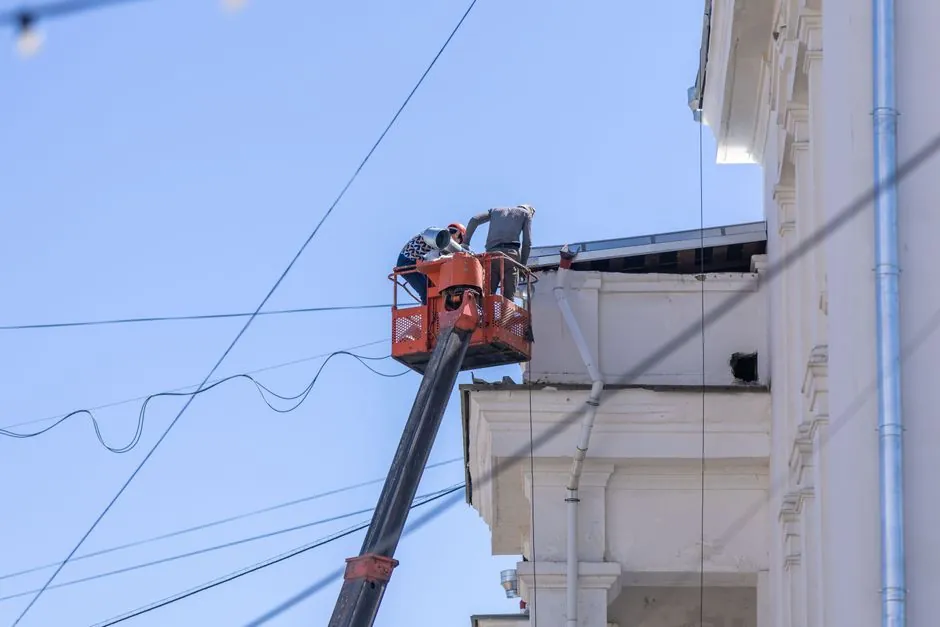
Selecting electrical equipment for elevated work in flammable atmospheres is a multi-variable problem: zone classification, enclosure protection type, ingress rating, and total carried mass all have to be reconciled before a worker clips onto a harness [S2].
Most outages in oil and gas, petrochemical, and tank-farm service are no longer ignited by the process, but by portable tools, lighting, and welding receptacles used aloft, which is why UL 1203, NFPA 70 (NEC), and IEC 60079 govern the equipment more strictly than the scaffold itself [S4][S5].
Start with the Zone or Division, Not the Product
OSHA 29 CFR 1910.307 permits explosion-proof apparatus in Class I, Division 1 and Division 2 locations, provided the equipment is approved for the specific division [S1]. Under the parallel IECEx/ATEX zoning model, gas atmospheres are split into Zone 0 (continuous), Zone 1 (likely), and Zone 2 (unlikely), and dusts into Zone 20/21/22, and the protection concept changes with each step [S2][S5].
Scaffolding around a floating-roof tank, a flare stack, or a distillation column typically sits in Zone 1, which means hand lamps, junction boxes, and reels need a rated protection concept such as flameproof enclosure (Ex d), increased safety (Ex e), or pressurized (Ex p), not just a generic "explosion-proof" label [S2]. Selecting by catalog SKU before classifying the area is the most common audit finding in incident reports.
Protection Concepts: a Side-by-Side Comparison
Four protection concepts dominate elevated-work procurements. Flameproof (Ex d) contains any internal ignition and vents the gas through machined flame paths, which makes it heavy and inappropriate for live work but ideal for fixed junction boxes and control stations aloft [S2]. Increased safety (Ex e) adds creepage distances, terminals, and temperature limits so that sparks and hot surfaces cannot occur, which is the typical choice for cable reels, breakers, and luminaire drivers [S2]. Pressurization (Ex p) keeps a protective gas (often instrument air) at positive internal pressure, and suits analyzer shelters or control cabins lifted by crane [S2]. Intrinsic safety (Ex ia/ib/ic) limits energy below ignition thresholds, which is the only concept that allows true hand-held operation, including for radios, gas detectors, and drop lights [S2][S5].
For the criteria a procurement engineer actually weighs, the comparison reads: Ex d wins on Zone 1 versatility and mechanical impact survival, but loses on weight and the need for de-energized maintenance; Ex e wins on terminal access and lower cost but is restricted to Zone 1/2, not Zone 0; Ex p handles instrumentation well but requires a continuous purge-gas supply, a logistics problem on a scaffold at 30 m; Ex i is the only concept that is safe to operate live, but power is capped at roughly 1.3 W in Ex ia for Group IIC hydrogen atmospheres, which rules out work lights and most power tools [S2][S5].
Weight, Mass, and Fall-Arrest Arithmetic
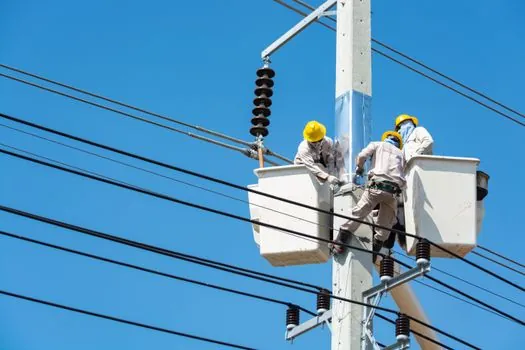
Worker fall-arrest systems in North America are commonly anchored at 5,000 lb (22.2 kN) per attached worker, and European EN 361 harnesses are rated to a similar 15 kN arrest load, but the limiting factor is almost never the anchor, it is the sustained load on the worker's lumbar spine over a shift [S2]. Industry guidance for elevated hazardous-area work typically caps the carried weight of handheld equipment at 5 kg per arm to keep cumulative tool mass below the 11 kg threshold where shoulder and back injury rates climb sharply, though the exact limit is set by site procedure rather than a single standard.
That ceiling disqualifies most cast-aluminum Ex d hand lamps (3 to 4 kg empty) once a rechargeable battery pack is added, which commonly pushes the assembly past 6 kg, and pushes the operator into a two-handed carry that interferes with both harness D-rings and the 100% tie-off rule. A practical workaround used on tank-shell scaffolds is to specify increased-safety (Ex e) LED luminaires fed by Ex e cable reels, so the only item in the worker's hands is a 0.5 to 1.5 kg drop light on a tether.
Enclosure Material, IP Rating, and the 1 m Drop Test
Stainless steel grades AISI 304 and AISI 316L, along with marine-grade aluminum alloys and borosilicate glass lenses, dominate the enclosure material list because they balance impact strength with corrosion resistance in offshore and coastal plant service [S2]. For work at height, the additional selection criterion is drop survival: portable Ex d and Ex e equipment is commonly specified to survive a 1 m drop onto concrete, the same threshold UL 1203 uses for impact qualification of fixed enclosures [S4].
Ingress protection should be at minimum IP65 (dust-tight, water-jet resistant) for outdoor elevated work, and IP66 or IP67 is preferred on FPSO and offshore platform scopes where wave spray and deck wash-down are routine [S2]. The working temperature class (T1 to T6) must sit below the auto-ignition temperature of the surrounding gas, with T6 (85 deg C surface limit) reserved for hydrogen-rich and light-hydrocarbon service, and the equipment's ambient rating must cover the actual scaffold microclimate, which on a sun-exposed Gulf-coast column can hit 55 to 60 deg C ambient and derate the temperature class by one full step [S2][S5].
Power Delivery Aloft: Reels, Connectors, and Portable Transformers
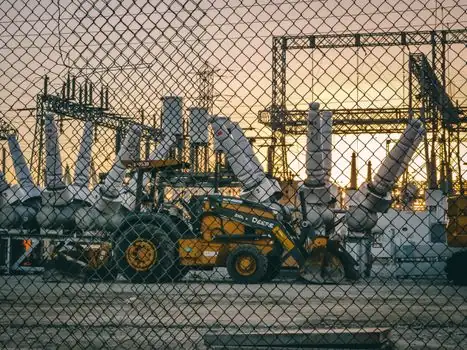
Ex e cable reels with 30 to 50 m of H07RN-F or SOOW cable are the default 230/400 V distribution method on refineries and chemical plant scaffolds, paired with Ex e plug-and-socket connectors to ATEX/IECEx-certified IP66 housings [S2]. For 110 V tool operation, an Ex e step-down transformer (typically 230/400 V primary to 110 V secondary) is mounted on the scaffold deck, not suspended, because a 5 kVA dry-type unit in a cast enclosure can weigh 35 to 50 kg and creates an instant dropped-object hazard if the lifting sling fails.
For welding, inspection, or NDT work aloft, see the parallel spec map for Explosion-Proof Electrical Selection for Welding Operations, which covers Ex d welding receptacles, ground-clamp continuity, and the additional hot-work permit layer that purely electrical selection does not address. Cable management matters as much as the equipment itself: a hard-wired Ex d junction box with a 1.5 m whip and a strain-relief gland rated for the full cable mass is the only practical way to keep a 25 mm SOOW cable from sawing through a gloved hand on a windy day at 25 m elevation.
Who This Is For, and Who It Is Not For
This selection logic is built for fixed-site maintenance, turnaround, and shutdown crews working on offshore platforms, refinery columns, chemical plant reactors, LPG spheres, and tank farms where the area is already classified Zone 1 or Zone 2. It is not appropriate for mining (Group I M1/M2 equipment follows a separate EN/IEC 60079 lineage and is outside this scope), it is not appropriate for Zone 0 entry, which forbids most portable electrical equipment outright, and it is not appropriate for purely mechanical work where non-electrical tools (Ex-rated manually-operated chain blocks, for example) can eliminate the ignition source from the equation entirely [S2][S5].
The dominant failure modes in incident reviews are not enclosure rupture, they are wrong-zone selection (Zone 1 equipment installed in a Zone 0 sumpl), damaged flame paths from dropped enclosures, missing or compressed gaskets on re-assembled gear, and field-modification of certified equipment such as drilling additional conduit entries, all of which void the certification and the insurance position in a single action [S4][S5]. A consistent spec discipline of Zone-first, protection-concept-second, weight-and-ergonomics-third, and drop-survival-fourth keeps the worker tied off, the inspector satisfied, and the plant on the right side of NFPA 70 and IEC 60079.
Trackable next signals: UL 1203 revision cycle, IEC 60079-0 and -1 maintenance updates, and any site-specific lifting-basket rules for pressurized (Ex p) analyzer cabins on offshore turnarounds through 2026 Q4.
For the relevant spec sheets and selection criteria, see explosion proof electrical, explosion proof, and explosion proof button.