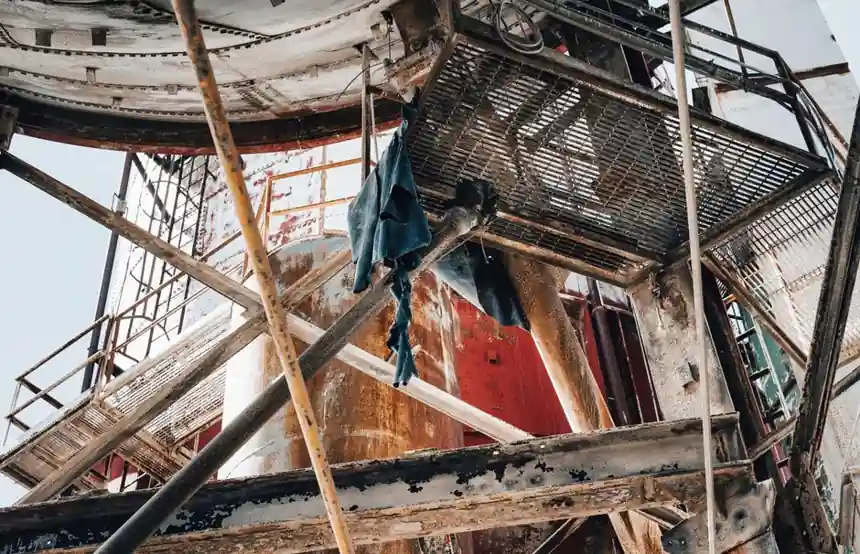
Explosion suppression and flameless venting both mitigate dust deflagration, while flameless venting prevents the spread of flame and thermal fronts and reduces pressure in the protected equipment [S1][S2][S8].
This comparison applies to combustible-dust bucket elevators, especially indoor installations handling grain, food, pellets, starches, polymers, or specialty chemicals, where the boot, head, and dust-collection connections require coordinated protection [S1][S3].
Choose by Threat Mode, Location, and Consequence
Flameless venting is suitable for indoor or partially indoor bucket elevators because its protective mesh contains the flame [S3][S5]. It is the practical choice where an ordinary explosion vent would release flame, hot particles, or pressure into an occupied building [S1][S3].
A detection and control system can trigger a suppression bottle within milliseconds of ignition, discharging sodium bicarbonate into the elevator [S2].
Neither device replaces prevention. Bucket-elevator ignition sources include belt slippage, misalignment, hot bearings, loose fasteners, metal contamination, and embers arriving from an upstream conveyor [S1][S2]. Prevention measures include dust collection at the boot and head, housekeeping, grounding and bonding, foreign-object exclusion, bearing-temperature monitoring, belt-alignment monitoring, and spark detection or extinguishing [S1][S3].
Compare Response, Installation, and Operating Impact
It does not rely on a large flame outlet area, but it requires a maintained detection system, an appropriate suppression agent, and a verified response envelope for the protected elevator volume.
Flameless venting uses passive pressure relief plus flame quenching. The device must release pressure, cool or contain the flame, and manage thermal fronts; the ELEVEX FLEX system is described as preventing flame and thermal-front spread while reducing pressure in the protected equipment [S8]. Unlike suppression, flameless venting allows the deflagration to develop more fully, with cleanup and fire-damage mitigation still required after the event [S1][S4].
Apply Flameless Venting to Indoor Head, Boot, and Legs

The head and boot are the most likely segments to experience a deflagration because product rapidly enters and exits these sections, where dust clouds, product accumulation, and multiple ignition sources may be present [S2].
Flameless venting requires space for the venting and flame-quenching assembly and must account for the heat and pressure generated during an event. The mesh is part of a flameless-venting arrangement intended to contain the flame, and flameless venting is suitable for indoor or partially indoor installations [S3][S5].
Engineer Suppression as a Fast Detection and Isolation Function
Suppression is most defensible where the elevator has a validated detection-and-control architecture and the incipient explosion must be arrested rapidly.
The design basis must define where dust clouds can form, which detector can identify ignition, how quickly the control system acts, and how much agent is required for the protected volume. Potential ignition sources include degraded or overheated bearings, belt slippage, and metallic impurities in the product flow [S2]. Reliable sensing and a disciplined preventive-maintenance program are therefore part of the suppression case, not optional accessories.
Isolation is used to prevent propagation through ducts, silos, and other connected dust-handling equipment [S2][S6]. An unprotected deflagration can propagate from the head or boot through the legs, inlets, outlets, silos, other processing equipment, and de-dusting lines [S2]. For a broader view of the mechanical hazards surrounding this equipment, see Bucket Elevator Inspection Door Placement for Maintenance.
Control Propagation and Verify Dust-System Interfaces
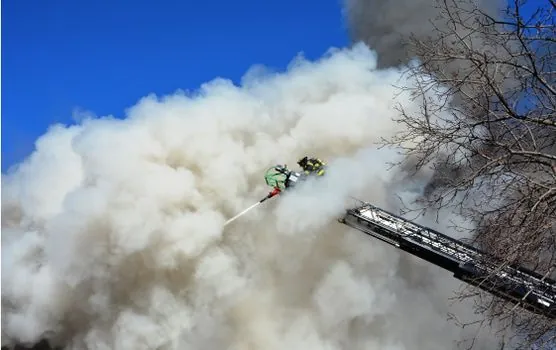
Without reliable protection, a deflagration in the head or boot can propagate through the elevator legs, inlet and outlet ducts, silos, and dust-collection lines connected to cyclones or dust collectors [S2]. A correct decision therefore depends on the protected volume plus every credible propagation path, not on the elevator casing alone.
Flameless venting controls flame discharge from the protected elevator, while isolation separately prevents pressure or flame transmission through connected equipment [S3][S6]. Suppression likewise operates at the point of deflagration, so isolation valves or barriers may still be required on connected ducts and process vessels [S2][S6].
Do not assume that vented or suppressed equipment remains undamaged. With venting or flameless venting, the event can fully develop within the process equipment, leaving cleanup, fire-damage mitigation, and equipment inspection in the recovery plan [S1][S4]. For multi-machine handling systems, the same interface discipline applies when comparing bucket elevator arrangements with enclosed transfer equipment.
Base the Selection on a Documented Hazard Assessment
The minimum dust data set includes material identity, particle size, explosibility parameters, minimum ignition energy, minimum explosible concentration, and the locations where dust clouds and deposits accumulate [S1][S3]. Antistatic belts and grounding are specifically relevant when the material has an MIE below 10 mJ [S3].
For indoor flameless venting, the assessment must also cover available space, personnel exposure, flame and hot-particle discharge, reaction forces, installation orientation, and interaction with the head, boot, legs, ducts, and dust collector [S1][S2]. The Fike EleGuard vent panel cited for elevator use is installed with six riveted bolts and is described as complying with applicable NFPA installation requirements, while EleQuench adds flameless venting for indoor applications [S2].
For suppression, document detector performance, control logic, agent delivery, discharge time, protected volume, maintenance access, and the residual pressure and thermal effects for the enclosure [S2]. Applicable local dust-explosion and electrical-area requirements must also be established for the selected equipment. Fike states that its protection-selection tool considers dust type, particle size, location, and related equipment data, which shows why a generic device recommendation is inadequate [S2].
Make a Practical Selection and Verification Plan
Choose flameless venting for an indoor bucket elevator when the design intent is to permit pressure relief without a visible external flame event and the required installation space and quench assembly can be provided [S1][S3][S5]. Choose suppression when rapid incipient-event detection, a maintained agent system, and a validated low-response-time basis provide a better engineering fit [S2].
For either selection, specify protection for the head, boot, and both legs as appropriate, coordinate it with connected equipment through isolation, and include post-event inspection and cleanup in the operating plan [S2][S4]. Verify the final selection through a documented dust-hazard assessment, installation review, commissioning test, maintenance schedule, and operator training rather than relying only on a device model name [S1][S2][S3].