
For any task falling under the Work at Height Regulations 2005 definition, where a fall to a lower level is reasonably foreseeable, a face shield sits inside a layered PPE system that starts at the anchor and ends at the chin strap, so its mechanical rating has to be matched to the actual impact energy, not to the worst case on the shelf [S1].
Three hard gates dominate the choice in 2026: the EN 166 mechanical-impact letter grade (S, F, B, or A), the EN 170/172 optical and UV class stamped on the visor, and the head/harness interface that keeps the visor at the right geometry after a sudden stop on a lanyard [S3].
What the EN 166 letter grade really constrains
EN 166 mechanical impact uses four letter grades, each tied to a projectile speed: S at 12 m/s, F at 45 m/s, and B at 120 m/s, with A as a high-energy variant for the same 190 g projectile class used in ballistic tests [S3].
The 2017 VIZEN face-shield field notice is the cleanest demonstration of why this letter matters: serial numbers 15300 to 16365 were rated only to F (45 m/s) despite the technical notice showing B (120 m/s), and Petzl issued a free replacement under the 3-year guarantee, with the down-rated units still compliant on every other stamp including EN 166, ANSI-ISEA Z87.1-2010, EN 170 2C-1.2, optical class 1, the short-circuit-arc mark 8, and the 4 kA arc class 1 [S3].
For work at height on tower, scaffold, or MEWP platforms, the practical floor is EN 166 F (45 m/s); a 190 g steel ball at that speed carries roughly 193 J of kinetic energy, which is the energy band of a dropped hand tool or a 12 mm nut falling 2 m, and B (120 m/s) covers the higher-energy fragment band seen in grinding or chipping while aloft [S3].
Standards the visor has to clear, beyond impact
A 2026-spec face shield for elevated work should carry EN 166 as the umbrella, plus EN 170 2C-1.2 or 2C-1.4 for UV filtering on outdoor steel work, and where arc-flash is on the same ticket, the short-circuit-arc mark 8 and a 4 kA class 1 designation, both of which are stamped on the VIZEN reference unit as a baseline example of a multi-rated visor [S3].
ANSI-ISEA Z87.1-2010 is the parallel US standard and is the right cross-check on any visor sold into North American tower crews, while EN 166 1 for optical class 1 is the only acceptable distortion grade for tasks that need continuous sight of instruments, fall-indicator lines, or height gauge markings during lift setup [S3].
Optical class 2 and 3 are permitted under EN 166 but introduce measurable dioptric and astigmatic deviation, and they are wrong for any task where the worker reads a tape, an angle, or a level at arm's length, including most inspection work from a aerial work platform basket.
Who the high-impact F/B visor is for, and who it is not for

EN 166 F and B visors are built for users who can see the impact come and brace: a roofer on a fixed scaffold, a steel erector on a tower, a linesman on a wood pole, and a rigger aloft on a MEWP where overhead work is the primary hazard [S1][S3].
They are not for chemical splash, not for molten-metal foundry work, and not for biological hazards; those duties need an EN 166 3 chemical splash mark, an EN 166 9 molten-metal mark, or a dedicated biological shield such as the ZShield Flex reusable frame, which is targeted at food service, teaching, and non-emergency medical use rather than fall-energy impact [S2].
Open-source projects such as the OLC FlexShield for emergency workers show the alternative path: a flexible, printable visor optimised for splash and droplet coverage rather than 45 m/s particle energy, and are explicitly not substitutes for a rigid EN 166 F/B shield on a tower [S4].
Helmet interface, chin guard, and fall-arrest geometry
For work at height, the face shield has to ride on a class E or class G industrial helmet that meets EN 397 or ANSI Z89.1, and the visor mount has to survive the same fall-arrest event the harness is rated for, typically a 6 kN peak on the dorsal D-ring. [S2]
A chin guard is not optional on a tower visor: when a worker drops into the harness, the head rotates forward, and a chin-less shield leaves the throat and lower jaw exposed to the same falling tool the eye shield is rated to stop, so spec sheets should require an integral chin curtain or a separately certified chin guard that latches to the helmet shell [S1].
Quick-release mounts are preferred for any task where the visor has to come off in under 5 seconds, such as a confined-space rescue, and the face shield spec should call out the tool-less release and the retention lanyard that prevents the visor from falling onto a person below.
Comparison: shield classes against the four work-at-height hazards
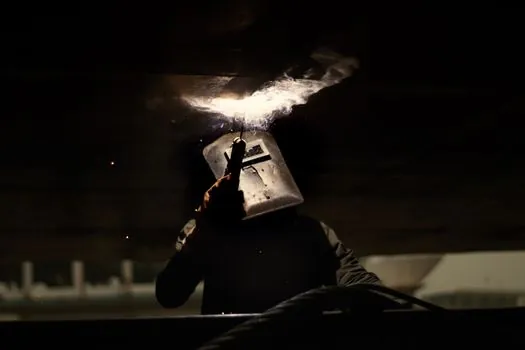
Across the main EN 166 mechanical grades plus the chemical and arc variants, the decision matrix for elevated work looks like this: S (12 m/s) covers dust and light overhead debris on indoor platforms and is the minimum entry point; F (45 m/s) covers dropped hand tools and small fittings on scaffold and tower work; B (120 m/s) covers grinding chips and high-energy fragments from cutting while aloft; and the chemical mark 3 covers paint and solvent splash during coating or cleaning, a duty that frequently overlaps with a separate face shield selection for confined space entry task in the same job pack. [S2]
On optical class, EN 166 class 1 is required for any task involving instrument reading or fine alignment, class 2 is acceptable for general assembly and erection, and class 3 is restricted to short-duration, coarse work where distortion is tolerable, and on arc, the 4 kA class 1 plus mark 8 combination is the right floor for any work within 600 mm of an energised LV conductor or within the arc-flash boundary of an HV panel [S3].
Inspection, traceability, and the VIZEN-style recall lesson
The single most useful 2017-to-2026 lesson in face-shield specification is the serial-number discipline the VIZEN notice exposed: every visor on a height-work site should be traceable to a lot, and the mechanical-impact letter printed on the visor has to match the technical notice for that exact lot, because the down-rated F units were still legitimately CE-marked on every other line of the stamp [S3].
For warehouse and logistics sites that share crew across mezzanine, rack, and loading-dock work, a separate spec map applies and the F/B grading above is too aggressive, so cross-reference the face shield selection for warehouse operations guide for the racking and forklift duty set.
Track three signals over the next planning cycle: any EN 166 revision that tightens the 190 g projectile test, any extension of the 4 kA arc class to a higher short-circuit level, and the publication of an updated VIZEN-class field notice on a current production lot, all of which would force a re-spec of the visor stack on every height-work job pack.