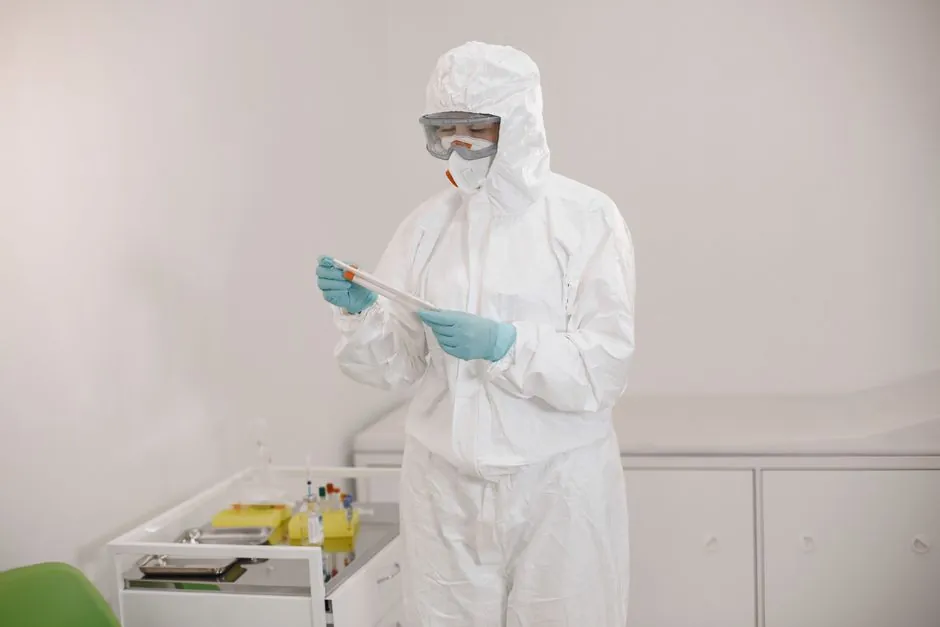
For laboratory work, a face shield is selected as a chemical-splash and bioaerosol barrier, not a droplet screen, and the dominant 2026 specification pattern uses an autoclavable polypropylene headband paired with a PET visor in the 0.18 to 0.5 mm thickness range [S1].
The scope covers wet-chemistry benches, BSL-2 benches, PCR/UV enclosures, and cleanroom pass-throughs, and the same open-source design files (3D-printed headband, die-cut visor, die-cut strap) are the reference geometry being adapted by lab procurement teams in place of disposable clinical shields [S1][S3].
Lab-specific selection criteria: splash, UV, and autoclave compatibility
A lab-spec face shield must pass three independent gates: chemical-splash resistance of the visor, optical clarity for pipetting and balance reads, and compatibility with the lab's sterilization loop, with PET and PPSU the two dominant visor resins [S1]. PET at 0.18 to 0.5 mm gives adequate clarity and impact resistance for routine bench work, while PPSU costs more but survives repeated 134 degrees C autoclave cycles without haze or warping [S1]. For UV-intensive workflows such as Plas-Labs PCR UV chambers, dedicated replacement visors (e.g. the Sigma-Aldrich Z566187 / Z566195 / Z566209 / Z566217 / Z566225 / Z566233 compatible shield) are specified, with the listed 2026 part offered as a single-unit replacement rather than a full head assembly [S6].
Beyond the visor, the headband is the hidden failure point: standard 3D-printed PETG or PLA headbands absorb splashes, deform at 60 degrees C, and cannot survive hydrogen peroxide vapor, so lab procurement is migrating to injection-molded polypropylene headbands rated for autoclave, EtO, alcohol, bleach, H2O2 vapor, gamma, UV-C, and electron-beam sterilization [S1]. A 2025 open-source frame (SHL-face-shield) also retains the 3D-printable geometry as a low-volume fallback for labs that cannot justify an injection-mold tool change [S5]. The strap carries equal weight: natural, synthetic, or silicone rubber at 0.8 to 1.6 mm thickness and Shore A 40 to 55 is the design range for lab straps, balancing skin contact comfort against stretch set over repeated autoclave cycles [S1].
Comparison of main lab face-shield configurations
Three configurations dominate the lab market in 2026, and they line up cleanly against cost, sterilization ceiling, and use case. The table below distills the choice for a specifier. [S1]
Disposable PET visor + 3D-printed headband: lowest unit cost, single-use, cannot be autoclaved, suited to low-throughput teaching labs and visitor PPE [S1][S5]. Reusable PET visor (0.18 to 0.5 mm) + injection-molded PP headband: mid-cost, rated for full hospital sterilization set including autoclave and H2O2 vapor, the default for BSL-2 wet benches [S1]. PPSU visor + PP headband: highest cost, full assembly can be autoclaved intact without disassembly, specified for cleanroom, GMP, and shared multi-user benches [S1]. Where a lab already runs a Plas-Labs PCR UV chamber, the OEM-pattern replacement shield (NACRES NB.35, pkg of 1) is the only visor guaranteed to seal against the existing UV-source housing, and substituting a generic shield risks UV leakage at the gasket face [S6].
Who a lab-spec face shield is for, and who it is not for
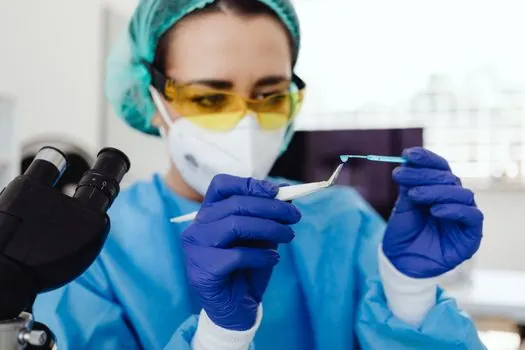
This selection is for lab managers, EHS officers, and procurement engineers specifying splash and bioaerosol PPE for wet-chemistry, microbiology, PCR, and cleanroom benches, where the dominant failure mode is repeated sterilization, not single-use droplet exposure [S1]. It is not a substitute for a chemical splash goggles specification under ANSI Z87.1 or for powered air-purifying respirator hoods used in BSL-3 work, and it is not the right PPE for grinding, soldering, or molten-metal tasks where EN 166 mechanical-impact ratings govern instead. For those adjacent use cases, see the industrial face shield reference for impact-rated geometries and the face shield machine guide for automated production of disposable visors when lab demand exceeds hand-assembly rates [S1].
Real lab use cases mapped to a face-shield spec
Wet-chemistry bench with concentrated acids: specify PPSU visor + PP headband, autoclavable as a unit, with a Shore A 50 silicone strap to resist acid vapor softening of natural rubber; this combination is the cleanest fit to the open-source White Label geometry [S1]. BSL-2 microbiology bench: PET 0.3 mm visor + PP headband, sterilized by H2O2 vapor between sessions, which is the stated working point of the PP headband design [S1]. PCR/UV enclosure: OEM replacement shield matched to the chamber's part number (Z566187 series), no field-modification, because the UV-C seal is geometry-dependent and the OEM visor is the only one with the documented gasket line [S6]. Teaching lab with high turnaround: disposable PET visor + 3D-printed headband is acceptable if the lab accepts single-use disposal and the headband is rotated out weekly [S5]. Cleanroom GMP suite: PPSU visor + PP headband, full-assembly autoclave, lot-traceable resin certificates from the supplier [S1].
Limitations, failure modes, and standards to watch
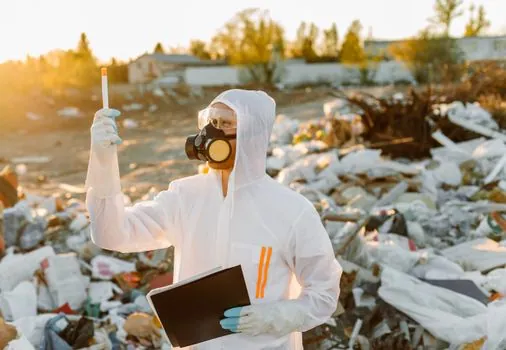
The first failure mode in lab service is visor hazing from repeated autoclave cycles, which is why PET is restricted to 0.18 to 0.5 mm and PPSU is the upgrade path for any lab running more than 50 cycles per visor [S1]. The second is headband creep: a 3D-printed PETG headband will deform under H2O2 vapor and cannot be re-sterilized, so any lab adopting open-source 3D-print files must budget for a switch to PP once throughput justifies an injection-mold run [S1][S5]. The third is UV-C degradation of anti-fog coatings: a generic anti-fog layer will haze after 20 to 40 hours of UV-C exposure inside a PCR chamber, so chamber-internal shields should be ordered as OEM replacement parts rather than coated aftermarket stock [S6][S7]. Standards to track are ANSI Z87.1 for splash and impact, EN 166 for the European equivalent, and ISO 14644 for cleanroom particulate behavior, although the open-source reference designs cited here do not yet publish a Z87.1 or EN 166 test report and lab buyers should request that data sheet before signing off on a geometry [S1][S8][S9].
Open-source designs and supply signals to track
Six public repositories anchor the current lab face-shield geometry: Cederb/Faceshield.nu (119 stars, 21 forks, the European reference with ISO838 and 3-hole variants) [S3], erfindergarden/brussel-faceshield (A4-foil frame for low-cost visor stock) [S4], SHLFab/SHL-face-shield (3D-printable frame, last updated 2025-08) [S5], and the Kuss-Faceshield-Frame pair under baloe and Kunststoffschmiede, which uniquely publishes both 3D-print, injection-mold, and sheet-metal build files under CC BY-NC-SA [S8][S9]. The 2026 supply-side signal to watch is whether the White Label injection-mold files reach a commercial molder willing to run lab-grade PP at 10,000 parts-per-day economics, because that is the unit-cost crossover at which reusable lab shields become cheaper per wear than disposable clinical shields [S1]. A secondary signal is whether any of the open-source projects publish an EN 166 or ANSI Z87.1 test certificate, since lab EHS officers will not approve a geometry without that data, and its absence remains the gating gap in 2026 [S1][S3][S5].
For lab specifiers building out adjacent PPE chains, the engineering plastic selection gates for automotive cover the same PP-versus-PET-versus-PPSU tradeoff at production volumes, and the wire rod selection guide for hospitals is the closest analog for grade-traceability documentation that lab QA teams can adapt to PP resin certificates.
Spec-level background on the components involved: pressure transmitter.