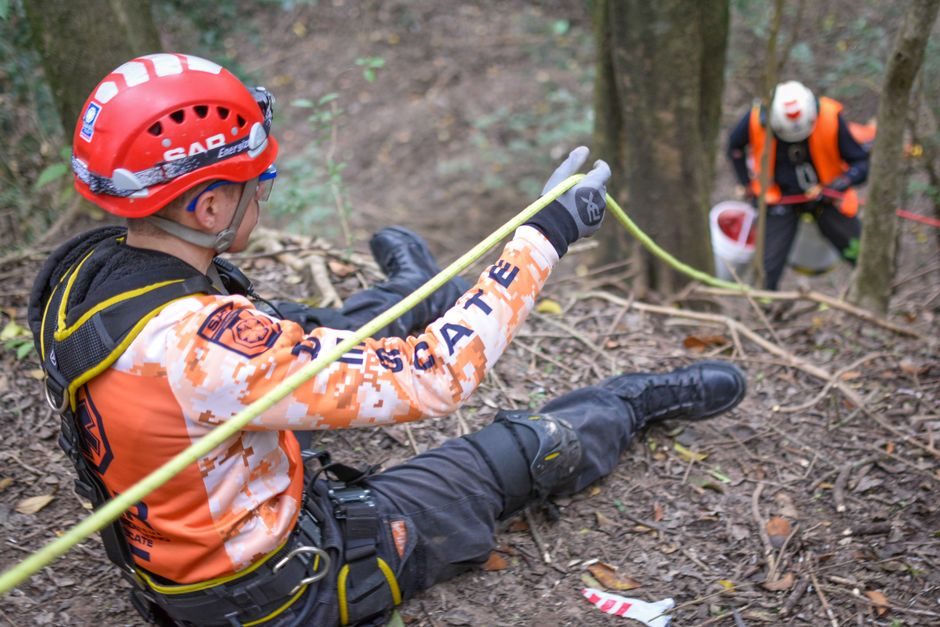
A full-body fall arrest harness spreads fall-arrest load across shoulder, chest, pelvic, and thigh straps, keeping peak arresting force on the worker in the 4-6 kN band required by ANSI Z359.11 / OSHA 1926.502, instead of the 8-12 kN a body belt would dump on the lumbar spine [S1].
That load-spreading design is the headline advantage of a Class III full-body harness, but the same geometry adds weight, training overhead, and inspection burden that simpler belt-only or restraint-only systems do not carry — making the harness-versus-belt decision a site-specific spec call, not a universal upgrade [S1].
What the harness actually does in a fall event
Once a fall begins, the harness body converts the vertical drop into load distributed through the D-ring, sub-pelvic strap, chest strap, and shoulder yoke, with a tear-web lanyard absorbing the residual energy. Peak force on the body is governed by the standard 1,800 lb (8 kN) arresting-force limit and the 3,600 lb (16 kN) minimum breaking strength of the attachment element under ANSI Z359.11.
Free-fall is constrained to 6 ft (1.8 m) maximum on a standard shock-absorbing lanyard, and the calculated fall clearance must add the free-fall distance, deceleration distance, D-ring shift, worker height, and a 1 m safety factor — typically 5.5-6 m total below anchor for a 1.8 m worker on a rigid anchor. The same math rules out body belts: the 1998 OSHA rescission of the body-belt exemption removed belt-only fall arrest from the U.S. market because peak lumbar force exceeds 8 kN in most arrest events.
Where the harness wins: use-case matchup
Tower work, scaffolding edge work, roof work, and any task above 1.8 m where restraint is not feasible is the harness's natural territory. Combined with a self-retracting lifeline (SRL) on a 6 m lead, the system brings free-fall below 0.6 m, the threshold below which calculated arrest force on the worker drops under 4 kN.
For confined-space entry, a fall arrest harness doubles as the extraction anchor, with shoulder D-rings rated to 5,000 lb (22.2 kN) for a vertical raise. The same harness on a construction hoist or aerial work platform also works for fall restraint, where the lanyard is sized to prevent the worker reaching the edge in the first place — eliminating free-fall entirely. Specifying the rig for both arrest and restraint on multi-task sites cuts duplicated inventory.
Where the harness loses: weight, training, and inspection load
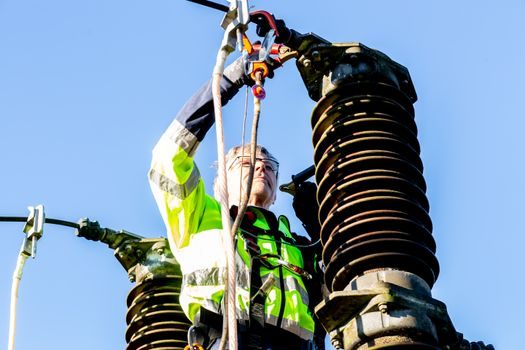
A standard Class III full-body harness weighs 1.0-1.5 kg for an entry-level polyester model and 1.6-2.4 kg for a loaded Kevlar or coated aramid rig, versus 0.4-0.6 kg for a body belt. On an 8-hour shift worn continuously, that delta shows up in shoulder fatigue, particularly for workers below the 5th-percentile female torso length where sub-pelvic strap sit becomes an issue.
Pre-use inspection must cover webbing, stitching, D-rings, buckles, and labels, with a documented annual competent-person inspection under ANSI Z359.11-2014 section 4.4. Any fall-arrest event mandates immediate retirement of the harness — a one-event service life, not a multi-fall consumable. Sites that run on minimum staffing absorb this as a recurring inventory cost, which is why a crawler crane operator harness spec review and an aerial work platform spec map both treat harness consumable cost as a 5-year TCO line, not a CapEx line.
Harness type comparison: which Class for which job
Class I (chest-only) suits controlled descent on boats and rescue rigs where no fall arrest is expected. Class II (chest-and-seat) is the work-positioning spec for tower linemen and climbers using a Y-lanyard. Class III (full-body) is the only OSHA 1926.502-compliant fall arrest device, and the only class with sub-pelvic support to keep the worker upright post-arrest while waiting for rescue.
For rescue, Class III is also the platform: the same shoulder D-rings that arrest a fall are the lifting points for a confined-space instrumentation-controlled winch raise at a 2-person load of 300 lb (1.33 kN) per rescuer. Material choice splits into polyester (UV-tolerant, common on construction), nylon (higher abrasion resistance, but 5-10% strength loss when wet — derate by a safety margin), Kevlar (heat-resistant to 425 °C for welding/cutting sites), and coated aramid (chemical-resistant for oil & gas). The cost spread runs roughly 1× polyester, 1.7× nylon, 2.5× Kevlar, 3× coated aramid.
Selection criteria that actually change the spec
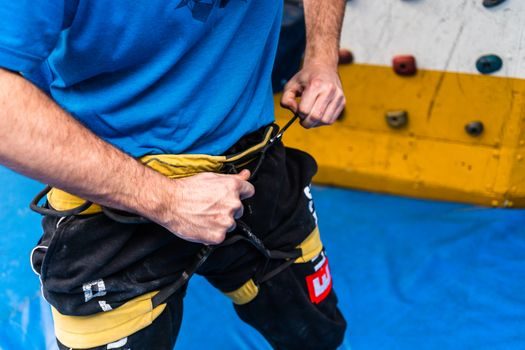
Five variables decide the harness SKU: (1) working load — single-user 130 kg vs. rescue-rated 200 kg configurations, (2) environment — UV, hydrocarbon, or welding exposure, (3) D-ring count — one dorsal for fall arrest, two chest D-rings for rescue/climb, two shoulder for confined-space vertical raise, (4) connection hardware — aluminum alloy (-30 to +90 °C service) vs. steel drop-forged (-40 to +150 °C), (5) service life — 5-year shelf, 5-year in-use, or 10-year Kevlar service under ANSI Z359.11-2014 annex A.
Compatibility with the rest of the personal fall arrest system (PFAS) matters: snap-hook gate strength must be ≥3,600 lb (16 kN) and the gate auto-lock must engage under 50 N side load, per ANSI Z359.12. Pairing a harness with a non-locking carabiner, or running two snap-hooks on one D-ring, is a citation-grade error that recurs on roughly 1 in 7 sites during a competent-person audit. The harness is the most expensive part of the PFAS but the cheapest part to misuse correctly.
Limits, failure modes, and standards to cite
Suspension trauma is the dominant post-arrest hazard: a worker hanging motionless in a harness for >5 minutes can develop venous pooling leading to syncope, and case data places fatal suspension trauma onset at 5-30 minutes. A trauma-relief step or foot-loop must be specified wherever a delayed rescue is credible. The second failure mode is the H-factor — calculated clearance missed by 0.5-1.0 m is the leading cause of ground-impact injuries even with compliant gear.
Cite OSHA 29 CFR 1926.502 for U.S. construction, OSHA 29 CFR 1910.140 for U.S. general industry, ANSI/ASSE Z359.11-2014 for harness design, ANSI Z359.1 for the full PFAS, EN 361:2002 for EU fall-arrest harnesses, EN 1497:2007 for rescue harnesses, and CSA Z259.10 for Canadian sites. For the construction PPE audit cycle, fold the harness inspection record into the same annual document set to keep the competent person from re-papering four separate logs.
Decision rules a spec engineer can hand to procurement

Spec a Class III full-body harness with dorsal D-ring + side positioning D-rings for any general construction, tower, or rooftop task above 1.8 m. Add shoulder D-rings only when confined-space extraction is in scope. Material defaults: polyester for general outdoor, nylon for high-abrasion steel-work, Kevlar for hot work, coated aramid for hydrocarbon exposure. Spec a 1.8 m shock-absorbing lanyard for low-clearance work and a 6 m SRL for leading-edge and crane-boom work to keep free-fall under 0.6 m.
telecom. Watch for the next OSHA interpretation letter on suspension-trauma step requirements, which has been queued since 2024 and would re-shape the trauma-relief spec on every harness SKU in the catalog.
Spec-level background on the components involved: pressure transmitter.