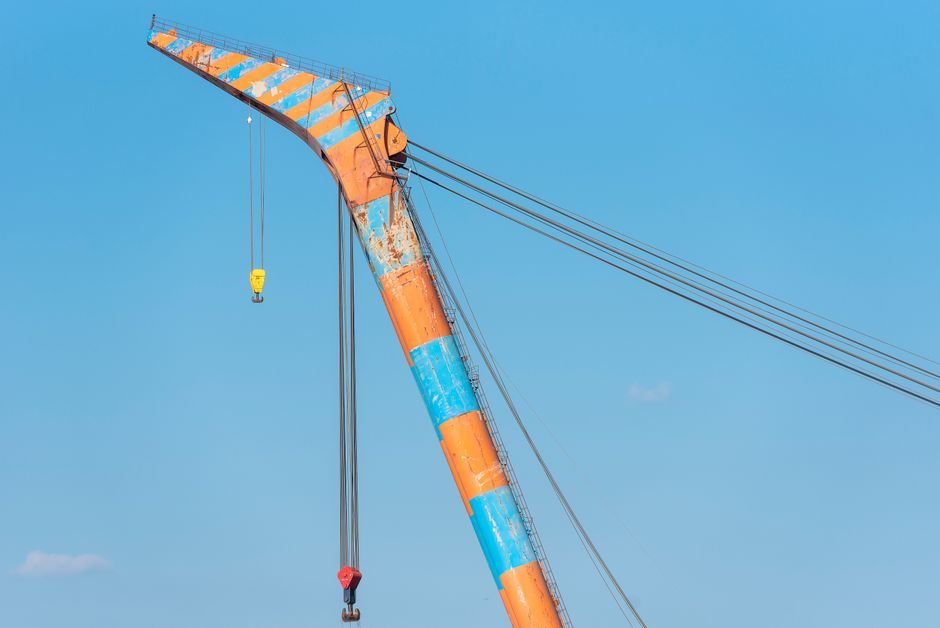
Crawler cranes deliver lifting capacities from roughly 100 t for compact telescopic units up to 3,500 t for the XCMG XCC8800 and Manitowoc 31000 class lattice-boom machines, with no requirement for outrigger pads on prepared ground [S1].
That single fact — track-on-soil, no stabilisers, high hook time per shift — is why the format dominates wind-farm erection, petrochemical module lifts, bridge segment launches, and heavy civil foundation work where a mobile crane would burn hours levelling jack plates.
What a crawler crane actually is and where it fits
A crawler crane is a mobile crane mounted on twin continuous tracks instead of rubber tyres, with the superstructure — engine, cab, boom, and counterweight — slewing on a turntable [S1]. Track shoes typically measure 0.9–2.5 m long, distribute load over a 4–12 m long ground contact patch, and lower ground bearing pressure to 50–120 kPa versus 200–500 kPa for an equivalent-capacity mobile crane on outrigger pads [S2].
Track format splits the market into two camps: lattice-boom crawlers (Liebherr LR series, Manitowoc 14000–31000, Sany SCC8000–SCC40000) for 250–3,500 t heavy-lift duty, and telescopic-boom crawlers (Liebherr LTM-class crawler variants, Tadano GTC, XCMG XGC, Sany SCC800C–SCC5500C) for 80–350 t pick-and-carry work that occasionally road-travells short distances [S1]. The lattice camp favours wind, power, and refinery sites; the telescopic camp bridges into mobile crane duty cycles.
Where crawler cranes win — the engineering upside
Track-on-soil load distribution is the headline advantage: ground bearing pressure 50–120 kPa lets a 600 t crawler walk onto a gravel pad or weak subgrade that a mobile crane on outriggers would refuse without matting [S2]. Lift planning teams therefore mobilise fewer timber mats, fewer steel plates, and fewer ground-prep hours per shift, which on remote wind or pipeline spreads offsets the heavier transport load.
Hook-time efficiency runs 15–25 % higher than a mobile crane on equal-duty projects, because the crane does not need to deploy outriggers, relevel after each swing, or pack up to reposition between picks [S2]. When wind farms lift 80–140 t nacelles at 100–140 m hub height, the tower crane class can’t match reach-to-radius ratio, and the all-terrain mobile can’t hold radius while swinging without re-stabilising — the crawler with fixed track footprint handles both cleanly.
On 24/7 heavy-lift projects, a crawler can pick-and-carry loads of 30–60 % of its chart capacity over short distances without re-rigging, which is a duty cycle a mobile crane cannot replicate without slewing, lowering, and re-setting outriggers. Counterweight packages on the 600–3,500 t class are modular 20–250 t slabs, so the same machine moves between refinery, wind, and bridge contracts with a configuration change rather than a fleet change [S1].
Where crawler cranes lose — the hard trade-offs

Transport is the cost ceiling: a 600 t lattice crawler disassembles into 12–25 truck loads versus 5–8 for an equivalent mobile crane; each 30–80 t load typically needs a heavy-axle low-bed, escort vehicles, and night-time road permits, which is the single largest line item on a project mobilisation budget [S1][S2].
Track wear compounds the operating-cost problem. Track shoes, pins, bushings, and drive sprockets on a 250–600 t class crawler need replacement every 1,500–4,000 operating hours depending on ground abrasiveness; a single 2.0 m shoe set runs 8,000–25,000 USD per side on a 400 t unit, and the undercarriage is non-tyred, so it cannot be field-swapped in 30 minutes the way a mobile crane tyre is changed [S2].
Self-erection time is 4–10 hours for a 250–400 t lattice crane versus 1–3 hours to deploy outriggers on an all-terrain mobile crane; a 3,000 t class needs 2–4 days of boom pre-assembly with an assist crane, which is why a tower crane on a static site is preferred for sustained vertical lifts at one location [S1][S2]. Track width also caps the equipment’s transport envelope at 3.0–4.5 m for most road-going classes, which means above 600 t the machine is usually rail-shipped or partially disassembled for the first/last 50 km [S2].
Decision criteria — crawler vs mobile vs tower
For a procurement engineer, the question is not “crawler good or bad” but which format scores higher on the four project-defining variables below. Each criterion is graded qualitatively because site conditions — soil class, road class, lift height, lift weight — vary project by project and no universal percentage applies [S1].
(1) Ground condition: soft pad, weak subgrade, or unpaved yard — crawler wins; prepared hardstand with crane matting budget — mobile crane is competitive. (2) Lift weight: above 250 t on a 12–80 m radius — crawler wins; 50–200 t general pick-and-carry — telescopic mobile wins on transport cost. (3) Lift frequency: more than 8 picks per shift with short repositioning — crawler wins; 1–3 lifts per day with long repositioning between — mobile crane wins. (4) Project duration: more than 6 months on one site — crawler amortises its mobilisation; less than 1 month on multiple sites — mobile crane road-travelling wins [S1][S2].
A tower crane is the right tool when the site is fixed, the lift pattern is repetitive vertical work (high-rise core, refinery steel, shipyard modules), and the work span is months-to-years — a gantry crane or stacker crane handles yard storage work and is not a competitor in this duty class.
Who should and who should not buy or hire a crawler crane

Buy or long-term lease a crawler crane if your project pipeline is dominated by wind-farm hub-and-nacelle erection, oil-and-gas module lifts, heavy-civil bridge construction, or refinery turnaround work where lift cycles repeat at 200–3,500 t for 12–36 months — the higher purchase and transport cost amortises against the per-shift hook-time and ground-prep savings [S1][S2].
Do not buy a crawler if your work is 80 t and below, scattered across many short urban or road-accessible sites, or where the operator base only holds mobile-crane tickets — the transport, undercarriage, and rigging crew costs will not be recovered [S2]. Hire instead through a project-by-project contract that bundles mobilisation, fuel, and rigger supply, and benchmark the daily rate against an equivalent mobile crane plus crane-mat rental.
Failure modes, sourcing, and standards to anchor your spec
Common crawler-crane failure modes during lift execution are: track-chain stretch on uneven pad, boom-backside buckling at high-radius charts above 70 m, counterweight slab pin shear on over-rigged configurations, and slewing-ring bolt loosening after 8,000–12,000 hours — each maps to a specific OEM service bulletin that should sit in the pre-lift document pack [S1][S2].
Anchor the specification to the standards the industry actually uses: ASME B30.5 for mobile and crawler crane inspection, EN 13000 for crawler crane design requirements, FEM 1.001 for calculation rules, and ISO 4309 for wire-rope inspection intervals — operators should hold a CPCS A02 or NCCCO LBC certification, and riggers should hold CPCS A61 or equivalent for land-based heavy lift [S1][S2]. Lift planning must reference the OEM load chart, the OEM ground-bearing-pressure map, and a site-specific geotech report that justifies the pad class; without those three documents, the lift is not insurable in most regulated markets [S1].
For 2026 sourcing, the Chinese OEM tier (XCMG, Sany, Zoomlion) is pricing 15–30 % below the European-Japanese tier (Liebherr, Manitowoc, Tadano) on equivalent capacity, and lead times on 250–800 t lattice crawlers from Chinese suppliers are running 6–10 months versus 12–24 months from European plants as of mid-2026 [S3]. Spare-parts inventories for undercarriage and slewing-ring components remain the main risk on Chinese units in regions without a local service depot, so the procurement decision still needs to weight service-network coverage, not just the headline unit price.
Track the next signal: published 2026 OEM price lists for 250–600 t class crawlers in Q4, plus any new EN 13000 revision cycle that tightens slewing-ring bolt-pattern documentation, plus the next round of OEM telematics dashboards that publish average undercarriage-replacement hours per site class — these three data points will refine the cost-per-hour figures above for any project mobilising in 2026–2027.
Background reading: Programmable DC Power Supply Price 2026: Cost Bands and Drivers.